
Hemp moth
Grapholita delineana
Description
How to identify
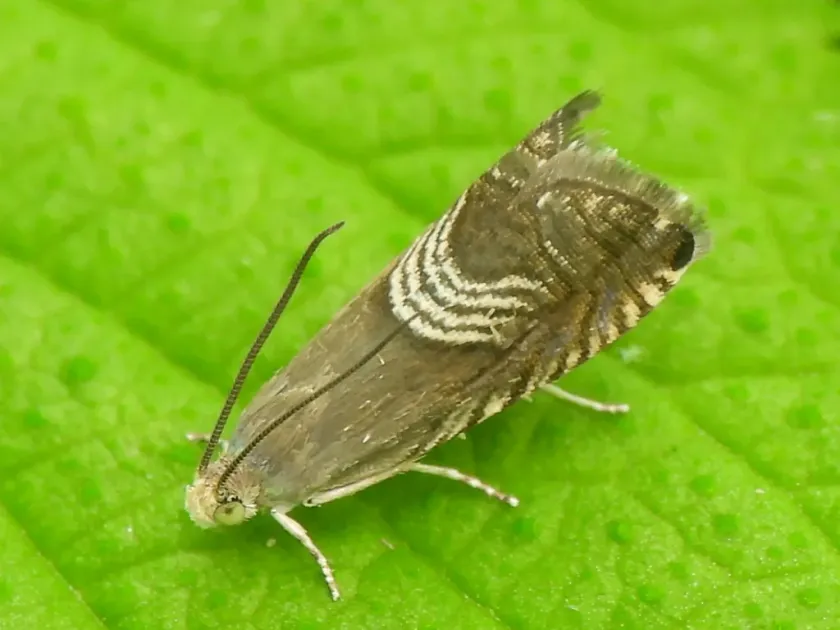
The hemp moth (Grapholita delineana) is a small moth belonging to the family Tortricidae. The adult moth has a wingspan of approximately 10–13 mm, with forewings that exhibit a variegated pattern of brownish and grey shades, typical for members of this family.
The larvae, which are the primary damaging stage, are about 10 mm long when fully grown. They possess a characteristic light-colored body (whitish or pinkish) with a dark head capsule and a distinct thoracic plate, making them relatively easy to identify during field scouting.
Eggs of the hemp moth are tiny and flat, usually laid singly or in small clusters on the leaves, stems, or leaf axils of the hemp plant. Their small size and placement make them difficult to detect without careful observation.
Pupation takes place inside dense silken cocoons constructed by the larvae. These cocoons are typically found within plant debris, hollow stems, or just below the soil surface, providing protection during the dormant season.
The lifecycle and number of generations per year are heavily influenced by temperature. Higher ambient temperatures accelerate development, allowing the insect to complete its cycle faster and potentially leading to multiple generations in a single growing season.
What it damages
The hemp moth primarily attacks industrial hemp crops. The larvae feed on various parts of the plant, including leaves, stems, and reproductive structures, depending on the plant's growth stage.
Young larvae often feed on the tender tips of the plant, boring into the stem and tunneling through the pith. This tunneling interferes with nutrient transport and can cause the stems to weaken, bend, or die entirely.
During the flowering and seed-forming stages, the larvae move to the inflorescences. They feed directly on the flowers and developing seeds, which causes direct yield losses and reduces the quality of the harvested grain.
Stems damaged by the moth become structurally unsound and prone to lodging, especially under adverse weather conditions like strong winds or heavy rain, significantly complicating mechanical harvesting.
Furthermore, the entry holes created by the larvae serve as portals for secondary infections, including fungal pathogens, which can exacerbate plant stress and lead to overall crop decline.
When it appears
The flight of the first generation of adults usually coincides with the vegetative growth phase of hemp, typically starting from late May to June, depending on local climate conditions and plant development.
The pest typically produces several generations throughout the growing season. Subsequent generations are often more numerous, with peak infestation pressure frequently observed during the mid-summer months.
Larval activity is most intense during July and August, when the plant is transitioning to the flowering stage. This period is the most critical time for monitoring and implementing protective measures.
As temperatures drop in the autumn, the final larval generation enters diapause. They seek shelter in plant stalks or the soil to survive the winter, waiting for the return of favorable spring conditions to begin their development again.
Effective management requires tracking moth flight using pheromone traps, which helps to forecast the timing of egg hatching and ensures that intervention measures are applied at the most vulnerable stage of the pest.
Signs of infestation
The first indicator of an infestation is often the wilting or drooping of the apical parts of the plant. This is usually caused by larvae boring into the terminal shoot or the top of the stem.
On the stems, one can often find small entry holes surrounded by frass (larval excrement). This external evidence of tunneling is a clear sign that the larva is already feeding inside the plant tissue.
Inflorescence damage is visible as webbed-together flower clusters, where the larva feeds while protected by its silk threads. These clusters often appear distorted, discolored, or prematurely dried out.
In cases of heavy infestation, the plants may show symptoms of yellowing at the top, a condition often referred to as "white top," resulting from the destruction of the central vascular tissue in the stem.
Visual confirmation of adults in the field during dusk hours is a strong warning sign. If moth counts increase, it indicates that a new wave of larvae will soon hatch, necessitating immediate field inspections.
Control measures
Cultural control is a cornerstone of hemp moth management. Deep plowing of the soil after harvest is highly effective at burying plant debris and destroying the overwintering pupae of the pest.
Maintaining proper crop rotation and ensuring sufficient spatial isolation between industrial hemp fields and wild hemp populations can significantly reduce the risk of re-infestation.
Biological control using formulations based on Bacillus thuringiensis is an environmentally friendly option that can effectively manage larval populations while sparing beneficial insects in the field.
Chemical control should be strictly timed to coincide with the period when larvae hatch from eggs, but before they enter the stems, as they are well-protected once they tunnel into the plant tissue.
- Monitor adult flight using specialized pheromone traps.
- Remove crop residues promptly after the harvest.
- Apply insecticides only when the economic injury threshold is exceeded.
Taxonomy
- Latin name
- Grapholita delineana
- Order
- Lepidoptera (butterflies)
- Family
- Tortricidae
- EPPO code
- CYDIDE
Discussion
No discussions yet — be the first.