
Eucalyptus weevil
Gonipterus scutellatus
Description
How to identify
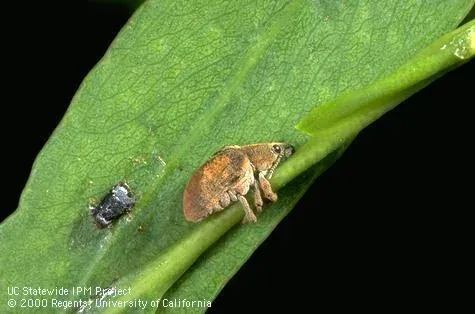
The eucalyptus weevil (Gonipterus scutellatus) is a beetle belonging to the Curculionidae family, which has become a significant invasive pest of eucalyptus plantations globally. Adult beetles are 7–9 mm long and exhibit a distinct reddish-brown to dark brown coloration with white markings.
The beetle's body is covered in dense hairs, giving it a somewhat matte appearance. It features a short, robust snout. Eggs are laid in clusters on the leaves, encased in a dark, protective material that prevents desiccation and predation.
Larvae are legless and possess a yellow-green body with darker stripes. They are highly mobile on the leaf surface despite lacking limbs and exhibit voracious feeding behavior, which is the primary cause of foliage loss.
The pupal stage occurs in the soil, where the insects form small earthen cells. Depending on temperature and moisture levels, the insect can undergo multiple generations per year in subtropical environments.
Adults are primarily nocturnal but can be found during the day on foliage. They are capable of flight and spread quickly across plantations, making early detection a primary challenge for foresters.
What it damages
Both adult beetles and their larvae feed exclusively on eucalyptus leaves. They show a clear preference for young shoots, foliage, and terminal buds, which can lead to severe stunting of tree growth.
Feeding damage typically starts at the leaf margins, progressing until only the major veins remain. This process is known as skeletonization and significantly reduces the tree's photosynthetic capacity.
Heavy defoliation weakens the overall health of the trees, making them vulnerable to secondary pathogens, drought, and environmental stress. In severe cases, repeated infestations can result in the death of entire stands.
Economic losses are profound, as damaged trees suffer from reduced wood yield and lower pulp quality. This pest poses a constant threat to the viability of commercial eucalyptus plantations worldwide.
Nurseries are particularly at risk, as heavy infestation can completely destroy young seedlings, leading to substantial financial losses and delays in forest replanting programs.
When it appears
The activity of the eucalyptus weevil generally begins in the early spring, as temperatures rise above 10–12 degrees Celsius. Adults emerge from their overwintering sites to feed on existing foliage.
Reproductive peaks often coincide with the flushing of new leaves on eucalyptus trees, which provides an ideal food source for the next generation of larvae. Spring and early summer are usually the periods of highest activity.
In mid-summer, extreme heat may slow down the development cycle, pushing the insect into a period of reduced activity. However, if conditions remain favorable, multiple overlapping generations can occur within a single year.
As autumn approaches, adult beetles begin seeking sheltered areas under the bark or in the soil debris for the winter. They are highly adapted to survive through various winter climates.
Continuous monitoring throughout the growing season is essential, as fluctuations in population density can occur rapidly based on humidity and the availability of new growth.
Signs of infestation
Characteristic "notched" or "serrated" leaf margins are the most immediate visual sign of an eucalyptus weevil infestation. This pattern is caused by the methodical feeding habits of the larvae.
The presence of small, dark, granular frass (excrement) on the leaf surface is a reliable indicator of recent or ongoing feeding activity in that specific area.
Egg clusters, appearing as small, brownish, or olive-colored lumps on the leaves, are easily identifiable upon close inspection and serve as a warning of an impending larval outbreak.
Thinning of the canopy and exposed branches are visible from a distance, indicating a high level of defoliation. A forest stand that suddenly loses its vibrant green color is often a sign of an unchecked infestation.
General tree stress, such as epicormic shooting (growth of small branches from the trunk) following severe defoliation, is a common physiological response to weevil damage.
Control measures
Biological control using the egg parasitoid wasp Anaphes nitens is the most successful and widely implemented strategy. This parasitoid has been introduced in many countries to manage the weevil population naturally.
Chemical control should be limited to high-value nurseries or young plantations where immediate intervention is necessary to prevent tree loss. Systemic insecticides are generally the most effective.
Silvicultural practices, including maintaining healthy tree density and providing proper fertilization, help trees tolerate damage and accelerate canopy recovery after an infestation.
Strict quarantine and biosecurity measures are vital for preventing the movement of infested nursery stock between regions, which is the primary driver of the weevil's spread.
- Utilize pheromone monitoring to track adult beetle emergence.
- Remove and destroy heavily infested seedlings in early outbreak stages.
- Promote biodiversity to encourage natural predators within the plantation environment.
Taxonomy
- Latin name
- Gonipterus scutellatus
- Order
- Coleoptera (beetles)
- Family
- Curculionidae
- EPPO code
- GONPSC
Discussion
No discussions yet — be the first.