
Eucalyptus snout beetle
Gonipterus pulverulentus
Description
How to identify
The Eucalyptus snout beetle (Gonipterus pulverulentus) is a member of the Coleoptera order and the Curculionidae family. Adult beetles typically measure 7-9 mm in length and possess a mottled brownish color.
The body is covered with fine scales, giving it a somewhat dull or metallic appearance. The head features a distinct rostrum (snout) which is used to feed on the plant tissue.
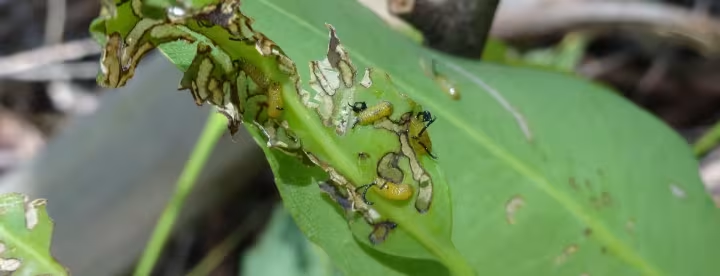
Larvae are yellowish-green in color and often develop a dark stripe along their back. They are frequently covered in a slimy secretion that serves as protection against predators and extreme environmental conditions.
The life cycle includes egg, larval, pupal, and adult stages. Depending on climate conditions, the insect can complete multiple generations annually, leading to rapid population outbreaks.
Females deposit eggs in small clusters on the surface of young leaves, covering them with an excremental layer that hardens into a protective capsule.
What it damages
The beetle primarily feeds on various species of the Eucalyptus genus. Both adult beetles and larvae cause damage by consuming the foliage of the trees.
Severe infestations on young trees often result in stunted growth, stem deformation, and significant loss of biomass, which is critical in commercial forestry.
Defoliation caused by heavy feeding weakens the tree's health, making it increasingly susceptible to secondary pests, pathogens, and fungal infections.
In mature trees, the beetle prefers the tender new growth at the canopy level. Persistent feeding prevents proper canopy development and weakens the tree's vigor.
Economic impact is significant, as timber yield is reduced, and the cost of managing wide-scale infestations in forests requires substantial resources.
Signs of infestation
The most visible sign of infestation is the notched, irregular feeding patterns along the leaf margins, caused by adult beetles.
Larvae create characteristic longitudinal tracks or "windows" in the leaves, removing tissue between the veins, which eventually leads to leaf necrosis.
Small, hard, dark-brown capsules attached to the leaves indicate the presence of egg clusters. These are reliable indicators for identifying early-stage outbreaks.
Premature leaf drop throughout the growing season is a common indicator of high population density within the tree canopy.
The presence of fine, dark excrement pellets on the leaves and ground beneath the infested trees is a clear sign of active feeding in the canopy.
Control measures
Biological control is the most sustainable management strategy, primarily through the introduction of the egg parasitoid Anaphes nitens, which significantly reduces beetle populations.
Chemical control is generally reserved for nursery settings or young plantations, where systemic insecticides can be applied to protect vulnerable trees.
Forest management practices include regular monitoring to detect outbreaks early and the removal of heavily infested material to limit the spread of the pest.
Strict quarantine measures on the movement of eucalyptus seedlings are essential to prevent the spread of the insect to new, uninfected geographic areas.
- Deployment of pheromone traps for monitoring.
- Silvicultural management to maintain tree health.
- Integration of native predatory insects.
Taxonomy
- Latin name
- Gonipterus pulverulentus
- Order
- Coleoptera (beetles)
- Family
- Curculionidae
- EPPO code
- GONPPU
Discussion
No discussions yet — be the first.