
Eucalyptus weevil
Gonipterus platensis
Description
How to identify
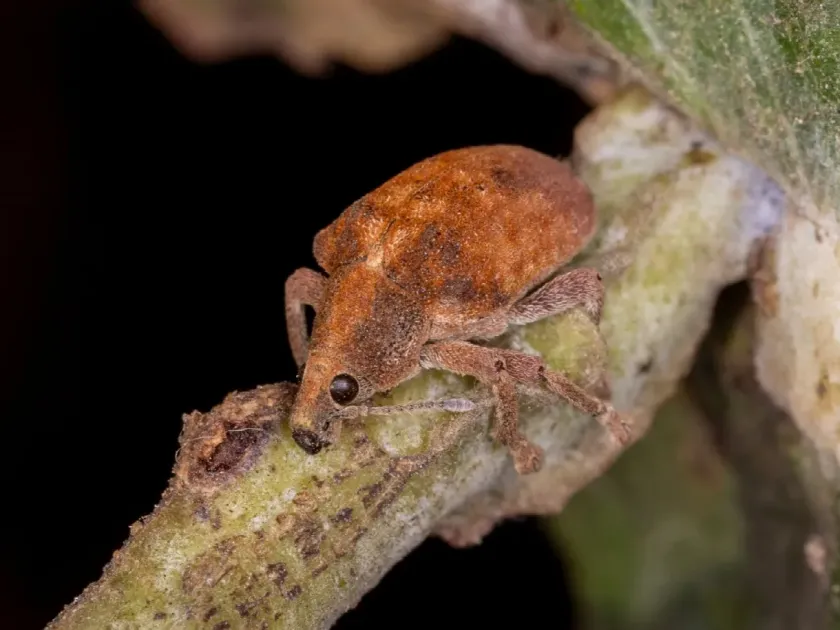
The Eucalyptus weevil (Gonipterus platensis) is a member of the Curculionidae family. Adult beetles are roughly 7–9 mm long, with a robust, oval-shaped body, typically brownish in color, covered in small pale scales that give them a mottled appearance.
Larvae are easily identifiable by their yellowish-green, slug-like appearance. They possess a characteristic behavior of carrying a protective layer of their own dark excrement on their backs throughout their development.
Adults are capable of flying long distances, which facilitates the rapid spread of the species into previously unaffected eucalyptus plantations. They exhibit a tendency to play dead when disturbed, making them difficult to spot during casual inspections.
Development involves distinct stages: egg, larva, pupa, and adult. While the life cycle occurs on the foliage, the larvae drop to the ground to pupate in the soil, which provides a critical refugium against many environmental stressors.
The beetle’s lifespan can span several months, allowing for overlapping generations in warmer climates. This reproductive flexibility makes it a highly resilient and difficult pest to eradicate completely once established.
What it damages
The primary hosts of this pest are species of the genus Eucalyptus. Both adults and larvae feed exclusively on the leaves, posing a significant threat to young plantations and mature trees alike.
Adult beetles cause damage by chewing irregular notches along the margins of the leaves, while larvae consume the leaf tissue, leaving behind only the veins and the thin, lower epidermis, which subsequently desiccates.
Heavy infestations lead to significant defoliation, which hampers the tree's ability to photosynthesize. This results in reduced growth rates, stunted development, and, in severe cases, the death of young seedlings.
Beyond direct growth loss, defoliated trees are significantly more susceptible to opportunistic fungal infections and other secondary pests that exploit the stressed condition of the host tree.
The economic impact of Gonipterus platensis is substantial, affecting timber production, nursery stocks, and the overall health of ornamental eucalyptus plantings in urban landscapes.
When it appears
The activity of the eucalyptus weevil is highly dependent on ambient temperature. In favorable regions with mild winters, the insect can remain active year-round, leading to multiple overlapping generations.
The spring season typically marks the emergence of overwintering adults. They start feeding immediately on the fresh, tender growth of eucalyptus, followed by the commencement of the egg-laying process.
Summer is the period of peak larval activity. During these months, the rate of development accelerates, often leading to rapid population explosions that can cause widespread defoliation in a short timeframe.
As temperatures decline in autumn, the beetles begin seeking protected overwintering sites, such as bark crevices or soil debris, to survive until the following spring.
The lack of a strict diapause in certain geographic ranges allows the weevil to maintain a constant pressure on its host trees, requiring consistent monitoring throughout the growing season.
Signs of infestation
The most reliable sign of an infestation is the presence of scalloped edges on the foliage caused by adult feeding. These notches are distinct and easily visible upon close examination of the canopy.
The presence of larvae is signaled by the dark, slime-like fecal casings they carry on their backs. These casings appear as small black spots on the leaves, often accompanied by the characteristic skeletonization pattern.
Skeletonized leaves that have turned brown and brittle are a clear indicator of a high larval population. These leaves often drop prematurely, leading to thinning of the tree's crown.
A general loss of vigor, characterized by stunted shoot growth and an overall pale or sickly appearance of the canopy, serves as a secondary indicator of sustained pest pressure.
Routine monitoring using canopy beating or branch inspection helps agronomists detect the presence of the beetle early, before significant economic damage occurs to the plantation.
Control measures
Biological control is the cornerstone of managing Gonipterus platensis. The introduction of the egg parasitoid Anaphes nitens has proven to be highly successful in suppressing weevil populations in many countries.
In nurseries or high-value young plantations, chemical control using systemic insecticides can be employed. These are typically applied as soil drenches or foliar sprays to ensure the pesticide reaches the larvae feeding on the leaves.
Cultural practices, such as ensuring proper site selection and maintaining tree health through irrigation and fertilization, can increase the resilience of eucalyptus trees against moderate pest damage.
Strict phytosanitary regulations are essential to prevent the movement of infested nursery stock between regions, which remains a primary cause of new outbreaks.
- Regular monitoring with pheromone or sticky traps.
- Use of entomopathogenic fungi as a biorational control agent.
- Manual removal of adults on small-scale ornamental trees.
- Integrated Pest Management (IPM) strategies to preserve natural enemy populations.
Taxonomy
- Latin name
- Gonipterus platensis
- Order
- Coleoptera (beetles)
- Family
- Curculionidae
- EPPO code
- GONPPL
Discussion
No discussions yet — be the first.