
Eucalyptus weevil
Gonipterus notographus
Description
How to identify
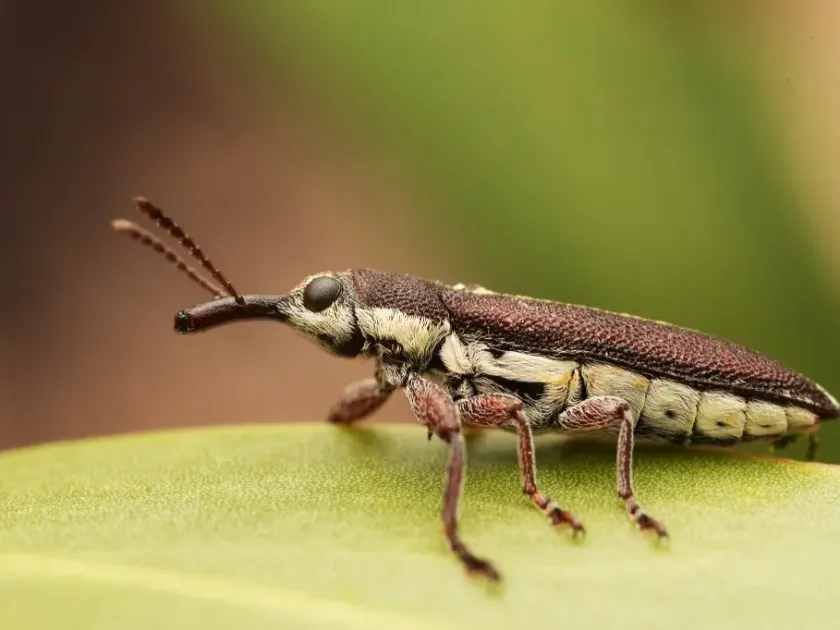
The Eucalyptus weevil (Gonipterus notographus, often associated with the Gonipterus scutellatus complex) is a significant forest pest belonging to the order Coleoptera and the Curculionidae family. The adult beetle is characterized by its elongated snout and mottled brown or grayish body.
The larvae are typically slug-like in appearance, with an elongated, flattened body. They are often coated with a slimy, protective secretion that serves as a defense against both environmental stress and potential predators in the canopy.
Adults are primarily nocturnal, making them difficult to spot during daylight inspections. They exhibit a distinct survival behavior of "dropping" from foliage when disturbed, falling to the ground to blend in with the leaf litter.
The life cycle of the weevil involves complete metamorphosis: egg, four larval instars, pupa, and adult. The number of generations per year is highly dependent on local climatic conditions, with multiple generations possible in warmer environments.
This invasive species has spread globally through international trade, specifically via the movement of infested seedlings and timber products. Its ability to colonize various Eucalyptus species makes it a persistent challenge for foresters worldwide.
What it damages
Eucalyptus weevils primarily feed on foliage, with a strong preference for young, succulent leaves of various Eucalyptus species. This makes young plantations and nurseries particularly susceptible to severe damage.
Adult beetles cause damage by feeding on the edges of leaves, creating distinctive, irregular notches. While this reduces the overall leaf area, the primary economic impact stems from larval feeding activity.
Larvae feed by consuming the leaf parenchyma, leaving behind only the tougher veins. This leads to heavy defoliation, which severely reduces the tree's photosynthetic capacity and weakens its overall physiological status.
Repeated defoliation stunts tree growth, results in the dieback of terminal shoots, and can eventually lead to tree mortality if the stress is prolonged or compounded by other environmental factors.
In addition to physiological damage, the loss of foliage renders trees more susceptible to secondary wood-boring insects and opportunistic fungal pathogens, significantly affecting the quality of commercial timber.
Signs of infestation
The most recognizable symptom of a Gonipterus infestation is the "scalloped" appearance of the leaf edges. Upon close inspection of the canopy, one can observe the characteristic feeding patterns left by both adults and larvae.
Presence of dark, granular frass on the leaf surface is a reliable indicator of active larval feeding. This residue can often become a substrate for sooty mold, which further degrades the health and appearance of the foliage.
Terminal shoot dieback and abnormal branching patterns are clear signs of a long-term infestation. When the apical meristem is damaged, the tree often attempts to compensate by producing excessive lateral growth, distorting the tree's architecture.
During the pupal stage, one may find small, earthen-like cocoons either on the leaves or in the soil near the base of the tree. Checking the soil or the trunk during twilight hours can reveal the presence of adult weevils.
Specialized pheromone-based monitoring traps are widely used in commercial forestry to track population density and determine the optimal timing for intervention strategies.
Control measures
Biological control remains the cornerstone of sustainable Eucalyptus weevil management. The introduction and protection of the egg parasitoid Anaphes nitens have proven highly effective in reducing larval populations in many countries.
Chemical control is generally reserved for nursery settings or high-value ornamental trees. Systemic insecticides are preferred, as they provide longer-lasting protection and can be timed to coincide with the most vulnerable larval stages.
Silvicultural management, including the selection of resistant Eucalyptus species and cultivars, is a proactive way to minimize the impact of the pest. Maintaining tree vigor through proper site selection and management is also crucial.
Sanitation practices such as removing infested plant material can help suppress local populations. However, this is only viable on a small scale, such as in gardens or small-scale plantations, due to the high mobility of the adults.
Strict phytosanitary regulations and quarantine procedures are essential to limit the spread of the weevil to new regions. All imported Eucalyptus material should be thoroughly inspected for any signs of egg or larval presence.
Taxonomy
- Latin name
- Gonipterus notographus
- Order
- Coleoptera (beetles)
- Family
- Curculionidae
- EPPO code
- GONPNO
Discussion
No discussions yet — be the first.