
Eucalyptus snout beetle
Gonipterus balteatus
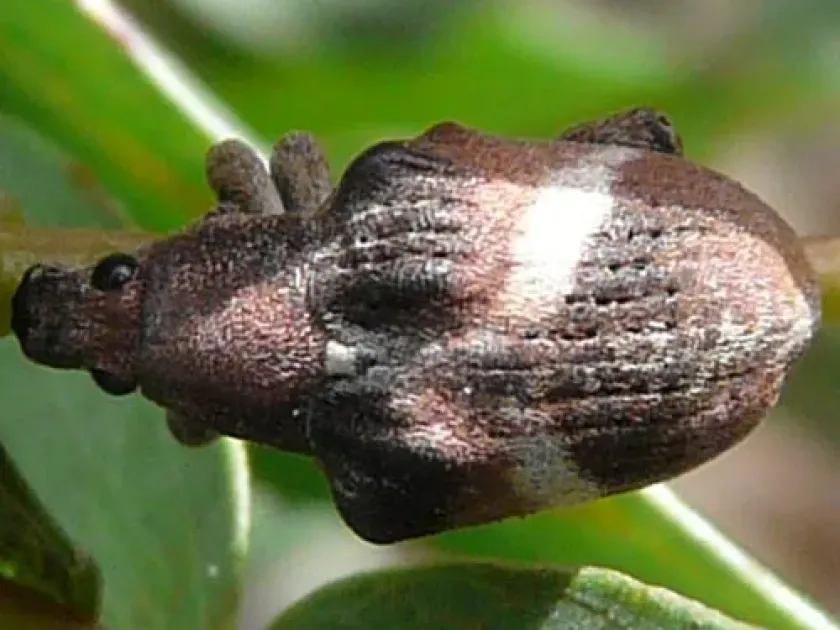
Description
How to identify
The Eucalyptus snout beetle (Gonipterus balteatus) is a member of the Curculionidae family, known for its significant impact on eucalyptus plantations globally.
Adult beetles are relatively small, typically featuring a distinct rostrum and mottled coloration, which helps them blend into the bark and foliage of their host trees.
Larvae are easily distinguished by their slimy appearance, which is a protective adaptation against desiccation and predators while they feed on the surface of the leaves.
The taxonomic classification of this species highlights its high level of specialization, as it has evolved exclusively to thrive on various species within the Eucalyptus genus.
Reliable identification involves observing both the adult insects and the specific feeding patterns they leave on the leaves, often requiring entomological expertise for confirmation.
What it damages
This pest primarily attacks the young leaves and shoots of eucalyptus trees, causing significant defoliation that hinders the tree's ability to photosynthesize.
Heavy infestations can lead to the death of terminal buds, which causes permanent deformation of the stem and branches, ultimately reducing the quality and volume of timber production.
In addition to direct foliage loss, the wounding of the tree tissue makes the plants more susceptible to opportunistic pathogens and wood-boring insects.
Seedlings and young saplings are particularly vulnerable, and without adequate management, a severe attack can lead to high mortality rates in newly established stands.
The cumulative damage results in substantial economic losses for forestry enterprises, necessitating proactive monitoring and intervention strategies.
##season##The life cycle of the Eucalyptus snout beetle is highly temperature-dependent, with developmental speed increasing during warmer months when eucalyptus trees produce new growth.
Adult beetles overwinter in protected areas such as bark crevices or leaf litter, emerging in the spring as soon as the weather becomes conducive to their activity.
Egg-laying occurs on the surface of young leaves, providing the larvae with an immediate and high-quality food source as soon as they hatch.
Depending on the climatic conditions, multiple generations can occur within a single year, allowing the population to build up rapidly in favorable environments.
After completing their larval stages, the insects move into the soil to pupate, eventually emerging as new adults to continue the cycle.
Signs of infestation
The most prominent sign of infestation is the characteristic scalloping of leaf edges, caused by adult beetles feeding on the margins of the foliage.
Larval damage appears as linear or longitudinal tracks on the leaf surface, as they consume tissue while leaving the epidermis intact, often accompanied by dark frass deposits.
- Scalloped edges on leaves (adult feeding).
- Surface trails on leaves (larval feeding).
- Premature yellowing or shedding of foliage.
- Dieback of terminal shoots and branch tips.
- Visible presence of slug-like larvae on young foliage.
Regular inspection of the canopy, especially the crown and upper branches, is crucial for early detection and efficient management of the beetle population.
Control measures
Biological control remains the most sustainable strategy, involving the introduction of specific parasitoids, such as egg-parasitizing wasps, which can significantly regulate beetle numbers.
Chemical control via systemic insecticides may be used in intensive plantation management, though application at scale requires careful environmental consideration.
Good silvicultural practices, including proper site selection and maintaining tree vigor through irrigation and fertilization, help trees resist and recover from infestation.
Sanitation measures, such as removing and destroying heavily infested plant material, can help suppress localized population growth and prevent further spread.
Integrating monitoring data with ecological control methods provides the most effective long-term solution for managing this pest in commercial forestry.
Taxonomy
- Latin name
- Gonipterus balteatus
- Order
- Coleoptera (beetles)
- Family
- Curculionidae
- EPPO code
- GONPBA
Discussion
No discussions yet — be the first.