
Chicken louse
Goniocotes gallinae
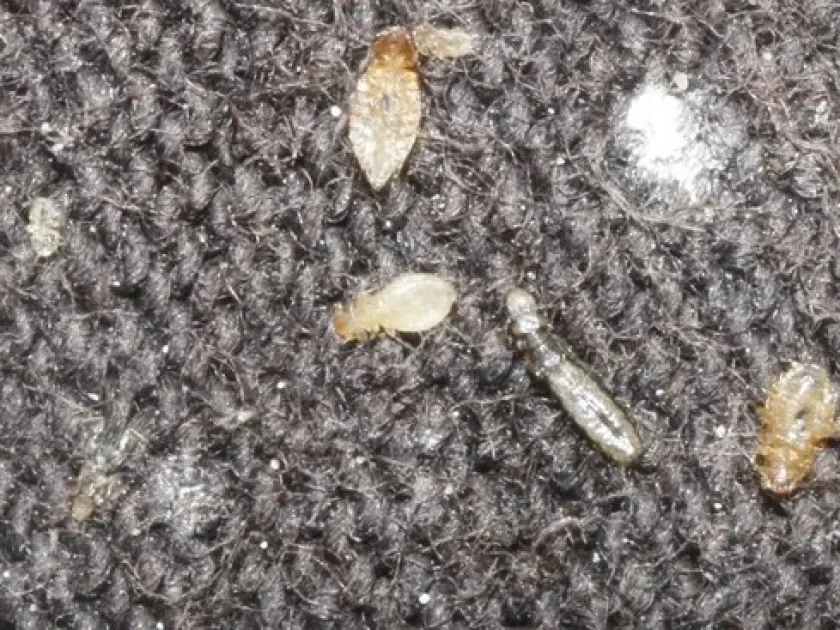
Description
How to identify
Goniocotes gallinae, commonly known as the chicken louse, is a species of chewing louse that belongs to the order Mallophaga and the family Philopteridae.
These parasites are small, dorsoventrally flattened insects, typically measuring about 1.5 mm in length, with a pale yellow or brownish coloration.
Unlike mites, they do not feed on blood. Instead, their chewing mouthparts are specialized for consuming feather barbules, skin scales, and dander found on the host's body.
Their life cycle is completed entirely on the host. Females lay eggs (nits) and attach them firmly to the base of the feathers, where they hatch into nymphs that resemble adults.
They are highly host-specific and cannot survive for long periods off the bird, which is why infestations spread primarily through direct contact between infected and healthy birds.
What it damages
The chicken louse primarily infests domestic poultry, including chickens, turkeys, and guinea fowl. They are widespread pests in both commercial and backyard farming.
The damage is caused by the parasite's constant grazing on feathers and skin, which irritates the birds and results in discomfort and stress.
Heavy infestations lead to broken feathers, ruffled plumage, and denuded skin patches, as the birds attempt to alleviate the irritation by excessive preening and pecking.
In growing chicks, high numbers of lice significantly retard growth and weight gain due to metabolic stress and loss of foraging time.
For layers, the presence of these lice often results in decreased egg production, leading to significant economic losses for the poultry producer.
Signs of infestation
The most noticeable sign of an infestation is a change in behavior, specifically restless behavior, constant preening, and feather pulling by the birds.
Upon closer examination, you can see small, pale, grain-like structures (eggs) clustered at the base of feathers, especially near the vent, under the wings, and on the neck.
Skin irritation and dermatitis are common in heavily infested birds, as the parasites move across the skin with their hooked legs, causing persistent itching.
Feathers may appear damaged, broken, or sparse, as the lice consume the barbules, causing the vanes of the feathers to detach and fall out prematurely.
Severely infested birds look unkempt, lose their vitality, and may show signs of physical exhaustion and increased susceptibility to other diseases.
Control measures
Effective management requires a multi-pronged approach that targets the lice on the birds and eliminates any surviving populations in the coop environment.
Application of approved insecticidal powders, sprays, or spot-on treatments directly to the birds is the most reliable way to clear an existing infestation.
Providing dust baths with a mixture of wood ash and fine sand allows the birds to naturally groom themselves and effectively suppress louse populations.
- Maintain high standards of coop sanitation.
- Regularly inspect the flock for signs of lice.
- Isolate new birds before introducing them to the main flock.
- Clean and disinfect housing regularly to kill wandering lice.
Integrated pest management also involves keeping the coop dry and well-ventilated, as damp environments can favor the survival of parasites in the environment.
Taxonomy
- Latin name
- Goniocotes gallinae
- Family
- Goniocotidae
- EPPO code
- GONOGA
Discussion
No discussions yet — be the first.