
Chicken louse
Goniocotes
Description
How to identify
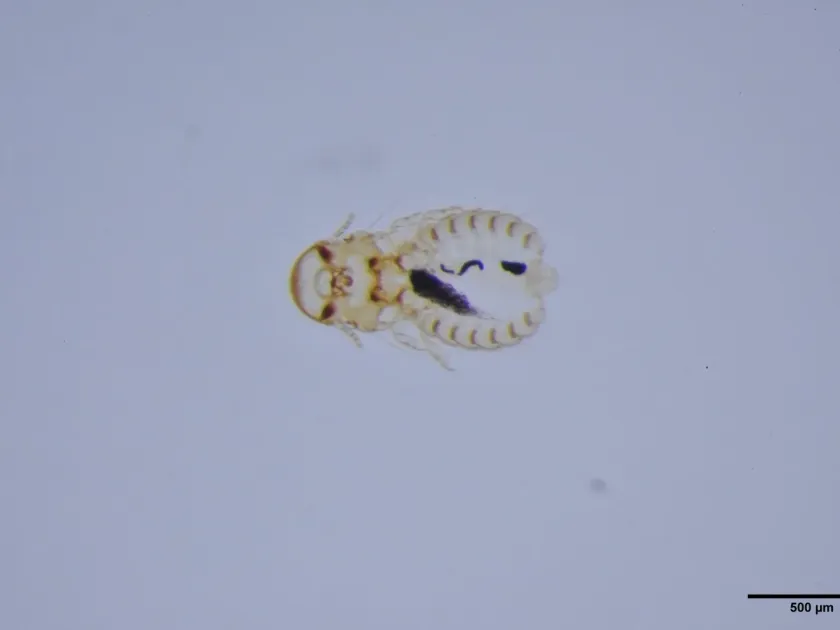
The chicken louse (Goniocotes gallinae) belongs to the order Phthiraptera and family Philopteridae. It is a small, wingless insect, measuring about 1–2 mm in length, characterized by a flattened body and a broad head.
These parasites possess chewing mouthparts designed to feed on dead skin, feather barbules, and skin debris. Unlike blood-sucking lice, they do not feed on the bird's blood, yet they cause extreme irritation.
The entire life cycle occurs on the bird's body. Females lay eggs (nits) that are firmly cemented to the base of the feathers, particularly in the fluff region and around the abdomen and wings.
The developmental process consists of the egg stage, three nymphal instars, and the adult stage. The cycle is rapid under warm conditions, allowing the population to explode if proper hygiene is not maintained.
Once separated from the host, the chicken louse is quite fragile. Lacking the heat and food source provided by the bird's body, adult lice typically perish within a few days, making environmental sanitation a key part of eradication.
What it damages
This pest exclusively targets domestic chickens and other poultry. By living on the host's skin, they cause significant physiological stress that impacts the overall health and economic output of the flock.
Constant itching and irritation lead to restlessness. Affected birds spend significant energy on preening and scratching, which reduces the time spent feeding and resting, eventually leading to weight loss.
In laying hens, the stress caused by an infestation often results in a marked decline in egg production. The nutritional resources that would typically go into egg formation are diverted to manage the physiological stress of the infestation.
Damage to the feather structure reduces the insulation capacity of the plumage. This forces the bird to expend more metabolic energy to maintain body temperature, weakening the bird's constitution.
For chicks, a heavy infestation can be devastating, leading to stunted growth, severe emaciation, and increased susceptibility to secondary bacterial infections through skin abrasions caused by constant scratching.
Signs of infestation
The most prominent sign of infestation is altered behavior. Birds may appear restless, continuously preening, and trying to rub their bodies against feeders or coop walls to alleviate the persistent itch.
A physical inspection of the bird often reveals adult lice crawling on the skin, especially in areas like the vent, neck, and under the wings. Feathers may appear ragged, broken, or eaten at the base.
Observing nits (eggs) attached to the base of the feathers is the most reliable diagnostic sign. These nits appear as small, light-colored clusters or particles firmly glued to the feather shaft.
General lethargy and a pale appearance of the comb and wattles can be secondary symptoms indicating a high level of infestation and the subsequent toll on the bird's health.
In cases of severe infestation, patches of feather loss (alopecia) may become visible, and the skin in those areas may show signs of inflammation and irritation from persistent scratching.
Control measures
Effective control involves the use of approved insecticides in the form of dusts, sprays, or spot-on treatments specifically formulated for poultry use. Application must be thorough to reach the skin surface.
A comprehensive sanitation program is essential. This includes treating the coop environment, cleaning nesting boxes, and removing old bedding to destroy any lice that may have fallen off the host.
Providing dust baths with a mixture of wood ash and sand allows birds to naturally control the population. This natural grooming behavior is an effective supplement to chemical control methods.
Proactive management includes quarantining new birds before introducing them to the main flock and regularly inspecting the coop for signs of pest activity.
- Isolate infested birds to prevent the spread to healthy individuals.
- Re-apply treatment after 10–14 days to target any nymphs that hatched after the initial application.
- Maintain strict coop hygiene by regularly removing manure and debris.
Taxonomy
- Latin name
- Goniocotes
- Family
- Goniocotidae
- EPPO code
- GONOSP
Discussion
No discussions yet — be the first.