
Gnathotrupes
Gnathotrupes
Description
How to identify
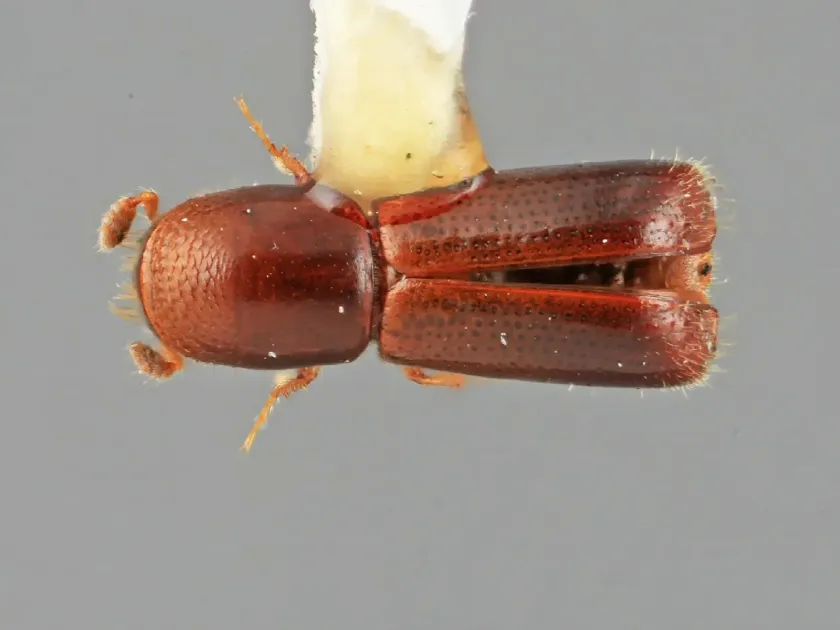
Gnathotrupes is a genus of bark beetles belonging to the family Curculionidae and the subfamily Scolytinae. These insects are small, typically cylindrical beetles designed for life within wood tunnels.
The adult beetles are generally dark in color, ranging from deep brown to black, which aids in camouflage against the bark of their host trees.
Their anatomy is specialized, with a head partially retracted into the prothorax, a common trait among many wood-boring bark beetles.
The larvae are typically legless, cream-colored, and C-shaped, spending their entire developmental period feeding inside the wood galleries created by their parents.
Identification to the species level usually requires a specialist due to the high morphological similarity between different species within this genus.
What it damages
Gnathotrupes species primarily attack stressed, dying, or recently felled trees, although large populations can overwhelm and colonize healthy hosts.
They bore into the wood, creating intricate gallery systems that severely disrupt the vascular system of the tree, impeding the transport of water and nutrients.
The resulting damage often leads to the decline and eventual death of the affected branch or the entire tree if the infestation is severe enough.
These beetles also act as vectors for various pathogenic fungi, which further degrade the wood and accelerate the decay process within the tree.
In forest nurseries, Gnathotrupes can be particularly devastating, causing significant losses of seedlings that are unable to recover from tunneling damage.
When it appears
The activity of Gnathotrupes is highly dependent on ambient temperature, with adult emergence typically starting in the early spring as temperatures rise.
Throughout the warmer months, multiple generations can emerge, provided that host availability and environmental moisture levels are sufficient for development.
Peak infestation periods often coincide with mid-summer heatwaves, during which trees are under physiological drought stress and are more susceptible to attack.
As autumn approaches, activity levels drop, and the beetles prepare for overwintering, seeking refuge within the host wood or under thick bark.
During the winter, the beetles remain in a state of diapause, effectively surviving the cold by staying sheltered deep inside the timber.
Signs of infestation
The primary indicator of a Gnathotrupes infestation is the presence of "frass," a sawdust-like material pushed out of tiny entry holes in the bark.
Entry holes are small and circular, appearing on the surface of branches or the main trunk, often hidden in bark crevices.
Affected trees often show signs of foliage yellowing or premature wilting, indicating that the vascular system is no longer functioning correctly.
In some cases, the tree may exhibit resin or sap weeping as a defensive response to the tunneling insects, leaving visible stains on the bark.
Removing a section of the bark reveals the complex network of tunnels, which is the most definitive sign of an active infestation by these wood-boring beetles.
Control measures
Effective management begins with strict sanitation practices, such as the rapid removal and destruction of infested wood to prevent the spread of new generations.
Monitoring using pheromone-based traps is a crucial strategy to detect the onset of beetle flights and determine the optimal timing for protective measures.
When necessary, systemic or contact insecticides can be applied to the trunk during peak flight seasons to protect high-value or vulnerable trees.
- Maintaining tree vigor through proper silviculture.
- Prompt disposal of logging residues.
- Application of specialized chemical treatments.
Promoting natural biodiversity, including the protection of woodpeckers and predatory insects, serves as a sustainable long-term strategy to regulate beetle populations.
Taxonomy
- Latin name
- Gnathotrupes
- Order
- Coleoptera (beetles)
- Family
- Curculionidae
- EPPO code
- GNARSP
Discussion
No discussions yet — be the first.