
Tsetse fly
Glossina morsitans
Description
How to identify
The tsetse fly belongs to the genus Glossina and the family Glossinidae, known for its unique and highly specialized survival mechanisms.
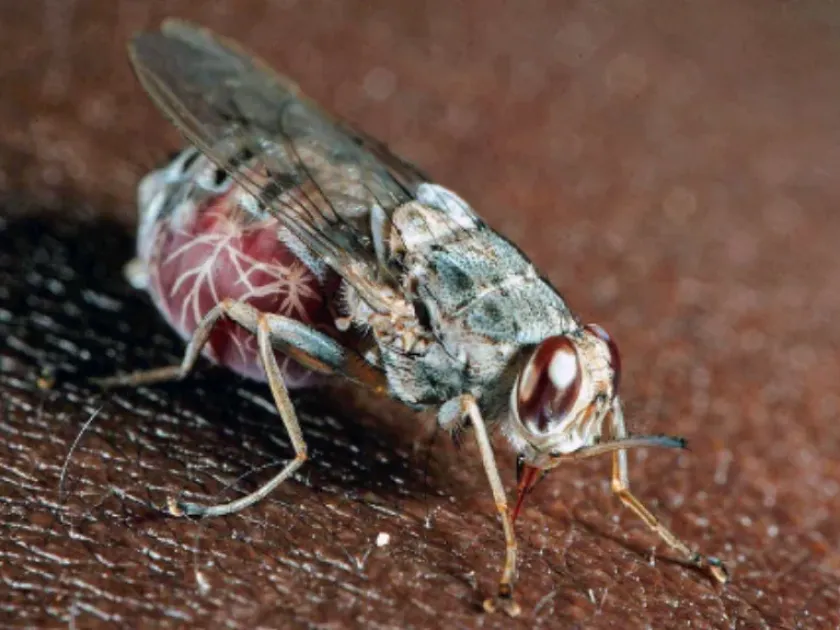
These flies are generally brown or grey in color and can be easily recognized by their distinct resting posture, where the wings fold over each other like scissors.
The proboscis is a rigid, forward-projecting organ that allows the fly to feed exclusively on the blood of vertebrate animals.
Unlike most insects, the tsetse fly exhibits adenotrophic viviparity, meaning the female gives birth to a single, fully developed larva that immediately burrows into the ground.
Their flight is rapid and agile, enabling them to pursue their prey effectively across savanna and forest environments.
What it damages
The tsetse fly is not a botanical pest and does not feed on crops, yet it causes significant indirect damage to agricultural production.
It acts as the primary vector for Trypanosoma parasites, which cause nagana in livestock and sleeping sickness in humans.
The presence of this insect makes large tracts of land unsuitable for cattle farming, leading to vast economic losses and food insecurity.
Agricultural operations are severely hampered because working livestock cannot be safely maintained in infested regions.
The mortality rates for untreated livestock are extremely high, often wiping out entire herds and destabilizing local agricultural economies.
When it appears
The activity of the tsetse fly is governed by the tropical and subtropical climate of sub-Saharan Africa, where it thrives in humid environments.
They are strictly diurnal hunters, showing increased activity during the warmer periods of the day when they can detect hosts by vision and scent.
Environmental factors like rainfall patterns influence their breeding cycles and the density of their population within specific areas.
While seasonal changes in weather may fluctuate their activity levels, they remain present and dangerous throughout the entire year.
Migration patterns of wild game often dictate where the fly populations congregate, making some areas seasonal hotspots for infection.
Signs of infestation
Signs of infestation on a farm include persistent tail-swishing and agitation in cattle, often accompanied by the sound of swarming insects.
Physical evidence on animals includes localized skin reactions and inflammation at the bite site, which can be prone to secondary infections.
Systemic clinical signs in affected animals include fever, anemia, general weakness, and reduced milk or meat production.
As the disease progresses, cattle exhibit significant weight loss, lethargy, and a dull coat, indicating severe underlying pathology.
In cases of chronic infection, animals may become emaciated and fail to recover, necessitating immediate veterinary diagnosis and culling.
Control measures
Effective pest management relies on the deployment of insecticide-treated traps and targets that utilize visual and olfactory attractants to lure flies.
Aerial spraying with ultra-low volume insecticides is sometimes used in integrated pest management programs to suppress large-scale populations.
- Sterile Insect Technique (SIT) to reduce reproductive rates.
- Bush clearing to eliminate essential shaded resting habitats.
- Application of repellents on cattle to minimize individual bite risk.
Continuous monitoring of fly densities through trap surveillance is essential for evaluating the success of suppression campaigns.
Integrated strategies combining vector control with prophylactic veterinary medicine are required to reclaim land for safe livestock management.
Taxonomy
- Latin name
- Glossina morsitans
- Order
- Diptera (flies)
- Family
- Glossinidae
- EPPO code
- GLOSMO
Discussion
No discussions yet — be the first.