
Poppy stem weevil
Glocianus marginatus
Description
How to identify
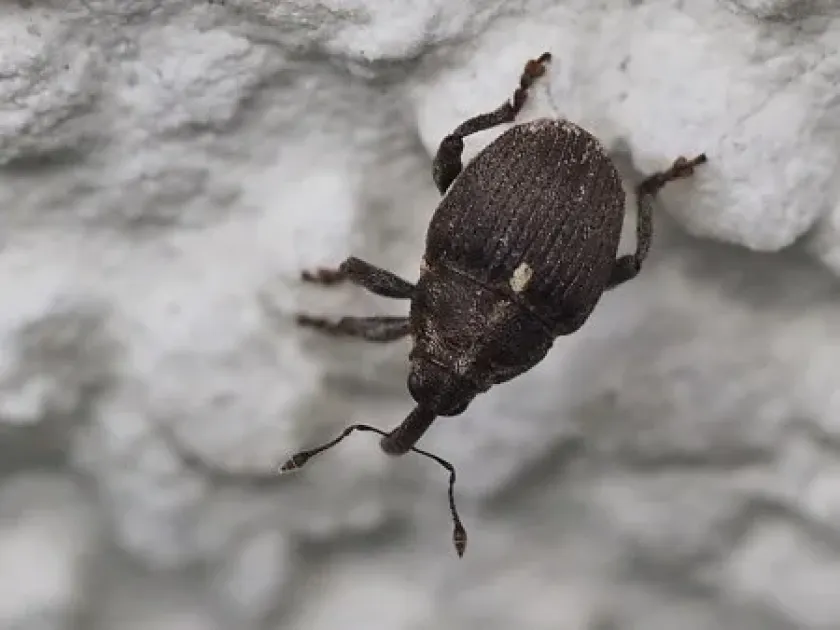
The poppy stem weevil (lat. Glocianus marginatus) belongs to the order Coleoptera, family Curculionidae. This is a small beetle, about 3–4 mm in size, with an elongated body shape and a long, curved snout.
The coloration of the insect is typically dark gray or black, featuring light scales that form spots or stripes on the elytra. The larvae are legless, creamy-white, with a yellowish head, reaching about 5 mm in length.
The beetles are capable of flight but often drop to the ground when threatened, mimicking death, which makes them difficult to detect during field inspections.
Adults overwinter in the soil or under plant debris in fields where poppies were previously grown. In spring, as temperatures rise, they emerge to search for host plants.
The insect's life cycle is closely synchronized with the phenology of the poppy, allowing them to time their emergence from diapause with the appearance of crop seedlings.
What it damages
The main host plant for this species is the poppy, both oilseed and opium varieties. The pest causes significant economic losses in regions where poppy is grown commercially.
The beetles damage young seedlings by chewing small, characteristic holes in leaves and stems. This stunts the plant's growth during its most vulnerable developmental stages.
The larvae are more destructive as they penetrate inside the stem or flower stalk. Inside, they create internal tunnels by feeding on plant tissues.
As a result of internal vascular damage, nutrient flow is disrupted, leading to stunted plant development and a substantial reduction in seed yield.
In cases of heavy infestation, plants may lodge, leaves turn yellow prematurely, and flower heads may wither or fail to develop properly.
When it appears
The emergence of overwintered beetles begins when air temperatures reach 10-12 degrees Celsius, usually coinciding with the rosette stage of the poppy plant.
The mating and egg-laying period is spread out over several weeks, depending on regional climatic conditions, typically occurring during May and June.
The female deposits eggs directly into the tissues of the stems or leaf petioles, choosing the most succulent parts to ensure a food supply for the larvae.
Larvae develop inside the plant for several weeks before exiting to pupate in the soil at a depth of 5-10 centimeters.
A new generation of beetles emerges in late summer, after which they feed actively before preparing for overwintering in the topsoil layer.
Signs of infestation
During the early vegetative stages, the first signs of infestation are small "window-like" holes on the cotyledons and true leaves caused by adult feeding.
Upon inspecting stems, one can observe egg-laying sites marked by small dark spots or depressions surrounded by tissue discoloration.
Wilting of individual flower stalks or lateral shoots is a strong indicator that larvae are present and blocking the internal transport of nutrients.
When an infested stem is cut open, larval excrement and tunnels filled with brown frass can be found, confirming the presence of the poppy stem weevil.
- Yellowing of shoot tips
- Deformation of poppy stems
- Reduction in plant height and biomass
- Smaller seed capsule diameter
Control measures
The most important agrotechnical control method is strict adherence to crop rotation. Poppy should not be planted on the same field more than once every 3-4 years.
Deep autumn plowing after harvest helps destroy a significant portion of larvae and pupae residing in the soil.
Chemical control involves the use of systemic and contact-stomach insecticides during the period of mass beetle emergence on the field.
Monitoring the pest population using yellow sticky traps or regular visual inspections of field margins is highly recommended.
Insecticide applications are most effective during the rosette and early bolting phases, before the larvae have penetrated deep into the plant tissues.
Taxonomy
- Latin name
- Glocianus marginatus
- Order
- Coleoptera (beetles)
- Family
- Curculionidae
- EPPO code
- CEUTSI
Discussion
No discussions yet — be the first.