
Poppy stem weevil
Glocianus maculaalba
Description
How to identify
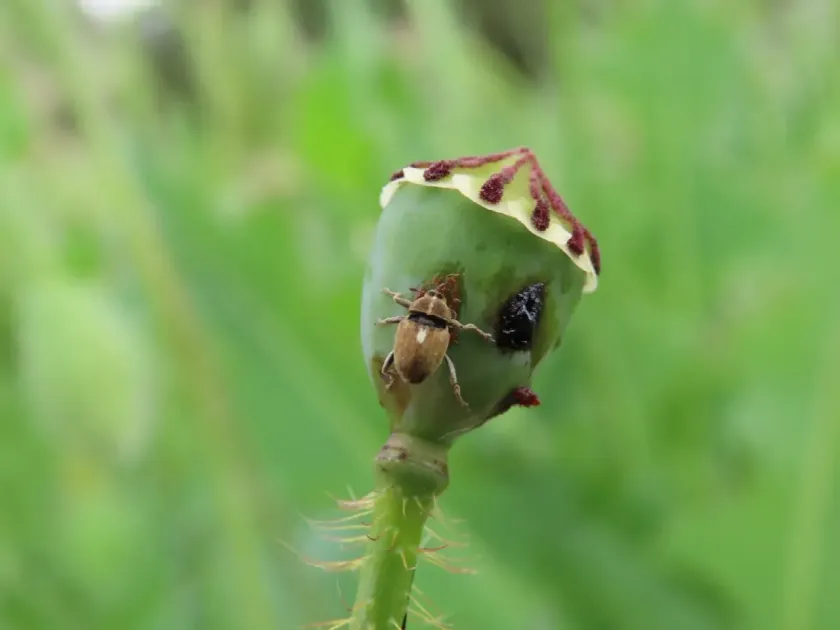
The poppy stem weevil, scientifically known as Glocianus maculaalba, belongs to the Curculionidae family. Adult beetles are small, measuring about 3 to 4 mm in length.
The body of the beetle is covered with grayish-white scales. A distinctive physical feature is a light-colored, shield-shaped mark on its elytra, which makes it identifiable under close inspection.
The larvae are typically legless, cream-colored with a brown head, and exhibit a curved, C-shaped posture. They are internal feeders, developing within the stems or seed capsules of the poppy plant.
Eggs are small, oval-shaped, and yellow. Females deposit these into the plant tissue, a strategy that offers significant protection for the developing offspring against external predators.
Pupation occurs in the soil. Once the larvae complete their feeding stage, they exit the plant, burrow into the ground, and construct an earthen cell to undergo metamorphosis into adult beetles.
What it damages
Poppy stem weevils primarily target oilseed poppy plants. The damage is most severe during the larval stage, which impacts the generative organs and significantly reduces seed yield.
Adult beetles feed on the leaves of the poppy, creating small, irregular perforations. While this defoliation is rarely fatal, it weakens the plant's overall photosynthetic capacity.
The primary economic damage is caused by larvae tunneling through the stem. This disrupts the vascular system, causing stunted growth, physical deformation of the stalks, and wilting.
Larval infestation of the seed capsule is highly destructive. They consume the developing seeds and internal tissues, causing the capsules to turn yellow prematurely and lose their commercial value.
In cases of high infestation rates, the pest can ruin a significant percentage of the harvest, impacting both the quantity of seeds and their oil content, which is critical for agricultural output.
When it appears
Adult weevils overwinter in the soil or under crop residues from the previous season. They emerge in the spring once the soil temperature consistently reaches about 8–10 degrees Celsius.
Upon emergence, adults feed on young poppy shoots to gain the necessary energy for reproduction. This phase is crucial for the early assessment of pest pressure in the field.
Egg-laying typically coincides with the budding and flowering stages of the poppy. During this time, females actively seek healthy plants to provide the best environment for their larvae.
The larval stage lasts throughout the early summer months. Their growth is tightly synchronized with the development of the poppy plant, ensuring that nutrients are available throughout their maturation.
The new generation of adults emerges in the late summer. They may feed on nearby wild host plants from the poppy family before retreating into the soil to begin the overwintering process.
Signs of infestation
Small, irregular holes on the leaves, known as shot-holes, are the first visible indication of adult weevil activity in the poppy field.
Visible bending, twisting, or abnormal thickening of the stems often indicates that larvae are tunneling inside, disrupting the plant's structural integrity.
Premature yellowing of seed capsules, occurring when the rest of the field is still healthy, is a strong indicator of larval infestation within the capsule.
Exit holes found on the surface of the stem or the base of the capsule signify that mature larvae have completed their development and have returned to the soil to pupate.
Overall stunted development and reduced plant vigor across the field are secondary signs, often reflecting a high density of larval tunnels that have compromised nutrient transport.
Control measures
Crop rotation is the most effective cultural method to manage this pest. Poppy should not be replanted in the same area for at least three to four years to break the pest's lifecycle.
Deep autumn plowing of the fields after harvest is essential to expose the overwintering adults to adverse weather conditions and soil predators, significantly reducing their population.
Eliminating weeds related to the poppy family, such as field poppies, is vital as these plants act as alternative hosts that support weevil populations between cropping seasons.
- Application of registered insecticides during the budding phase.
- Monitoring adult populations using yellow sticky traps.
- Harvesting the crop promptly to prevent larvae from migrating into the soil.
Chemical control must be timed precisely to target adult beetles before egg-laying occurs, as the larvae become protected once they bore into the plant tissue.
Taxonomy
- Latin name
- Glocianus maculaalba
- Order
- Coleoptera (beetles)
- Family
- Curculionidae
- EPPO code
- CEUTMA
Discussion
No discussions yet — be the first.