
Toad bug
Gelastocoris
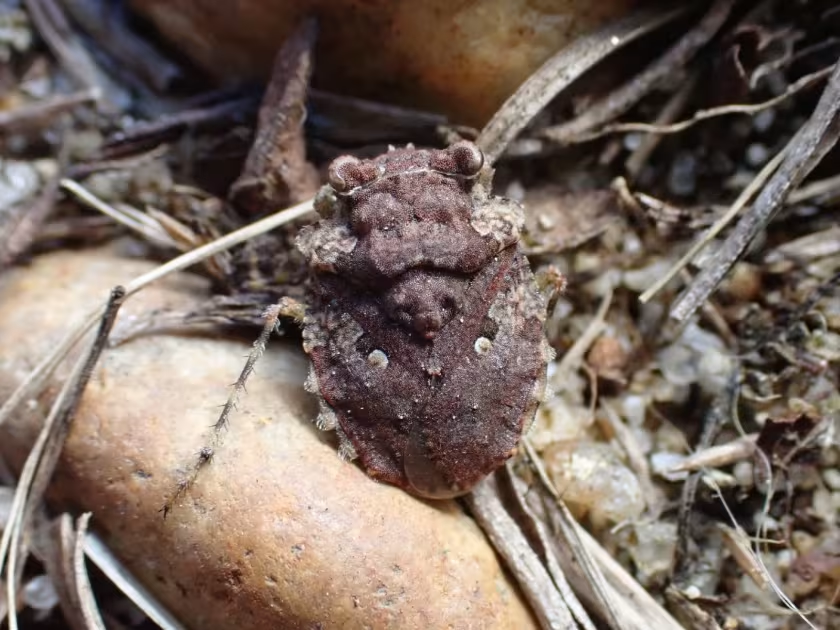
Description
How to identify
Toad bugs, belonging to the family Gelastocoridae, are named for their striking physical resemblance to toads. Their bodies are typically rounded and bumpy, and their eyes protrude significantly from the sides of the head.
Their coloration often mimics the substrate they inhabit, making them masters of camouflage. Unlike many herbivorous insects, they possess powerful forelegs adapted for grasping prey.
Taxonomically, this genus is classified within the suborder Heteroptera. Despite their somewhat menacing common name, they are not major agricultural pests but rather play the role of predators within the ecosystem.
Adult individuals usually measure between 7 and 10 millimeters in length. Their appearance has evolved to facilitate survival in riparian zones, where they spend most of their active life hunting smaller insects.
A distinctive feature of their movement is that they do not fly over long distances; instead, they prefer short hops and rapid dashes across moist soil or sand surfaces.
What it damages
From an agronomic perspective, toad bugs are not classified as dangerous pests of agricultural crops. They are active predators and do not feed on plant saps or tissues.
Their presence in fields often serves as an indicator of healthy biological diversity, as they consume other insects, including minor pests that inhabit the soil or ground surface.
The risk associated with their presence is virtually non-existent, as they lack the piercing-sucking mouthparts capable of causing significant mechanical damage to crop stems or foliage.
Growers should distinguish this species from true pests, such as the shield bug or meadow bug, which cause direct damage to cereal and industrial crops.
Consequently, an economic threshold for damage has not been established for this species, as any form of crop injury caused by them is excluded.
When it appears
The activity of toad bugs is directly correlated with warm weather and the availability of moist substrates. They are most frequently observed from late spring through early autumn.
They prefer damp habitats; therefore, their concentration increases near irrigation canals, water bodies, and fields with high groundwater levels.
During the winter, adults enter diapause, seeking shelter in the soil or under plant debris to survive unfavorable environmental conditions.
The peak of their life cycle occurs during the summer months, when soil temperatures favor the rapid development of larvae, which also lead a predatory lifestyle.
Migration to fields is rare and typically occurs in response to the drying up of their usual water-adjacent habitats.
Signs of infestation
There are no direct signs of crop infestation by toad bugs. Unlike phytophagous insects, they do not leave feeding punctures or necrotic spots on leaves.
Their presence can only be detected by directly inspecting the soil surface near water sources or waterlogged field areas.
Their behavior gives them away: upon sensing human movement or machinery, the bug makes a sharp jump and freezes, successfully mimicking a clod of dirt or a small stone.
The absence of damage on cultivated plants is the primary diagnostic sign confirming that found specimens pose no threat to the crop.
If the destruction of other small insects is observed in the fields, toad bugs may be acting as part of a natural control system for pest populations.
Control measures
Specialized control measures against toad bugs are not required, as they do not inflict damage on agricultural production.
The use of insecticides to eliminate this species is counterproductive, as it disrupts the ecological balance and kills beneficial entomophagous insects.
Agronomic practices, such as draining waterlogged areas, may indirectly reduce their population, but such actions are unnecessary for crop protection purposes.
It is recommended to maintain species diversity in fields, as predatory bug species assist in suppressing the population of harmful soil-dwelling organisms.
- Avoidance of blanket chemical treatments.
- Regular monitoring of entomofauna composition.
- Preservation of natural biocenoses surrounding agricultural fields.
Taxonomy
- Latin name
- Gelastocoris
- Order
- Hemiptera (bugs, aphids, leafhoppers)
- Family
- Gelastocoridae
- EPPO code
- GELASP
Discussion
No discussions yet — be the first.