
Cherry fruit weevil
Furcipus rectirostris
Description
How to identify
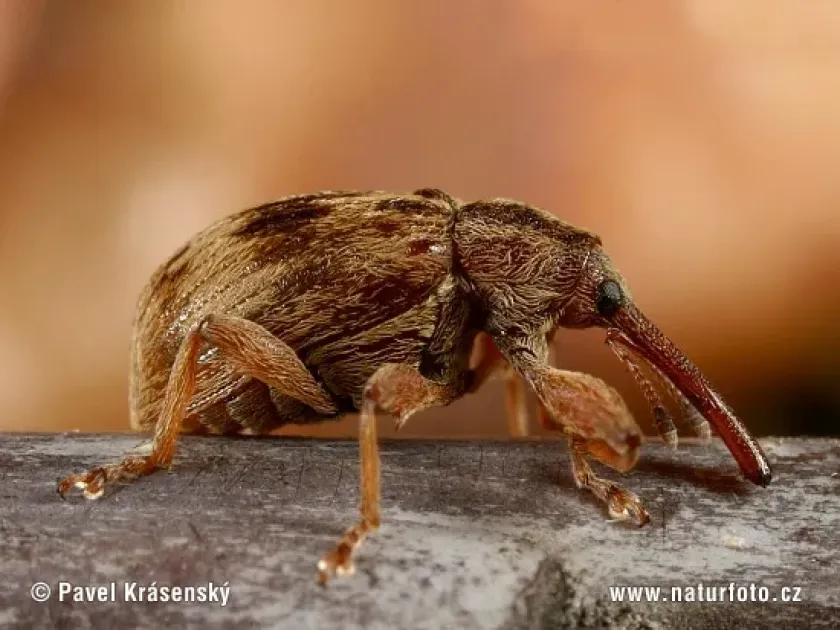
The cherry fruit weevil (Furcipus rectirostris) is a member of the Curculionidae family. Adult weevils are roughly 5–6 mm long and are easily recognized by their distinctively long rostrum or snout, which is used for feeding and laying eggs.
The adult insect displays a coloration ranging from reddish-brown to yellowish-brown, often covered in dense setae (hairs). This appearance provides excellent camouflage against the bark of fruit trees.
The larvae are legless, C-shaped grubs with a shiny, dark-brown head. They grow to approximately 7 mm in length and live exclusively inside the fruit, specifically targeting the seed.
Pupation occurs within the soil under the tree canopy. The pupa is of a free type, which allows it to develop effectively within the top layer of the ground before emerging as an adult in early summer.
Spotting adults is possible during the early spring as they climb into the canopy to feed on swelling buds. Their tendency to drop to the ground when disturbed makes them easier to collect for monitoring.
What it damages
The primary damage is caused by the larvae, which bore into the developing fruit and consume the kernel. This inevitably leads to premature fruit drop and significant yield loss.
Adult weevils cause damage by feeding on buds and blossoms, creating deep puncture holes. This activity can prevent fruit set or damage the reproductive organs of the flower, rendering it infertile.
The cherry fruit weevil affects various stone fruits, including cherries, sweet cherries, plums, and apricots. In untreated orchards, it can render the majority of the crop unmarketable.
Beyond direct consumption, the wounds caused by weevils serve as entry points for pathogens, such as brown rot (Monilinia), leading to rapid spoilage of the fruit.
Economic impact is high because the damage is often irreversible once the larva has entered the stone, meaning preventive measures must be taken before egg-laying occurs.
When it appears
Adults overwinter in the soil at depths of 10–15 cm. They emerge in the spring when temperatures consistently rise above 10–12°C, typically coinciding with the tree's bud-burst phase.
The feeding phase on buds and leaves precedes egg-laying. After the flowers are pollinated and the fruit begins to form, the female weevil bores a hole in the young fruit to deposit an egg.
Larval development takes approximately 30 to 40 days. During this time, the larva matures inside the cherry pit, shielded from direct pesticide contact.
By late June or July, mature larvae exit the fruit and drop to the ground, where they burrow into the soil to pupate and remain in a dormant state until the following spring.
There is one generation per year. This predictable life cycle allows orchardists to target the adult population with precision sprays during the short window between emergence and egg-laying.
Signs of infestation
Small, pin-prick holes on petals or developing buds are the first indicators of adult weevil activity in the orchard canopy.
Dark, discolored spots on the skin of young cherries signify the sites where eggs were laid. These spots often harden as the fruit grows, creating a visual tell-tale sign.
Prematurely yellowing or dropping fruit that appears intact from the outside but contains a hollowed-out or infested pit is a definitive sign of larval presence.
Shaking the branches over a white sheet during the morning hours often reveals the presence of adults, which will remain motionless for several minutes after falling.
Early fruit drop in early summer is a classic indicator that larvae have finished their growth cycle and have exited the fruit to enter the soil.
Control measures
Cultural management includes tilling the soil around the tree base in the autumn to expose overwintering stages to frost and birds, significantly reducing the pest population.
The systematic collection and disposal of fallen fruit (mummies) is crucial, as it removes the larvae before they can return to the soil to complete their life cycle.
Chemical control should be timed to coincide with the period between emergence and the hardening of the fruit stone. Applications are typically recommended before and immediately after flowering.
Monitoring using sticky traps or manual shaking can help determine the density of the weevil population and verify if an insecticide application is necessary.
- Fall tillage of orchard floor.
- Strict sanitation by removing fallen fruit.
- Insecticide application at the bud-burst stage.
- Early morning branch shaking to collect adults.
- Use of pest-monitoring traps.
Taxonomy
- Latin name
- Furcipus rectirostris
- Order
- Coleoptera (beetles)
- Family
- Curculionidae
- EPPO code
- ANTHRE
Discussion
No discussions yet — be the first.