
Atlantic puffin
Fratercula arctica
Description
How to identify
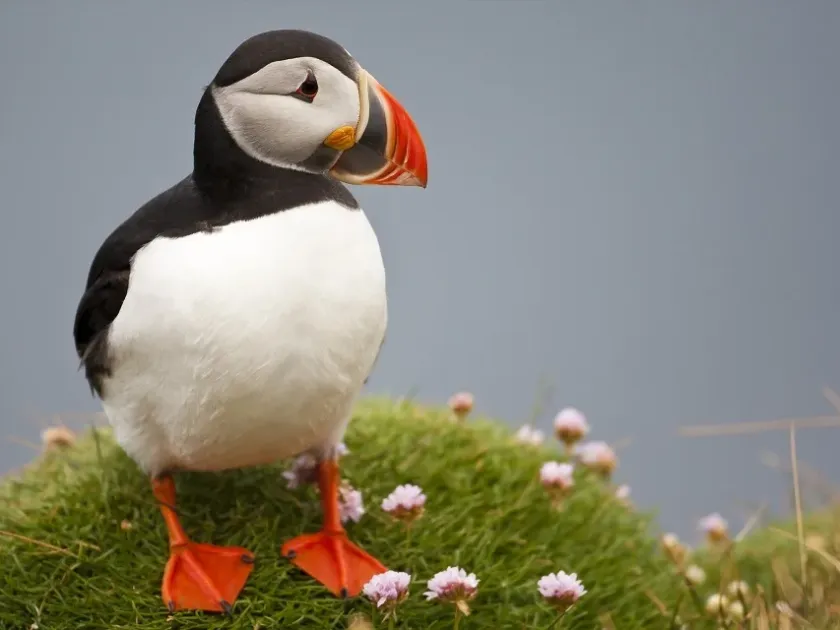
The Atlantic puffin (Fratercula arctica) is a species of seabird in the auk family (Alcidae), order Charadriiformes.
This species is widely recognized for its brightly colored beak and distinct black-and-white plumage.
They are specialized marine birds adapted for swimming and diving in cold northern waters.
Puffins typically nest in colonies, burrowing into soil or utilizing crevices in rocky coastal cliffs.
They are not terrestrial birds and lack any evolutionary adaptations for feeding on agricultural land.
What it damages
The diet of the Atlantic puffin consists entirely of small marine fish and aquatic invertebrates.
They do not consume vegetation, grains, or any parts of agricultural crops, meaning they pose zero risk to farmers.
Scientific literature confirms that these birds are not pests in any horticultural or agricultural context.
Puffins do not damage root systems, leaves, or fruits of cultivated plants during their life cycle.
Therefore, there is no economic loss associated with the presence of puffins near farmland.
When it appears
The breeding season of the Atlantic puffin occurs during the spring and summer months.
Outside of the breeding season, these birds spend their time in the open Atlantic Ocean.
Their life cycle does not intersect with planting, growing, or harvesting seasons of crops.
Seasonal migrations are entirely dependent on marine food availability rather than terrestrial agricultural cycles.
Their presence is confined to isolated coastal areas far from typical agricultural fields.
Signs of infestation
Evidence of a puffin colony includes burrow entrances on coastal slopes or cliff sides.
These burrows do not interfere with soil quality or surrounding vegetation used for cultivation.
There are no signs of crop damage such as peck marks, broken stems, or trampled harvests caused by puffins.
Observers may see high concentrations of birds near their nests, but these are solely coastal interactions.
Any damage found near farms is generally attributable to other local wildlife, not seabirds like puffins.
Control measures
No agricultural control measures are required, as puffins are not considered plant pests.
It is essential to recognize that puffins are a protected species in many jurisdictions due to their conservation status.
Efforts should focus on preserving coastal ecosystems rather than managing these birds as pests.
Standard bird deterrent methods are completely unnecessary and inappropriate for this species.
Coexistence is the standard approach, as puffins and agriculture naturally occupy distinct ecological niches.
Taxonomy
- Latin name
- Fratercula arctica
- Family
- Alcidae
- EPPO code
- FRATAR
Discussion
No discussions yet — be the first.