
Corn thrips
Frankliniella williamsi
Description
How to identify
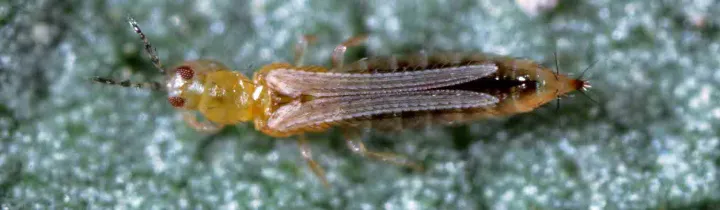
Corn thrips (Frankliniella williamsi) are small, slender insects belonging to the order Thysanoptera and the family Thripidae. Adults are typically 1–1.5 mm long, with a yellowish-brown coloration.
These insects are characterized by two pairs of narrow wings fringed with long hairs, which gives the order its common name. The immature stages, or larvae, resemble miniature adults but lack wings and are generally lighter in color.
The life cycle encompasses several stages: egg, two larval instars, prepupa, pupa, and adult. Pupation often takes place in the soil or protected areas of the plant, such as leaf sheaths.
Reproduction occurs throughout the growing season, as females insert their eggs directly into the epidermal tissue of the leaves or floral parts of the corn plant.
Because they are tiny and tend to hide in secluded parts of the plant like the whorl or leaf sheaths, they are difficult to detect during the early stages of infestation.
What it damages
While corn is the primary host, these thrips can affect various grass species and weeds, which serve as alternative food sources and reservoirs for the population.
Both adults and larvae cause damage by piercing the plant epidermis and sucking out the cell contents, which leads to the collapse and death of individual cells.
Beyond the direct physical damage to cells, corn thrips act as vectors for various plant viruses, potentially introducing diseases that cause significant yield loss and economic impact.
Infestation during the seedling stage is the most critical, as the damage can stunt plant growth, deform leaves, and weaken the corn stalk permanently.
Later in the season, thrips can invade the ears and damage silks, which may interfere with proper pollination and result in poor kernel set and overall reduction in grain quality.
Signs of infestation
The initial signs of infestation include light streaks, silvering, or stippling on the leaves, which are caused by the destruction of cellular tissue during the feeding process.
As the population density increases, leaves may curl, yellow, and undergo premature desiccation, resulting in a stunted appearance of the entire plant.
The presence of tiny black fecal spots on the leaves is a diagnostic sign of thrips activity, distinguishing their feeding damage from other environmental or nutritional issues.
By unrolling the young central leaves of the corn plant, one can usually observe clusters of active larvae and adults hiding within the protected environment of the whorl.
A overall reduction in crop vigor and height compared to healthy fields is a typical indicator that a significant thrips infestation is underway.
Control measures
Integrated pest management begins with weed control, as many weed species act as alternative hosts that maintain thrips populations before they move into corn crops.
Crop rotation and proper planting timing are essential to ensure the crop develops past the highly susceptible seedling stage before the peak thrips migration occurs.
Chemical control usually requires systemic insecticides capable of penetrating the leaf tissues and leaf sheaths to reach the insects, as contact-only sprays may be ineffective.
Monitoring using yellow sticky traps is a recommended practice to track population trends and determine the optimal timing for field intervention if threshold levels are exceeded.
Combining insecticidal seed treatments with follow-up foliar sprays during critical growth stages is the most effective approach for preventing significant economic damage.
Taxonomy
- Latin name
- Frankliniella williamsi
- Order
- Thrips
- Family
- Thripidae
- EPPO code
- FRANWI
Discussion
No discussions yet — be the first.