
Blueberry thrips
Frankliniella vaccinii
Description
How to identify
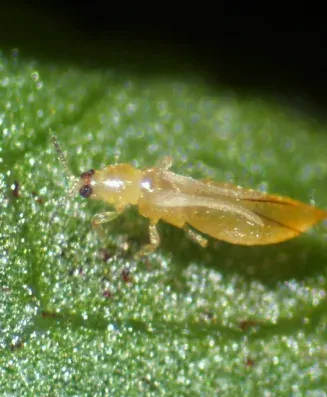
Blueberry thrips (Frankliniella vaccinii) are tiny insects belonging to the order Thysanoptera and the family Thripidae. Adult insects typically measure between 1 to 1.5 mm in length and possess a slender, elongated body, usually brown or yellowish-brown in color.
These pests utilize a piercing-sucking mouthpart to feed on plant juices. They have narrow, fringed wings that allow them to fly efficiently between plants, particularly during warm and calm weather conditions.
The larvae are significantly smaller than adults and often appear translucent, pale white, or yellowish. They are highly mobile and tend to congregate in sheltered areas, such as developing buds or young leaf clusters.
The life cycle encompasses several stages: egg, larva, propupa, pupa, and adult. Due to their rapid reproductive rate, populations can explode within a short period, especially during the peak of the growing season.
Females possess an ovipositor, which they use to insert eggs directly into the tissues of leaves or stems. This reproductive strategy provides protection against environmental stressors and makes them difficult to target with contact insecticides.
What it damages
Blueberry thrips primarily target the blueberry plant (Vaccinium spp.). They are particularly troublesome in both commercial highbush blueberry fields and smaller garden plantings.
Both adults and larvae cause damage by sucking sap from plant cells, which leads to a loss of vigor and potential stunted growth. Heavy infestations can significantly weaken the overall health of the blueberry bush.
The most severe damage occurs during the flowering stage. Thrips feed on the delicate reproductive parts of the flower, often resulting in flower abortion, poor pollination, and a drastic reduction in total fruit yield.
Infested foliage often exhibits characteristic curling, twisting, and whitening of the leaf tissue. This damage interferes with photosynthesis, which is critical for fruit development and plant energy storage.
Fruit quality is also negatively impacted. Berries can become malformed, lose their natural bloom, or develop necrotic spotting, making them aesthetically unappealing and unsuitable for fresh market sales.
When it appears
The activity of blueberry thrips typically begins in early spring, as temperatures rise above 10°C (50°F). Overwintered adults emerge from the soil to colonize newly emerging buds.
The bloom period is the most critical time for monitoring and intervention. During this time, thrips are protected inside the flowers, making them harder to detect and control effectively.
During the summer, multiple generations can occur, with the speed of development being directly linked to temperature. Warm, dry weather conditions often promote rapid population growth and increased activity.
As autumn approaches and temperatures drop, thrips seek out overwintering sites. They typically migrate toward the base of the plant, settling in the upper soil layers or beneath accumulated organic debris.
Climate plays a significant role in population dynamics. While excessive heat and drought favor rapid reproduction, heavy spring rains during the flowering window may naturally suppress local thrips populations.
Signs of infestation
The earliest sign of a thrips infestation is the presence of silvery, stippled areas on leaves and petals. This is caused by cells collapsing after their contents have been removed by the insects.
Bud deformation or premature flower drop is a clear indicator of a significant infestation. When flowers are gently opened, one can often see small, active insects moving inside the bloom.
Small, dark fecal spots, often found on the undersides of leaves or on succulent shoots, are a reliable diagnostic sign. These spots are the result of the insect's intensive feeding activity.
General lack of vigor or stunted branch tips, despite adequate irrigation and nutrient management, should prompt a closer investigation for thrips, especially in the upper canopy of the plant.
- Silvery discoloration of leaves.
- Distorted, curled leaf margins.
- Flower abortion and loss of set fruit.
- Dark, minute fecal spots on plant tissues.
Control measures
Cultural control begins with thorough sanitation. Clearing away weeds and accumulated organic matter from around the base of bushes in autumn significantly reduces the number of overwintering sites.
Blue sticky cards are an effective monitoring tool for determining the onset of adult activity. Placing these cards near the canopy allows growers to time their control efforts more precisely.
Biological controls, such as the use of predatory mites or entomopathogenic fungi (e.g., Beauveria bassiana), can be effective components of an integrated pest management program, particularly in high-humidity conditions.
Chemical intervention with systemic insecticides may be necessary if populations exceed economic thresholds. It is crucial to rotate chemical classes to prevent the development of insecticide resistance.
Maintaining a healthy, well-watered, and properly fertilized blueberry plantation helps plants withstand the stress caused by thrips, while keeping the surrounding area free of secondary host plants can slow the spread of the pest.
Taxonomy
- Latin name
- Frankliniella vaccinii
- Order
- Thrips
- Family
- Thripidae
- EPPO code
- FRANVA
Discussion
No discussions yet — be the first.