
Flower thrips
Frankliniella tritici
Description
How to identify
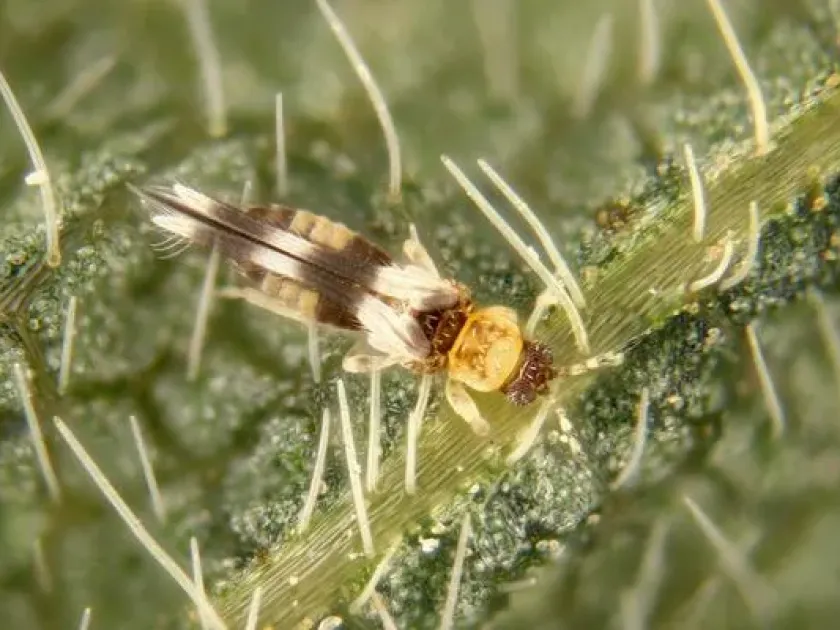
The flower thrips (Frankliniella tritici) is a member of the order Thysanoptera and the family Thripidae. These tiny insects, measuring about 1 to 1.5 mm, possess slender bodies and fringed wings, which are their most distinguishing morphological characteristic.
Adults are usually yellow to brownish-yellow, while the larvae are paler and wingless. They are known for their ability to hide deep within the floral parts of plants, making them extremely difficult to detect during the early stages of an infestation.
The life cycle consists of egg, two larval stages, propupa, pupa, and adult. Development is rapid and highly dependent on environmental conditions, particularly temperature, which can significantly influence the speed of population growth.
These pests are highly mobile and can spread quickly through wind currents or by moving between plants in dense agricultural or horticultural settings.
Proper identification often requires a hand lens or a microscope, as they are easily confused with other thrips species that share similar habitats and appearance.
What it damages
As polyphagous pests, flower thrips attack a vast array of crops, including wheat, vegetables, ornamentals, and various fruits, causing both direct and indirect damage.
They feed by piercing plant cells and sucking out the contents, which leads to the collapse of the epidermis, resulting in silvery or white streaks on leaves and petals.
Damage to the reproductive parts of plants is particularly severe, often causing bud blasting, distorted flowers, and reduced fruit set, which significantly impacts overall crop yields.
Beyond physical damage, they are notorious vectors of plant viruses, most notably the Tomato Spotted Wilt Virus (TSWV), which can have devastating consequences for greenhouse operations.
In high densities, the feeding activity leads to stunted growth, reduced photosynthetic capability, and eventually the death of severely infested plant tissues.
When it appears
Activity generally begins in the spring as temperatures rise, signaling the emergence of adults from their overwintering sites in soil or debris.
Populations tend to peak during the warmest summer months, where the combination of high heat and low humidity creates optimal conditions for multiple overlapping generations to flourish.
In temperate climates, activity tapers off as temperatures drop in autumn, though indoor or greenhouse environments can sustain populations throughout the year.
The duration of a single generation can be as short as two weeks in midsummer, allowing for a rapid population explosion if control measures are not implemented promptly.
Periods of dry weather are particularly favorable for thrips, as rain often washes them off foliage and helps to naturally regulate their numbers to some extent.
Signs of infestation
The most common sign of infestation is the presence of silvery, stippled areas on leaves that later become necrotic and brittle as the tissue dies.
Buds and flowers often show distortion, irregular coloring, or fail to open completely, which is a classic indicator of thrips feeding inside the floral structure.
Tiny black spots of frass (excrement) on the underside of leaves or within the folds of flower petals are strong indicators of an active thrips colony.
Fruit may exhibit scarring, "halo" spots, or malformation, which significantly reduces the aesthetic and commercial value of the produce.
General plant decline, including wilting or loss of vigor, often occurs when the thrips population is large enough to extract significant amounts of plant sap.
Control measures
Integrated Pest Management (IPM) is essential for controlling flower thrips, beginning with the removal of weeds that act as alternative hosts for the pest.
Chemical control should involve rotating insecticides with different modes of action to prevent the development of resistance within the thrips population.
Biological control agents, such as predatory mites (Amblyseius spp.) and minute pirate bugs (Orius spp.), are highly effective in controlled environments like greenhouses.
Blue sticky traps serve as a vital tool for both monitoring the presence of adult thrips and mass trapping to reduce their overall population pressure.
- Use reflective mulches to deter the insects from landing on plants.
- Sanitize tools and structures regularly to prevent cross-contamination.
- Encourage natural predators in the garden through diverse plantings.
- Apply systemic insecticides early in the season when population counts are low.
Taxonomy
- Latin name
- Frankliniella tritici
- Order
- Thrips
- Family
- Thripidae
- EPPO code
- FRANTR
Discussion
No discussions yet — be the first.