
Tomato thrips
Frankliniella schultzei
Description
How to identify
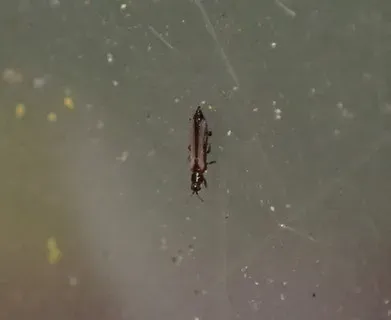
Tomato thrips (Frankliniella schultzei) belongs to the order Thysanoptera and the family Thripidae. These are tiny insects measuring approximately 1 to 1.5 mm in length, characterized by slender bodies and fringed wings.
The adults exhibit color polymorphism, ranging from yellowish to dark brown, which allows them to blend into the foliage. Larvae are generally lighter in color, wingless, and reside primarily in secluded parts of the host plant.
Their lifecycle includes egg, two larval stages, prepupa, pupa, and adult. The developmental rate is highly temperature-dependent, allowing for rapid population growth under warm greenhouse conditions.
Females insert eggs into plant tissues using a saw-like ovipositor. This biological trait makes the eggs protected from many contact-based pesticides, complicating the total eradication of the pest.
Tomato thrips populations are notorious for their ability to thrive in closed environments, often maintaining continuous generations throughout the year without entering true diapause.
What it damages
This species is a highly polyphagous pest that attacks a broad range of crops, including tomatoes, peppers, cucumbers, and many ornamental flower varieties.
The primary concern is its role as a vector for serious plant viruses, most notably the Tomato Spotted Wilt Virus (TSWV). Even a minor infestation can lead to the total collapse of a crop due to viral transmission.
Both larvae and adults cause damage by using their rasping-sucking mouthparts to pierce plant cells and ingest sap. This leads to the destruction of epidermal tissue and significant stress to the host.
Damage symptoms include silvery patches on leaves, leaf distortion, and premature necrosis. Heavy feeding pressure can severely stunt plant growth and reduce fruit quality.
Fruit damage manifests as distorted shapes, scarring, and chlorotic spotting. In severe cases, the fruit becomes unmarketable, leading to substantial economic losses for growers.
Signs of infestation
The first telltale signs are small silvery or bronze patches on the upper surface of leaves. Over time, these patches coalesce into larger discolored areas, leading to leaf wilting and shedding.
Tiny black fecal spots on the underside of leaves are a definitive indicator of thrips presence. Observing the foliage closely often reveals the small, quick-moving adults hidden in the veins.
Deformation of flowers and buds is a common sign of high density. In many cases, buds fail to open properly, or the resulting flowers are stunted and show abnormal patterns.
Growers should use blue sticky traps to monitor for the presence of the pest. These traps are highly effective at catching adult thrips and signaling the need for intervention.
Presence of mottled or ring-spotted patterns on tomatoes often points to viral infection transmitted by thrips, signaling that immediate action is required to stop the spread.
Control measures
An effective control strategy relies on Integrated Pest Management (IPM). Continuous monitoring using blue sticky traps is essential to detect the pest before it reaches outbreak levels.
Cultural practices, such as weed management around greenhouse perimeters, are crucial because many weeds act as alternative hosts for the tomato thrips population during off-seasons.
Biological control agents, such as predatory mites (e.g., Amblyseius cucumeris) and pirate bugs (Orius spp.), are highly effective at suppressing thrips populations in greenhouses.
Chemical control should be implemented judiciously, utilizing systemic insecticides. It is vital to rotate modes of action to prevent the development of insecticide resistance, which is common in thrips.
Sanitation after the harvest is mandatory. Removing all plant debris and disinfecting the greenhouse structure destroys hidden life stages and prevents the pests from carrying over to the next season.
Taxonomy
- Latin name
- Frankliniella schultzei
- Order
- Thrips
- Family
- Thripidae
- EPPO code
- FRANSC
Discussion
No discussions yet — be the first.