
Western flower thrips
Frankliniella minuta
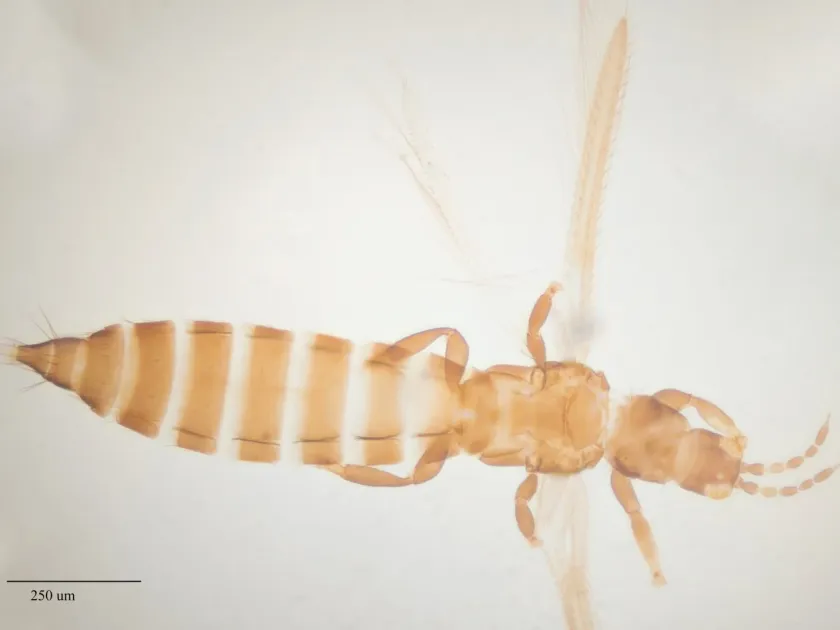
Description
How to identify
The Western flower thrips Frankliniella occidentalis is a small insect belonging to the order Thysanoptera. Adult individuals typically measure between 1 and 2 millimeters in length.
Their bodies are slender and vary in color from pale yellow to dark brown. They possess two pairs of narrow, fringed wings that allow them to fly and be easily dispersed by wind currents.
Identification is best achieved using blue or yellow sticky cards, which attract the adults and help growers estimate the population density within a greenhouse environment.
The life cycle consists of egg, larva, two pupal stages, and adult. The pupal stages usually occur within the soil or in crevices of the host plant.
Due to their small size and rapid reproductive rate, they are often overlooked until a significant population has established, making early detection vital.
What it damages
This pest is highly polyphagous, attacking a wide range of agricultural and ornamental crops, including tomatoes, peppers, cucumbers, and roses.
Thrips feed by piercing the plant cells and sucking out the contents, which causes the epidermal tissue to collapse and die, appearing as silvery scarring.
They are notorious for being vectors of several tospoviruses, most notably the Tomato Spotted Wilt Virus (TSWV), which causes severe crop loss and deformation.
Floral damage is a major economic concern, as the feeding activity on buds and blooms leads to deformed flowers, spotting, and premature petal drop.
In addition to cosmetic and viral damage, heavy infestations weaken the plant's overall health, leading to stunted growth and reduced yields in fruit-bearing crops.
When it appears
In temperate climates, the Western flower thrips is primarily a greenhouse pest, as it thrives in the stable, warm conditions provided indoors year-round.
In open fields, they are most active during warm and dry periods, as their development is accelerated by higher temperatures within the range of 25°C to 30°C.
They can survive in the soil or protected niches during cooler periods, but their development significantly slows down or stops below certain temperature thresholds.
Migration into greenhouses often happens via infested plant material, workers' clothing, or through ventilation systems during the warmer months.
The pest can complete its entire life cycle in as little as 10–14 days under optimal conditions, leading to multiple generations in a single growing season.
Signs of infestation
The first signs of an infestation include small, silvery, or bronzed patches on the leaf surface, which represent areas where cell contents have been removed.
Tiny black spots of excrement left on the undersides of leaves are a diagnostic indicator of the presence of thrips populations.
Buds may become distorted, fail to open, or show brown necrotic spots on the petals when they eventually bloom.
Young, rapidly growing tissue, such as terminal shoots, often becomes curled and twisted, displaying symptoms of stunted or erratic growth.
If you tap a leaf or flower over a white piece of paper, the dislodged adults, which look like tiny, fast-moving threads, will become clearly visible.
Control measures
Integrated Pest Management (IPM) is the most effective approach, focusing on exclusion, monitoring, and the use of biological control agents.
Sanitation is critical; all plant debris, especially old flowers and foliage, should be removed and destroyed to break the life cycle of the pest.
Chemical control should be used judiciously, rotating different modes of action to prevent the development of resistance, which is common in this species.
Biological control agents, such as predatory mites (e.g., Amblyseius cucumeris) and pirate bugs (Orius spp.), can be highly effective in reducing populations.
- Use blue sticky traps for monitoring and mass trapping.
- Maintain adequate humidity, as thrips prefer drier air.
- Screen greenhouse vents to prevent insect migration.
- Utilize entomopathogenic fungi as part of a biological control program.
- Thoroughly inspect new plants before introducing them into a clean area.
Taxonomy
- Latin name
- Frankliniella minuta
- Order
- Thrips
- Family
- Thripidae
- EPPO code
- FRANMI
Discussion
No discussions yet — be the first.