
Tobacco thrips
Frankliniella fusca
Description
How to identify
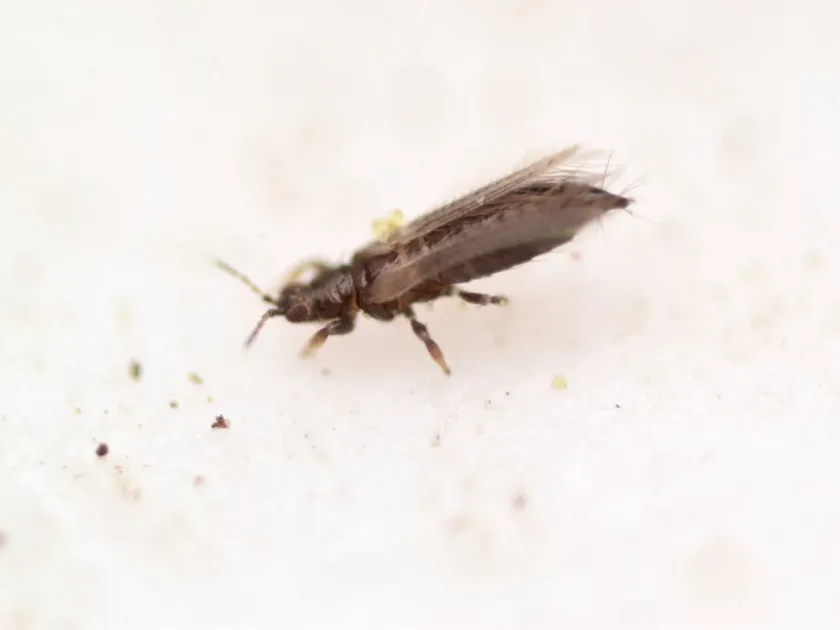
Tobacco thrips (Frankliniella fusca) is a small insect belonging to the order Thysanoptera and the family Thripidae. These pests are typically around 1 mm in length with slender bodies.
Adults possess fringed wings, which they use for short-distance flight and dispersal. Their color ranges from light yellow to dark brown, often allowing them to blend in with plant tissue.
The life cycle includes egg, two larval instars, prepupa, pupa, and adult stages. Notably, the pupal stage often occurs in the soil, providing protection from contact insecticides.
They can reproduce both sexually and through parthenogenesis. This high reproductive rate allows populations to explode under warm and dry environmental conditions.
Tobacco thrips are highly mobile and can be easily transported by wind or human activity, facilitating their spread across large agricultural areas and greenhouses.
What it damages
These insects are polyphagous, attacking a wide range of hosts including tobacco, cotton, soybeans, peanuts, and various vegetable crops like tomatoes and cucumbers.
By feeding on plant cell contents, thrips cause significant cellular destruction. This results in stippling, chlorosis, and general leaf curling, which reduces the plant's photosynthetic capacity.
Beyond direct feeding damage, they are notorious vectors for tospoviruses, specifically the Tomato Spotted Wilt Virus (TSWV), causing systemic infection and massive yield losses.
In heavy infestations, flowers may abort, and fruit may become scarred or deformed, significantly reducing the marketability and quality of the harvested product.
The damage is often progressive, starting from the lower leaves and moving upwards as the population increases and food resources are depleted.
Signs of infestation
The earliest symptom is the presence of tiny, silvery, or bleached spots on the foliage. These are caused by the thrips puncturing cells and sucking the sap.
Curling, twisting, and bronzing of leaves are classic signs of heavy infestation. Affected plants often exhibit stunted growth and an overall unhealthy appearance.
Black fecal deposits on the undersides of leaves act as clear diagnostic indicators for the presence of thrips colonies within the canopy.
In flowering plants, deformed buds and discolored petals are frequently observed, indicating that thrips are feeding within the developing floral structures.
Monitoring with yellow or blue sticky cards provides an objective measure of pest presence, allowing growers to initiate control measures before irreversible damage occurs.
Control measures
Integrated Pest Management (IPM) is essential for controlling tobacco thrips. This begins with sanitation, including the removal of weeds that serve as alternate hosts.
Cultural practices such as deep tillage help disrupt the pupal stages of the insect in the soil, effectively reducing the overwintering population for the next season.
Chemical control involves the use of effective insecticides. Rotating modes of action is critical to manage insecticide resistance, a common issue with this pest.
Biological control agents, such as predatory mites and pirate bugs, can be highly effective in greenhouse environments where pest populations are managed more intensely.
Proper irrigation and fertilization help plants compensate for damage, though these measures must be paired with direct control to maintain yield under high pressure.
Taxonomy
- Latin name
- Frankliniella fusca
- Order
- Thrips
- Family
- Thripidae
- EPPO code
- FRANFU
Discussion
No discussions yet — be the first.