
Bruner's flower thrips
Frankliniella bruneri
Description
How to identify
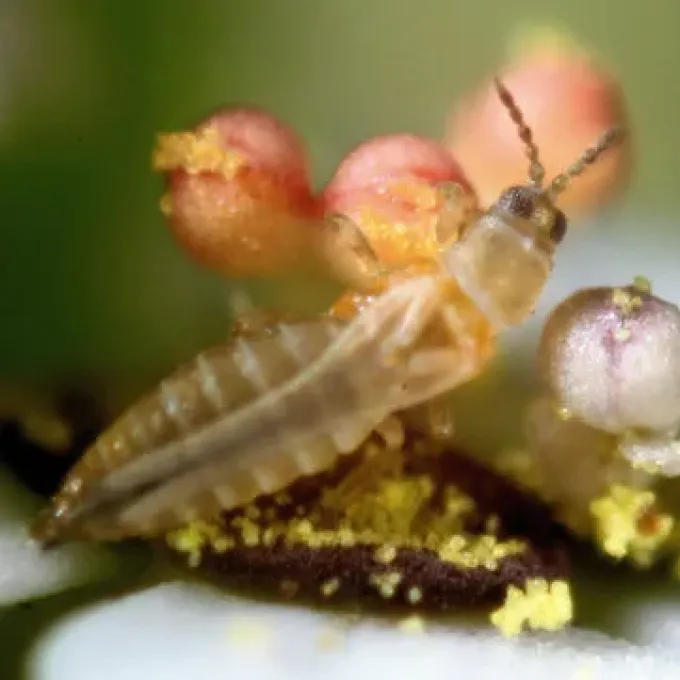
Bruner's flower thrips (Frankliniella bruneri) belong to the order Thysanoptera, family Thripidae. These are minute, slender insects typically measuring 1 to 2 mm in length, often yellowish or brownish in color.
Their key physical characteristic is the presence of narrow wings fringed with long hairs, which is the defining feature of the Thysanoptera order. They possess piercing-sucking mouthparts used for feeding on plant juices.
The life cycle is relatively complex, consisting of egg, two larval instars, prepupa, pupa, and adult stages. This rapid development allows them to complete multiple generations within a single season.
They are known for their cryptic behavior, preferring to hide in secluded areas like flower buds, leaf axils, and tight spaces, making them difficult to detect until the population has increased significantly.
Warm, stable conditions, particularly those found in greenhouses, provide an ideal environment for this species to thrive and spread rapidly between host plants.
What it damages
As a polyphagous pest, Frankliniella bruneri affects a wide range of horticultural, vegetable, and ornamental plants, including tomatoes, peppers, and various cut flowers.
They cause damage by piercing plant cells and extracting the contents. This leads to the collapse of the epidermis, resulting in silvery or necrotic patches on leaves and petals.
Infested plants show signs of stunted growth, leaf deformation, and blossom failure. In severe cases, the entire plant may wither due to the loss of nutrients and water.
Beyond direct feeding damage, these thrips are vectors for several critical plant viruses, which can lead to rapid transmission of diseases throughout a crop field or greenhouse.
Economic damage is most significant in ornamental floriculture, where even minor scarring or discoloration caused by thrips feeding renders flowers unsuitable for market.
Signs of infestation
The earliest signs of infestation are light-colored streaks or silvering on leaves, often concentrated along the veins where the thrips tend to congregate.
Tiny black spots on the underside of leaves or within flower buds are a clear indicator of the presence of thrips, representing their excrement and confirming their active feeding.
Deformation of young foliage and twisting of shoot tips are common symptoms that suggest an established colony is present and actively consuming tender plant tissues.
Flower buds that fail to open properly or exhibit mottled, discolored petals are classic indicators of a Frankliniella bruneri infestation in greenhouse settings.
Monitoring using blue sticky cards often reveals the presence of adult thrips before visible plant damage becomes widespread, allowing for proactive intervention.
Control measures
Integrated Pest Management (IPM) is essential for controlling this pest, combining biological, cultural, and chemical approaches for maximum efficacy.
Cultural practices should focus on sanitation, including the removal of weeds that act as alternative hosts and the proper disposal of infested plant material after harvest.
Biological control agents, such as predatory mites (e.g., Amblyseius species) and minute pirate bugs (Orius), are highly effective at suppressing thrips populations in protected agriculture.
Chemical control should be implemented judiciously, focusing on rotating different classes of insecticides to prevent the development of resistance in the thrips population.
- Regular monitoring using blue sticky traps.
- Sanitization of soil and growing media to remove pupae.
- Rigorous inspection of all new plant materials entering the greenhouse.
Taxonomy
- Latin name
- Frankliniella bruneri
- Order
- Thrips
- Family
- Thripidae
- EPPO code
- FRANBU
Discussion
No discussions yet — be the first.