
Frankliniella brevicaulis
Frankliniella brevicaulis
Description
How to identify
Frankliniella brevicaulis belongs to the order Thysanoptera and the family Thripidae. This tiny insect is often difficult to detect with the naked eye due to its small body size and secretive behavior.
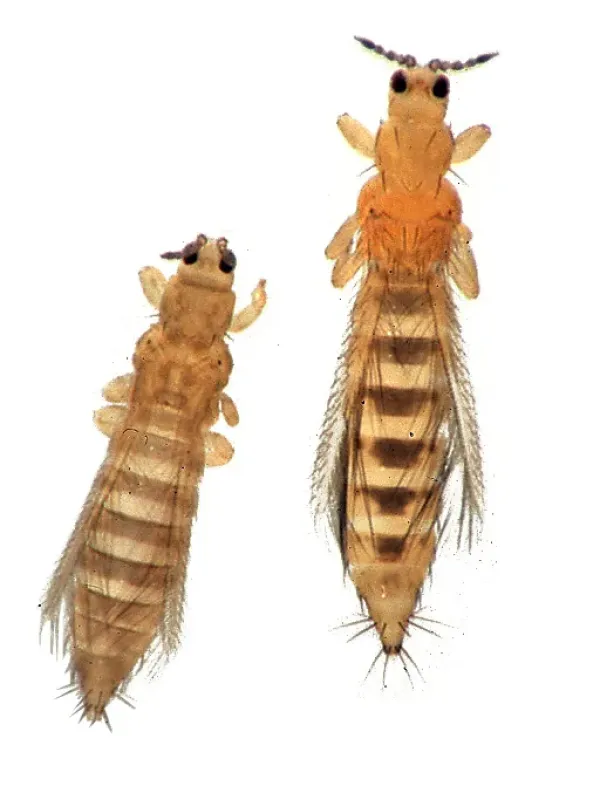
Adult individuals have a slender body approximately 1–2 mm long, typically yellowish-brown or brown in color. They possess fringed wings, which are a characteristic feature of all thrips, enabling active movement in search of food sources.
Larvae look similar to adults but lack wings and are generally lighter, often translucent. They undergo several developmental stages, including inactive pupal stages that frequently take place within the soil substrate.
Precise species identification requires microscopic examination of the head structure and setae on the body. Field diagnostics are often challenging due to the visual similarity of this species to other Frankliniella members.
This pest prefers environments with moderate humidity and temperature, often aggregating in inflorescences, flower buds, and on young, tender leaves, which complicates visual inspection during regular monitoring.
What it damages
This thrips species is a polyphage, meaning it feeds on a wide range of host plants. Primary targets include members of the Solanaceae, Asteraceae, and Fabaceae families, covering both vegetable and ornamental crops.
The pest causes damage in both open-field conditions and greenhouse facilities. Plants in the budding phase are particularly vulnerable as the insects congregate in delicate flower parts, extracting cell sap from the tissues.
In addition to direct damage through sap feeding, Frankliniella brevicaulis can act as a vector for various plant viral diseases. Even low population numbers can lead to significant reductions in the market value of the harvest.
Leaf damage appears as bleached spots or streaks, which may merge over time, eventually causing tissue necrosis. Characteristic black fecal spots are often found at the feeding sites of larvae and adults.
Under mass outbreak conditions, the pest can completely destroy the reproductive organs of the plant, causing premature flower drop and fruit deformation, which drastically reduces overall yield and product quality.
When it appears
The life cycle of Frankliniella brevicaulis is closely linked to climatic factors and photoperiod. In temperate climates, it becomes active in late spring with the onset of the mass flowering period of most crops.
Population peaks typically occur during summer months when higher temperatures accelerate the insect's metabolism. In greenhouses, development can occur year-round provided there is an available food source and suitable microclimate.
Within a single season, the pest can produce several generations, as the developmental cycle from egg to adult can take as little as 2–3 weeks under favorable conditions.
Adult overwintering often occurs in the top layer of soil or in plant debris, allowing them to successfully survive harsh conditions. With the return of warmth, insects emerge from their wintering sites and migrate to weeds.
The migration of pests from weed hosts to cultivated crops is a critical window for initiating protection measures, as this is the period when rapid colonization of the plot can still be prevented.
Signs of infestation
The first sign of infestation is the appearance of small silvery spots on the upper leaf surface, caused by tissue destruction and air filling the cells. This is a typical reaction to the piercing-sucking feeding of thrips.
During inflorescence inspection, one may notice deformation of petals, changes in coloration, and wilting. Heavily infested buds often fail to open and drop off prematurely.
On the undersides of leaves, slight curling is often observed, within which individual insects may be found. When shaking inflorescences over a white sheet of paper, the insects become visible as moving specks.
The presence of tiny black fecal droppings on the surface of leaves and flowers is an indirect but highly reliable confirmation of thrips colony activity on that specific plant area.
- Yellowing and deformation of terminal growth points.
- Silvery-colored film on leaf blades.
- Necrotic spot appearance on petals.
- Abscission of buds and ovaries without obvious causes.
- Specific feeding tracks resembling dark specks.
Control measures
Controlling Frankliniella requires an integrated approach, as this species is highly mobile and can quickly develop resistance to insecticides if they are managed improperly.
Agrotechnical measures include removing weeds near fields and greenhouses that act as pest reservoirs. It is crucial to practice crop rotation and properly dispose of post-harvest debris where pupae may overwinter.
Biological control methods involve the use of natural enemies, such as predatory mites (e.g., Amblyseius) or predatory bugs (e.g., Orius), which effectively reduce thrips populations in closed environments.
Chemical control consists of applying contact-stomach insecticides. It is recommended to rotate products from different chemical classes to prevent the pest from developing resistance to active ingredients.
The use of blue sticky traps allows for the early detection of the pest and monitoring of its population density, enabling the implementation of protection measures at the early stages of infestation.
Taxonomy
- Latin name
- Frankliniella brevicaulis
- Order
- Thrips
- Family
- Thripidae
- EPPO code
- FRANBV
Discussion
No discussions yet — be the first.