
Florida flower thrips
Frankliniella bispinosa
Description
How to identify
The Florida flower thrips (Frankliniella bispinosa) belongs to the order Thysanoptera and the family Thripidae. These are tiny insects typically measuring between 1 and 2 mm in length.
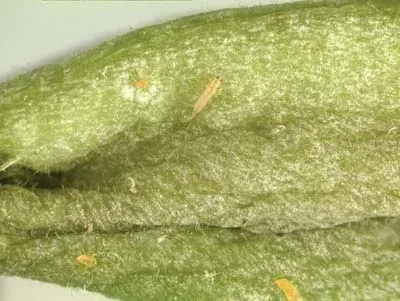
Adults have an elongated body that varies in color from pale yellow to light brown. A distinctive feature is their narrow wings fringed with long hairs, which allow them to be easily dispersed by wind currents.
The life cycle consists of several stages: egg, two larval instars, prepupa, pupa, and adult. Development is very rapid under high temperatures, leading to explosive population growth.
Larvae resemble adults in appearance but are smaller and wingless. They are highly active and feed intensely on plant tissues during their growth period.
In nature, this pest prefers a hidden lifestyle, sheltering deep inside flowers, buds, or leaf axils, making early detection a significant challenge for growers.
What it damages
This species is a polyphage and causes significant damage to a wide range of crops. It primarily attacks ornamental plants, including roses, chrysanthemums, and various citrus varieties.
In the agricultural sector, the pest is frequently found on strawberries, vegetable crops, and fruit trees, feeding on the tender parts of the plants.
The pest is also capable of causing severe losses in greenhouse environments, where the lack of natural predators allows its numbers to multiply rapidly.
Thrips are also vectors for several phytopathogenic viruses, making them a serious threat to commercial nurseries and large-scale greenhouse production.
The damage manifests as weakened plant vigor, reduced yields, and significant loss of marketability for flowers and fruits due to discoloration and scarring.
When it appears
The activity of the Florida flower thrips is directly linked to temperature. The most favorable conditions are found during warm spring and summer months.
In southern regions or greenhouse settings, the pest can remain active year-round, continuously reproducing on available host plants.
Population peaks usually coincide with mass flowering, as insects migrate onto buds to feed and lay their eggs in the developing flower tissues.
Under adverse conditions, development may slow down, yet the species' high plasticity allows it to recover quickly once environmental conditions improve.
Monitoring for the pest should begin as soon as the first buds appear, utilizing blue or yellow sticky traps to detect early infestations.
Signs of infestation
The first sign of an infestation is the appearance of small silvery spots or streaks on flower petals and the surface of young leaves.
Affected buds often become deformed, fail to open properly, or drop prematurely, significantly reducing the aesthetic value of the plants.
Tiny dark spots, representing the pest's excrement, can be observed on the underside of leaves near the feeding sites.
Severe infestations lead to leaf curling and the development of chlorotic zones, which may eventually necrotize due to secondary infections.
For accurate identification, gently tap a flower over a sheet of white paper; the tiny, rapidly moving insects will become visible against the white background.
Control measures
Effective control of Florida flower thrips requires an integrated management approach that combines cultural and chemical practices.
- Removal of weed hosts surrounding growing areas.
- Regular sanitation to clear plant debris from greenhouses.
- Use of biological control agents like predatory mites or bugs.
- Application of systemic insecticides during peak activity periods.
- Deployment of colored sticky traps for monitoring and suppression.
It is crucial to rotate insecticides from different chemical classes to prevent the development of resistance, to which this pest is highly prone.
Special attention must be paid to treating the undersides of leaves and deep within floral structures, where the insects tend to congregate.
Taxonomy
- Latin name
- Frankliniella bispinosa
- Order
- Thrips
- Family
- Thripidae
- EPPO code
- FRANBI
Discussion
No discussions yet — be the first.