
Western flower thrips
Frankliniella
Description
How to identify
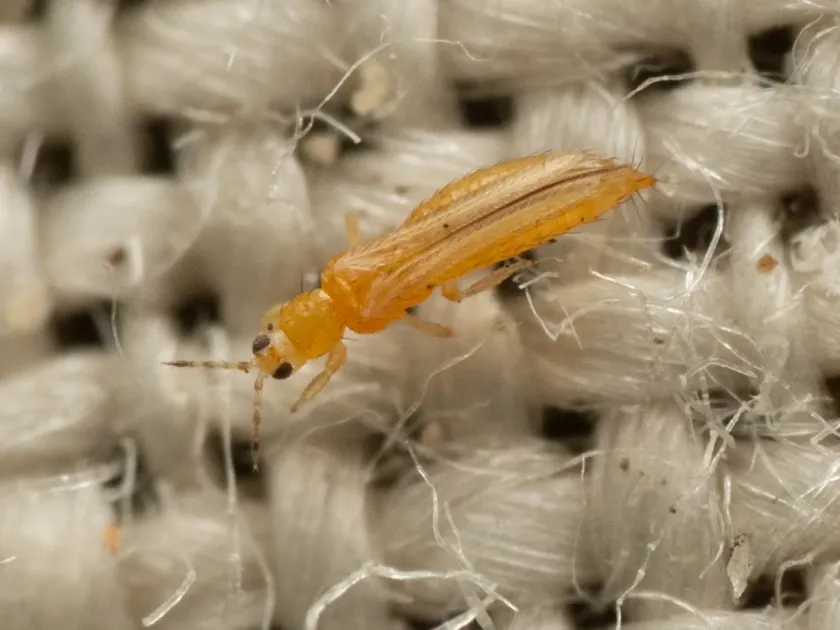
The Western flower thrips (Frankliniella occidentalis) is a significant pest belonging to the order Thysanoptera and the family Thripidae. These are tiny insects, measuring about 1–2 mm in length, with elongated bodies ranging in color from yellow to brown.
Adults possess two pairs of narrow wings fringed with hairs, which gives the order its common name. Larvae resemble adults in body shape but lack wings and are typically lighter in color, appearing creamy or yellowish.
The life cycle consists of egg, two larval stages, prepupa, pupa, and adult. Notably, the prepupal and pupal stages often occur in the soil or growing medium, which protects them from many foliar treatments.
They thrive in warm, humid conditions, with temperatures between 25–30°C being optimal. In greenhouses, they can complete their life cycle in as little as two weeks, leading to multiple generations per year.
Due to their small size and cryptic habits, identifying them requires careful inspection of growing points and the use of blue sticky traps for early detection.
What it damages
As a highly polyphagous pest, the Western flower thrips attacks over 500 plant species, including vegetables like peppers, cucumbers, and tomatoes, as well as ornamentals like roses and chrysanthemums.
The damage is caused by piercing and sucking plant juices, which leads to the collapse of epidermal cells. This results in stippling, silvering, and necrotic spots on the leaf surface.
This species is a notorious vector for several tospoviruses, most notably the Tomato Spotted Wilt Virus (TSWV). The transmission of these viruses is often more damaging than the feeding injury itself.
Feeding on flower buds causes deformed blooms, irregular growth, and premature senescence. In fruit crops, feeding on young ovaries can lead to scarring and misshapen fruit development.
Heavy infestations can result in total crop failure, particularly in high-value ornamental production where cosmetic quality is essential for marketability.
Signs of infestation
Early symptoms include tiny, pale, or silvery specks on leaves. As feeding continues, these spots coalesce, giving the foliage a dull, bleached appearance.
The presence of small, black, shiny fecal droplets on the underside of leaves is a definitive sign of an active thrips population.
Look for deformed, twisted leaves or terminal growth, which occurs when the insects concentrate their feeding on young, tender plant tissues.
In infested flowers, the petals may show streaks or discoloration. In many cases, buds may fail to open properly or may drop prematurely due to severe stress.
Monitoring using blue sticky traps is essential; large numbers of adult thrips trapped indicate a need for immediate intervention before the population explodes.
Control measures
Effective management of Western flower thrips requires an Integrated Pest Management (IPM) approach that integrates cultural, biological, and chemical strategies.
Cultural control involves stringent sanitation, such as removing weeds that serve as alternate hosts and ensuring that plant material brought into the greenhouse is pest-free.
Biological control agents, such as predatory mites (Amblyseius cucumeris) and minute pirate bugs (Orius spp.), are highly effective at suppressing populations in protected environments.
When using insecticides, it is critical to rotate chemical modes of action to delay the development of resistance, as this pest is known to develop tolerance very rapidly.
- Use blue sticky cards for population monitoring.
- Release predatory mites and pirate bugs as a preventative measure.
- Rotate chemical products to avoid resistance development.
- Maintain strict greenhouse hygiene and remove plant debris.
- Use fine-mesh screening on greenhouse vents to prevent immigration.
Taxonomy
- Latin name
- Frankliniella
- Order
- Thrips
- Family
- Thripidae
- EPPO code
- FRANSP
Discussion
No discussions yet — be the first.