
European spruce bark beetle
Fortiborus pilifer
Description
How to identify
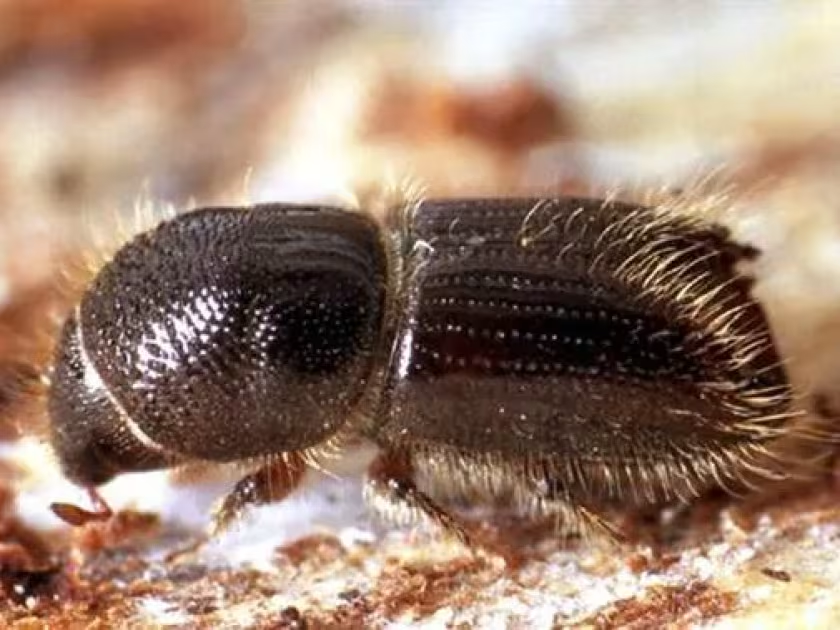
The European spruce bark beetle is a small insect belonging to the Curculionidae family. It typically measures between 4 to 5.5 millimeters in length with a dark, cylindrical body.
The posterior end of its elytra features a distinct concave depression lined with four pairs of teeth, which is a key diagnostic characteristic for field identification.
Larvae are small, white, legless grubs with a brown head capsule that live entirely beneath the bark, creating extensive galleries that disrupt the tree's vascular system.
The pupal stage is also white and develops within small chambers located at the end of the larval tunnels before transforming into the adult form.
Due to their cryptic lifestyle, these beetles are rarely seen on the surface, spending most of their life cycle under the bark of coniferous hosts.
What it damages
This beetle primarily targets Norway spruce, though it can infest other spruce, pine, or larch species, especially when trees are weakened by environmental stress.
By excavating galleries in the phloem, the beetles effectively girdle the tree, blocking the transport of nutrients and moisture, which leads to rapid tree decline.
Mass outbreaks can destroy vast tracts of forest in a single season, transforming vibrant green stands into grey, leafless landscapes that are highly susceptible to fire.
The galleries facilitate the entry of blue-stain fungi and other pathogens that further accelerate the decay process and degrade the quality of the timber.
Economic damage is substantial, as infested timber loses its commercial value and the costs of clearing dead stands are significantly high for forest owners.
When it appears
Adult emergence typically begins in early spring, triggered by ambient temperatures rising above 16-18 degrees Celsius, when beetles swarm to find host trees.
The beetle can produce multiple generations per year, depending on the thermal regime, which allows the population to grow exponentially during long, warm summers.
Throughout the growing season, adult beetles search for new trees to colonize, with activity levels peaking during mid-summer heatwaves or drought events.
As temperatures drop in autumn, beetles move to their overwintering sites, primarily in the leaf litter or in the thick bark at the base of spruce trees.
Monitoring during the spring flight period is crucial, as this is the most effective time to intervene and prevent the establishment of new infestation patches.
Signs of infestation
Visible brown wood dust, known as frass, appearing on the bark crevices and at the base of the tree is the primary indicator of an active infestation.
Trees undergoing attack may exhibit sudden color changes in their needles, turning from healthy green to yellowish, and finally to a brick-red color as the tree dies.
Tiny, round entry holes in the bark, often accompanied by resin flow on the trunk, indicate that the beetles have successfully begun their gallery construction.
When the bark is partially removed, a signature pattern of galleries is visible: a central maternal tunnel with numerous side larval galleries extending outwards.
Increased woodpecker activity on specific trees can also serve as a biological indicator, as they hunt for the larvae hidden beneath the bark layer.
Control measures
Sanitary felling and immediate removal of infested timber are the most effective management practices to lower beetle population pressure in forest areas.
Pheromone traps are widely used for monitoring population dynamics and capturing adult beetles during the main flight periods to reduce local densities.
In high-value areas like botanical gardens or private estates, chemical treatment or trunk injection with authorized insecticides can protect individual trees.
Trap trees, which are intentionally left or freshly cut to attract beetles, can be used to lure the insects and then debarked or removed before larvae develop.
Maintaining forest health through proper spacing and moisture management is the best long-term strategy to increase tree resistance to bark beetle attacks.
Taxonomy
- Latin name
- Fortiborus pilifer
- Order
- Coleoptera (beetles)
- Family
- Curculionidae
- EPPO code
- FORTPI
Discussion
No discussions yet — be the first.