
Faustinus
Faustinus
Description
How to identify
Faustinus is a genus of beetles belonging to the family Curculionidae (weevils), which includes several species that pose a significant threat to tropical and subtropical agroecosystems. These insects are characterized by a specific morphological structure typical of the Curculioninae subfamily.
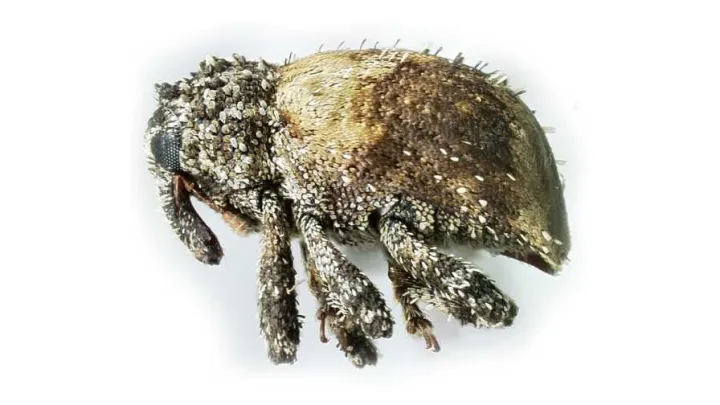
Adult beetles have an elongated body covered with scales and a characteristic long rostrum (snout). Their coloration typically varies from brown to almost black, providing excellent camouflage on the bark and stems of host plants.
The larvae of these beetles have a typical weevil morphology—legless, white or cream-colored, with a brown head capsule. They lead a concealed lifestyle, developing inside plant tissues, which makes their early detection extremely difficult.
Systematically, the genus belongs to the order Coleoptera. Unlike many other pests, Faustinus exhibits a high degree of host specialization, making it particularly dangerous when introduced into new regions.
Determining the specific identity often requires entomological analysis of genitalia, as species within the genus can be morphologically similar and difficult to distinguish even for trained experts.
What it damages
The primary crops damaged by representatives of this genus are solanaceous plants, particularly potatoes and various wild nightshades. The pest can cause severe damage to plantations, significantly reducing total yields.
Adult beetles feed primarily on leaves, leaving characteristic holes or notches along the leaf margins. However, the main economic damage is caused by the larvae, which reside inside stems and tubers.
By boring into the shoots, the larvae create tunnels that disrupt the normal flow of nutrients and water within the plant. This leads to wilting, shoot deformation, and the premature death of the vegetative part of the crop.
Damage to tubers by larvae renders the produce unfit for market and long-term storage. Affected areas become entry points for secondary fungal and bacterial infections.
In intensive agricultural regions, the damage from Faustinus can reach 30–50% of the harvest if appropriate monitoring and population control measures are not implemented.
When it appears
The life cycle of Faustinus is closely linked to the phenology of the host plant and environmental temperature. In tropical conditions, reproduction can occur almost year-round provided there is an available food source.
Adults are active during warm periods, which is when mating and egg-laying occur in plant tissues. Females typically deposit eggs into small cavities gnawed into stems or the bases of shoots.
The larval stage is the longest and occurs directly within the plant tissue. The pupal stage also often takes place in a protected environment—either inside the stem or in the topsoil layer near the damaged plant.
Development of a single generation can take from several weeks to several months, depending on weather conditions and the availability of nutrients in the host plant.
Population peaks usually coincide with the active vegetative growth phase of the crop, when the concentration of moisture and nutrients in the stems reaches its maximum.
Signs of infestation
The first clear sign of infestation is the appearance of small holes in the leaves and the presence of frass (excrement) on the surface of the stems. Puncture marks made by females during egg-laying are also noticeable on the stems.
Visible wilting of plant tops without obvious causes during dry weather often indicates internal larval damage. Cutting open a stem usually reveals winding tunnels and the larvae themselves.
On affected tubers, small entry holes surrounded by darkened tissue can be observed. During storage, such tubers rot quickly due to larval activity and the development of associated microflora.
Gradual yellowing and dropping of lower leaves can be a consequence of the disruption of the stem's vascular system, damaged by the feeding larvae.
The presence of adult beetles on the underside of leaves during the evening is a confirmation of site infestation and the need for immediate control measures.
Control measures
Effective management of Faustinus is based on an integrated approach combining agrotechnical, biological, and chemical methods. Strict quarantine control during the movement of planting material is the foundation of management.
Agrotechnical methods include crop rotation, where solanaceous crops are not replanted in the same field for at least 3–4 years. Destroying post-harvest residues, where larvae and pupae may survive, is an essential element.
Chemical control involves the use of systemic insecticides capable of penetrating plant tissues to target larvae located inside the stems. Applications should be timed to coincide with the periods of greatest adult activity.
Biological control can include the use of entomopathogenic fungi and nematodes, which effectively suppress larval stages in the soil or within plant stems.
- Use of healthy, certified seed material.
- Timely weeding of wild solanaceous plants (pest reservoirs).
- Regular monitoring of plantations using pheromone traps.
- Deep plowing of soil after harvest to destroy pupae.
Taxonomy
- Latin name
- Faustinus
- Order
- Coleoptera (beetles)
- Family
- Curculionidae
- EPPO code
- FAUSSP
Discussion
No discussions yet — be the first.