
Lesser house fly
Fannia canicularis
Description
How to identify
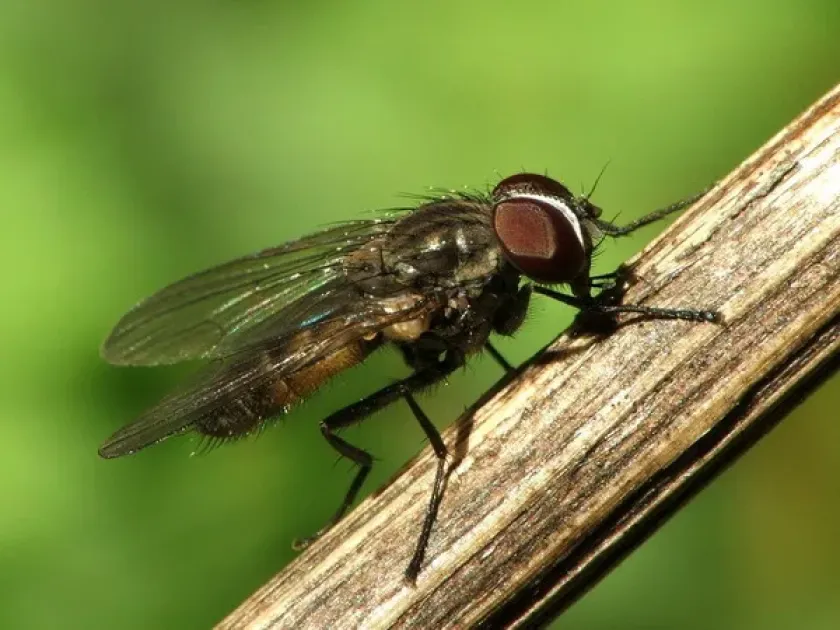
The lesser house fly (Fannia canicularis) is a member of the family Fanniidae. It is slightly smaller than the common house fly, typically reaching 5–6 mm in length.
Adult males are characterized by their distinct flight pattern, often hovering in mid-air in dark or semi-shaded indoor environments with jerky, zigzag movements.
Larvae are easily identifiable by their flattened, spiky appearance, featuring lateral processes with feathery bristles along their entire body length.
The overall coloration is grayish-black. Their wings are held overlapping in a parallel position when at rest, which is a key trait for accurate identification.
The life cycle is temperature-dependent and can be completed in as little as 15 days under optimal greenhouse conditions, facilitating rapid population growth.
What it damages
The primary damage is caused by larvae that feed on decaying organic matter, but they frequently attack the roots and stems of young seedlings in moist soil.
By consuming root tissues, the larvae inhibit the plant's ability to absorb water and nutrients, leading to stunted development and yellowing of the foliage.
The insect acts as a significant vector for bacteria and fungal pathogens, which can exacerbate the impact of the physical damage caused by the larvae.
In high-density greenhouse production, larval feeding creates entry points for soil-borne diseases like root rot, which can lead to seedling damping-off.
Heavy infestations can significantly lower the quality and vigor of ornamental plants and vegetable transplants, causing economic losses for growers.
When it appears
The lesser house fly is most active during the spring and summer, but in heated greenhouses, the life cycle may continue throughout the winter months.
Population peaks are generally associated with periods of high humidity and the use of organic soil amendments that haven't been fully decomposed.
Temperatures ranging from 20°C to 25°C are ideal for rapid reproduction, allowing multiple generations to occur within a single growing season.
During cooler periods, adult flies may aggregate in barns, storage sheds, or greenhouses, acting as reservoirs for future infestations in the crop.
Consistent management of the greenhouse environment, particularly moisture control, is crucial to limit the seasonal proliferation of this pest.
Signs of infestation
Visible swarms of flies performing erratic, zigzag flight paths around lights or in the upper reaches of the greenhouse are a primary sign of infestation.
Examining the soil surface or organic potting mix may reveal the presence of the distinctively flattened, bristle-covered larvae feeding near the roots.
Plants may show symptoms of poor root health, such as wilting during the brightest part of the day, stunted growth, and a general lack of vigor.
The presence of fecal spots on leaves or equipment indicates a significant population of adult flies within the facility, necessitating immediate action.
Small, irregular necrotic patches on the root system or the base of the stem can be a direct result of larval activity in the growth medium.
Control measures
Effective management begins with strict sanitation, including the removal of decaying organic material and the use of well-composted soil additives only.
Sticky traps, particularly yellow or blue models, are highly recommended to monitor adult fly populations and provide a degree of biological control.
Biological treatments involving entomopathogenic fungi can be applied to the soil to target and suppress the larval population without chemical residues.
Proper irrigation management is essential; avoiding overwatering and ensuring good drainage prevents the soil conditions that attract egg-laying females.
- Use fine mesh screening on greenhouse vents to exclude adults.
- Ensure rapid turnover of plant debris and dead organic matter.
- Conduct regular monitoring and inspection of young seedling trays.
Taxonomy
- Latin name
- Fannia canicularis
- Order
- Diptera (flies)
- Family
- Fanniidae
- EPPO code
- FANNCA
Discussion
No discussions yet — be the first.