
Exophthalmus similis
Exophthalmus similis
Description
How to identify
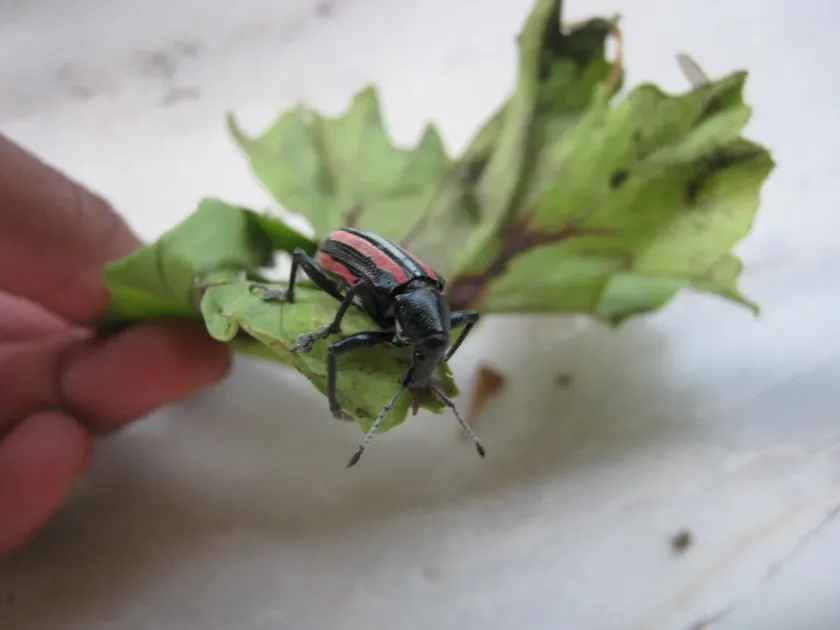
Adults of Exophthalmus similis are medium-sized beetles belonging to the Curculionidae family, characterized by a prominent snout (rostrum).
The body coloration typically ranges from dark brown to greyish tones, providing effective camouflage against the bark and foliage of host plants.
The exoskeleton is covered with dense scales, which give the weevil a dull or slightly metallic appearance under specific lighting conditions.
As a member of the order Coleoptera, this species exhibits a typical development cycle, with adults being primarily leaf-feeders in their active stage.
The rostrum structure is a key morphological feature used by entomologists for accurate identification within the genus Exophthalmus.
What it damages
This weevil primarily impacts citrus crops, including oranges, lemons, and limes, often causing significant stress to young trees in plantation settings.
Adults feed on leaf margins, creating distinctive notches that reduce the photosynthetic capacity of the plant and mar the aesthetic quality of foliage.
Larval stages are subterranean and feed on the roots and root collar bark, which can lead to severe nutrient deficiencies and tree decline.
Heavy infestations can result in stunted growth, yellowing of the leaves, and in extreme cases, the mortality of young citrus saplings.
Root damage also opens entry points for soil-borne pathogens, potentially leading to secondary fungal or bacterial infections in the root system.
When it appears
The life cycle of Exophthalmus similis is highly dependent on regional climate patterns, particularly rainfall and temperature fluctuations.
Adult activity typically peaks during the flush of new vegetative growth, when the availability of succulent leaves is high.
Development from egg to adult occurs over several months, with larval stages spending the majority of their time within the soil profile.
In tropical and subtropical climates, breeding can be continuous, leading to overlapping generations and persistent pressure on the crops.
Environmental factors, especially soil moisture, play a crucial role in the survival rate of the pupae and the timing of adult emergence.
Signs of infestation
Visible signs of infestation include irregular "notched" patterns on the leaf edges, a classic indicator of adult weevil feeding activity.
Systemic weakness in trees, such as chlorosis or premature leaf drop, may indicate underlying larval damage to the root system.
- Feeding notches along the leaf margins.
- Reduced vigor and stunted branch development.
- Presence of adult beetles on foliage during early morning inspections.
- Evidence of gnawing on the root collar bark near the soil line.
- Decreased fruit yield and poor quality of harvested citrus.
The presence of adult beetles can often be confirmed by shaking branches over a cloth or using sticky traps during the night or early morning.
Control measures
Effective management of Exophthalmus similis requires an integrated approach that targets both the foliar adult population and soil-dwelling larvae.
Foliar applications of insecticides are recommended during the peak adult activity window to reduce foliage damage and mating success.
Soil-applied systemic insecticides or biological controls, such as entomopathogenic nematodes, can be used to manage larval populations in the root zone.
Cultural practices, such as maintaining weed-free orchard floors, can reduce alternative host availability and disrupt the weevil's life cycle.
Regular monitoring using pheromone or light traps is essential for timely intervention, ensuring that control measures are applied when they are most effective.
Taxonomy
- Latin name
- Exophthalmus similis
- Order
- Coleoptera (beetles)
- Family
- Curculionidae
- EPPO code
- EXOHSI
Discussion
No discussions yet — be the first.