
Evetria colfaxiana
Evetria colfaxiana
Description
How to identify
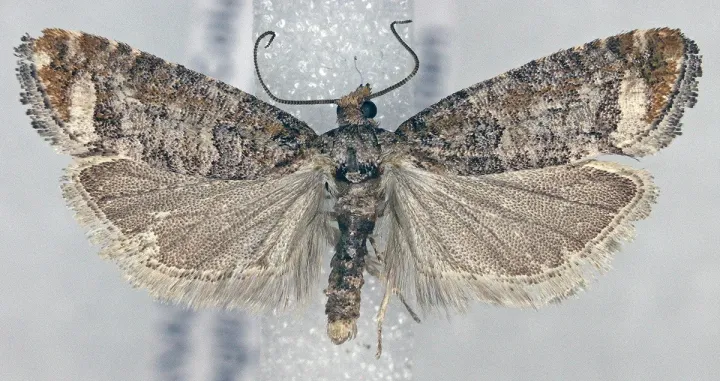
Evetria colfaxiana (often referred to as Dioryctria colfaxiana) is a moth species belonging to the family Tortricidae. These moths are generally small, with a wingspan ranging between 20 to 25 millimeters.
The adult moths exhibit cryptic coloration, featuring mottled brown and grey patterns that allow them to blend into the bark of coniferous trees perfectly. Larvae transition through several stages, changing from a pale yellow to a reddish-brown color as they mature.
The life cycle of this species is highly synchronized with the reproductive cycle of host conifers. This specialization allows the insect to effectively exploit cone development for its offspring.
Typically, this species completes one generation per year. Overwintering occurs primarily in the pupal or late larval stage, often within forest litter or deep crevices in the tree bark.
In the spring, adults emerge and lay eggs directly onto developing cones. This placement ensures that newly hatched larvae have immediate access to the internal tissues of the cones.
What it damages
The larvae primarily feed on the cones of conifers, with a particular preference for Spruce (Picea) and Douglas-fir (Pseudotsuga). Their feeding activity results in significant losses in seed production.
Larvae bore into the cone, damaging the scales and the central core. This destruction disrupts the maturation process and prevents the development of healthy, viable seeds.
Infested cones typically show signs of deformation and premature browning or drying. Under high population densities, the pest can ruin a vast majority of the cone crop in a given area.
Beyond the direct loss of seeds, the tunnels created by the larvae provide entry points for secondary pathogens, such as fungi, which further degrade the health of the host tree.
Because the larvae reside inside the cones, the full extent of the damage is often not apparent until the cones fail to open or fall prematurely.
Signs of infestation
The primary diagnostic sign of an infestation is the presence of frass (larval excrement) appearing on the surface of young cones, indicating that a larva has bored inside.
As the larvae feed, the cones lose their healthy green appearance, turning prematurely yellow or reddish-brown. Resin flow is often visible around the entry holes as the tree attempts to seal the wounds.
Closer examination may reveal silken webbing between cone scales, which the larvae use for protection and to stabilize the cone structures during their feeding period.
Early abscission or dropping of immature cones during mid-summer is a clear indicator that a substantial infestation is present in the canopy.
After the larvae have completed their development and the adults have emerged, empty tunnels and exit holes remain on the woody central stems of the cones.
Control measures
Chemical control using systemic insecticides is most effective when applied during the period of peak moth flight and egg-laying, preventing larvae from successfully entering the cones.
Biological control methods, such as the application of Bacillus thuringiensis, offer a more environmentally friendly approach to managing larval populations in forest settings.
Sanitation practices, including the collection and destruction of infested cones, are critical for reducing the local population and preventing the buildup of wintering pupae.
Monitoring programs utilizing pheromone traps are essential for timing control measures accurately, ensuring maximum efficacy and reducing the need for broad-spectrum pesticides.
Promoting a healthy ecosystem that supports natural predators, including parasitoid wasps and insectivorous birds, is a vital long-term strategy for managing this pest sustainably.
Taxonomy
- Latin name
- Evetria colfaxiana
- Order
- Lepidoptera (butterflies)
- Family
- Tortricidae
- EPPO code
- EVETCO
Discussion
No discussions yet — be the first.