
Tea shot hole borer
Euwallacea similis
Description
How to identify
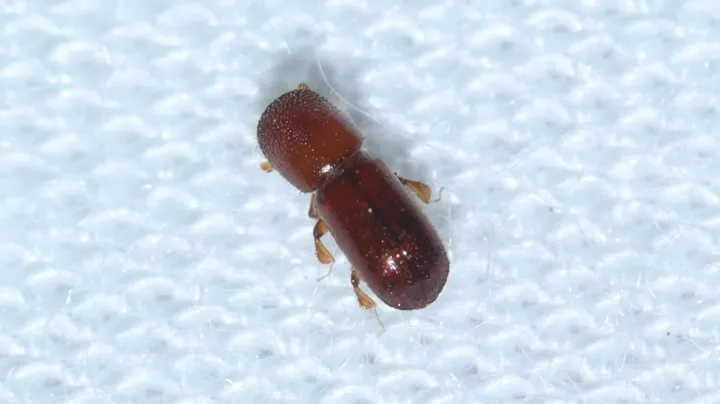
The tea shot hole borer, scientifically known as Euwallacea similis, belongs to the Curculionidae family and the Scolytinae subfamily. It is a tiny beetle, typically measuring between 2 to 2.5 mm in length.
Adults possess a dark brown or black cylindrical body. The surface of the elytra is covered with fine punctures and hairs, which serve as a diagnostic feature for identifying this specific species.
The larvae are legless, white-colored, and curved in shape, typical of most bark beetles. They develop exclusively within wood tissues, feeding on "ambrosia" fungi introduced into the galleries by the adult beetles.
Females are crucial for the species' dispersal, as they are capable of active flight over significant distances to locate suitable host plants for establishing new colonies.
The biology of this species is deeply linked to symbiotic fungi, which serve as the primary food source for the larvae. This fungal association makes the borer a particularly dangerous pest, as the mycelium spreads rapidly through the tree's vascular system.
What it damages
The tea shot hole borer is a polyphagous pest that attacks a wide variety of woody plants and shrubs. Its host list includes tea bushes, citrus, avocado, mango, cocoa, and numerous forest tree species.
While the pest poses a significant threat to weakened or stressed trees, it can also attack healthy and vigorous plants if the population density reaches high levels.
The primary damage results from the excavation of numerous radial tunnels within the trunks and branches. This causes mechanical damage to the xylem and disrupts the normal flow of water and nutrients within the plant.
In addition to physical tissue damage, the beetles introduce pathogenic fungi into the tree. The fungal mycelium clogs the vascular vessels, leading to leaf wilting, branch dieback, and eventually the death of the entire plant.
The economic impact on tea and fruit plantations can be catastrophic, as infested plantations often require total removal and replanting because affected areas cannot be easily recovered.
When it appears
The activity of adult tea shot hole borers is directly dependent on environmental temperature. In tropical and subtropical regions, the pest remains active almost year-round.
In regions with distinct seasonality, peak flight and reproductive activity typically occur during warmer periods. Beetles begin to emerge from old tunnels to colonize new plants at the start of spring.
The life cycle from egg to adult occurs relatively quickly under favorable conditions, allowing the species to produce several generations within a single calendar year.
High humidity levels promote both fungal growth and the survival of the young generation of beetles, which is why population outbreaks often coincide with rainy seasons.
Overwintering of adults and larvae occurs deep inside the wood of the host plant, providing them with reliable protection against external environmental stressors and temperature fluctuations.
Signs of infestation
The first visual sign of a borer infestation is the appearance of tiny entry holes on the bark, with diameters barely reaching 1-2 mm.
A characteristic "frass" or boring dust can often be observed around these holes, as beetles push fine sawdust out while excavating tunnels deep into the trunk.
Drops of gum or resin may ooze from the bark surface at infestation sites, which is the tree's defensive reaction to the beetle's attempt to penetrate the wood.
As the infestation progresses, leaves may yellow and drop prematurely, and specific branches may begin to dry out, becoming brittle and prone to breakage.
- Presence of a network of small holes on the bark.
- Accumulation of wood dust at the base of the trunk.
- Sudden crown wilting without obvious cause.
- Dark staining on branch cross-sections, indicating fungal infection.
Control measures
The primary control method involves strict orchard sanitation: all infested branches and dead trees must be promptly removed and destroyed by burning.
Chemical control is difficult because the beetles live protected inside the wood, making contact insecticides largely ineffective against adult stages.
Systemic insecticides may be used as a preventative measure; however, they do not guarantee full protection when the pest population density is high in the area.
It is essential to maintain tree health through proper irrigation, fertilization, and expert pruning, as stressed trees are significantly more attractive to wood borers.
In some regions, pheromone traps are successfully used to monitor populations, allowing for timely intervention and containment strategies to prevent the spread of the pest across the plantation.
Taxonomy
- Latin name
- Euwallacea similis
- Order
- Coleoptera (beetles)
- Family
- Curculionidae
- EPPO code
- XYLBSI
Discussion
No discussions yet — be the first.