
Tea shot hole borer
Euwallacea perbrevis
Description
How to identify
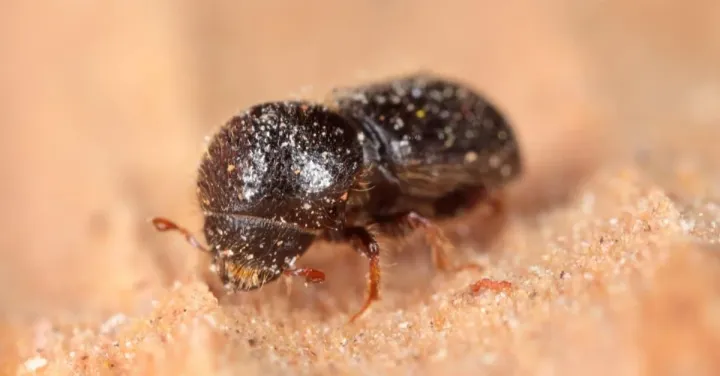
The tea shot hole borer (Euwallacea perbrevis) is a small beetle belonging to the Curculionidae family and the Scolytinae subfamily. Adults are cylindrical in shape, measuring approximately 2–2.5 mm in length, with a dark brown to black coloration.
A distinctive feature of this species is its symbiotic relationship with fungi of the genus Fusarium. Adult females carry fungal spores in specialized body structures called mycangia, which they use to inoculate their tunnels, creating a food source for their larvae.
The entire life cycle occurs within the host plant's tissues. Males of this species are significantly smaller, possess reduced wings, and rarely emerge from the galleries, where mating takes place.
Because they lead a hidden lifestyle, these beetles are difficult to spot on the bark. Identification relies primarily on inspecting signs of damage and using pheromone traps to monitor population levels.
As an invasive species in many parts of the world, this beetle poses a significant threat to agricultural stability, making early detection vital for effective management of infested areas.
What it damages
The tea shot hole borer has a wide host range, affecting both woody trees and important agricultural crops. Common targets include tea bushes, cacao, coffee, as well as various hardwoods like maple, avocado, and eucalyptus.
The primary danger lies not in the physical damage from boring, but in the infection of the plant with pathogenic fungi. As the beetle constructs its tunnels, it introduces spores that thrive and cause systemic vascular disease within the plant.
These fungal infections disrupt water and nutrient transport, leading to gradual branch dieback and, eventually, the death of the entire tree over one or more seasons. Young seedlings are particularly vulnerable and can succumb rapidly.
Severe economic losses are frequently recorded in commercial plantations where the beetle reduces both plant vigor and overall yield, often necessitating the complete removal of infected crops.
The beetle's ability to adapt to a broad spectrum of tree species makes it a persistent and dangerous threat to both natural forest ecosystems and commercial agricultural operations.
Signs of infestation
The most prominent sign of an infestation is the appearance of tiny entry holes on the bark, approximately 1 mm in diameter, which look similar to marks made by a fine drill bit.
Often, wood dust or "frass"—a characteristic byproduct of the beetle's tunneling process—can be seen accumulating near the entry holes or on the branches below the infestation site.
Necrotic patches or localized wilting on the bark surface are common, often resulting from the fungal infection introduced by the beetles. Branches may show signs of yellowing and premature drying without any clear external cause.
If an infested branch is cut open, dark, fungal-stained galleries can be observed inside, providing definitive proof of the beetle's colony and the associated spread of the pathogen within the plant tissue.
In advanced cases, the entire tree crown may appear sparse, with significant leaf drop and widespread dieback of skeleton branches, indicating that the infestation is well-established.
Control measures
The primary control strategy involves sanitary pruning and the immediate destruction of infested plant materials, preferably through burning, to prevent the spread of the beetle to healthy trees.
Chemical insecticides are generally ineffective against this pest due to its protected lifestyle deep within the wood, making preventive measures and early detection the cornerstones of any management program.
Maintaining good agricultural practices, such as proper irrigation and fertilization, helps reduce plant stress, which in turn makes trees less susceptible to initial colonization by the borer.
Research into biological control methods, including the use of entomopathogenic fungi or natural predators, is ongoing but currently faces challenges regarding implementation in large-scale agricultural settings.
Regular monitoring of plantings throughout the growing season is essential to identify new infestations quickly, allowing for prompt intervention before the pest can cause extensive damage to the entire orchard or plantation.
Taxonomy
- Latin name
- Euwallacea perbrevis
- Order
- Coleoptera (beetles)
- Family
- Curculionidae
- EPPO code
- EUWAPE
Discussion
No discussions yet — be the first.