
Kuroshio shot hole borer
Euwallacea kuroshio
Description
How to identify
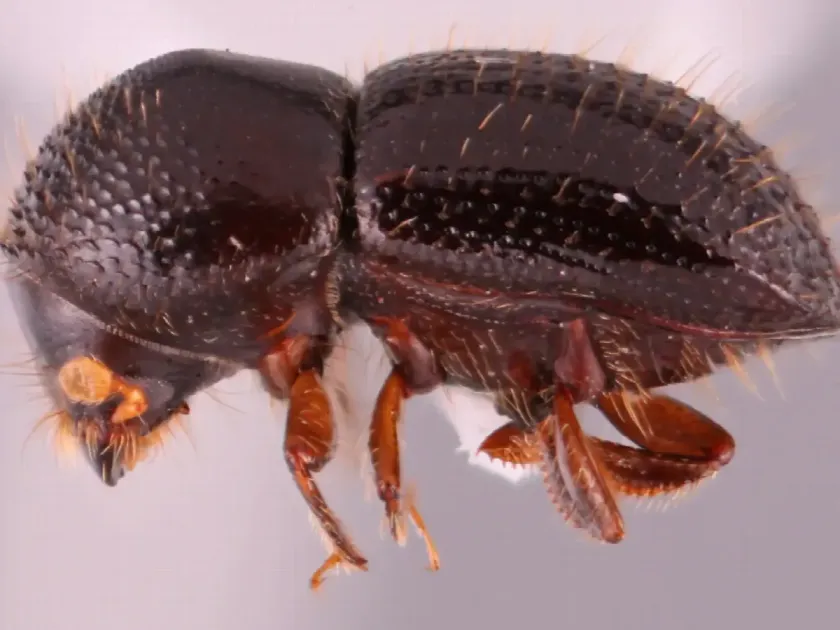
The Kuroshio shot hole borer (Euwallacea kuroshio) is a small beetle belonging to the Curculionidae family. Measuring only about 2 mm in length, these beetles are dark brown to black in appearance.
This species is a wood-boring beetle that maintains a symbiotic relationship with Fusarium fungi. Females possess specialized structures called mycangia, which they use to carry fungal spores to new host trees.
Their life cycle is unique because they do not eat wood directly. Instead, they cultivate fungal gardens within the galleries they excavate, and both larvae and adults feed on this fungus as their primary nutrient source.
The entire developmental process, from egg to adult, occurs within the host tree's galleries. This protected environment makes the insect difficult to target with conventional surface pesticides.
Females are the primary agents of dispersal, flying to new hosts to establish new fungal farms. This behavior allows the population to expand rapidly throughout susceptible tree species and forested areas.
What it damages
The Kuroshio shot hole borer is a significant polyphagous pest, attacking a wide range of trees including avocado, citrus, oak, willow, sycamore, and various ornamental species.
The most severe damage is caused by the associated fungus, Fusarium euwallaceae, which the beetle introduces into the wood. The fungus clogs the tree’s vascular system, leading to a condition known as Fusarium dieback.
As the tree's water transport system is compromised, leaves begin to wilt, and branches die back. In highly susceptible trees, this can result in the rapid death of the entire tree.
Although the beetle's entry holes are small, the combination of mechanical tunneling and the rapid spread of the fungal pathogen makes this pest a serious threat to ecosystem health.
In agricultural settings, particularly in orchards, an infestation can cause total crop loss and the complete removal of infected plantings to protect surrounding healthy trees.
Signs of infestation
The most recognizable sign of an infestation is the presence of small, round entry holes, roughly the size of a ballpoint pen tip, scattered across the bark of the trunk or branches.
Often, weeping or sap staining is visible around these entry holes. In some cases, a white, powdery residue or frass (boring dust) can be seen accumulating near the base of the tree.
Foliar symptoms include yellowing, wilting, and premature leaf drop. These symptoms are caused by the blockage of the xylem by the fungal infection introduced by the beetles.
When the bark is carefully peeled away, characteristic dark, necrotic staining can be observed in the wood surrounding the beetle galleries, indicating the localized spread of the Fusarium fungus.
Branch dieback is a common late-stage symptom, where individual branches or sections of the canopy turn brown and die, signaling significant structural damage to the tree's internal systems.
Control measures
Effective management relies heavily on strict sanitation. Infected branches or entire trees should be pruned or removed and disposed of immediately, preferably by chipping or burning, to kill the beetles inside.
Monitoring is crucial for early detection. The use of specific trap types and visual inspections of susceptible host trees can help identify an infestation before it spreads widely.
Chemical control is challenging due to the beetle's lifestyle deep within the wood. While systemic insecticides may provide some level of protection for healthy trees, they are not a cure for already infested ones.
Quarantine and movement restrictions on wood products, green waste, and firewood are essential to prevent the spread of this invasive species into non-infested regions.
Maintaining tree vigor through appropriate irrigation and care is recommended as a general preventative strategy, although it cannot guarantee total immunity against heavy beetle attacks.
Taxonomy
- Latin name
- Euwallacea kuroshio
- Order
- Coleoptera (beetles)
- Family
- Curculionidae
- EPPO code
- EUWAKU
Discussion
No discussions yet — be the first.