
Eastern ambrosia beetle
Euwallacea interjectus
Description
How to identify
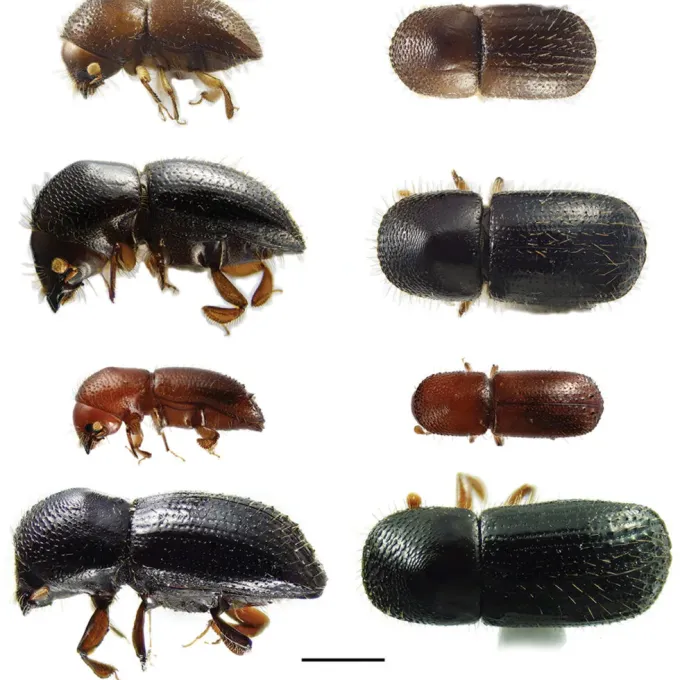
The Eastern ambrosia beetle (Euwallacea interjectus) is a small wood-boring beetle belonging to the Curculionidae family and Scolytinae subfamily. Adults typically measure between 2.5 and 3.5 mm in length.
Morphologically, they possess a cylindrical, dark brown to black body, which is characteristic of the tribe Xyleborini. Their bodies are covered in fine, scattered hairs and minute punctures.
Females of the species are specialized in carrying symbiotic fungi, known as ambrosia fungi, within their mycangia (specialized structures). This symbiosis is crucial for their life cycle.
Unlike many other bark beetles, these insects do not feed on wood directly. Instead, they excavate galleries in the xylem to cultivate fungi, which then serve as the primary food source for their larvae.
Detection is difficult due to their small size and the fact that they live deep inside the stems or branches of the host plant throughout most of their life stages.
What it damages
This species is highly polyphagous, attacking a wide range of host plants, including species of Acer, Salix, Populus, and various fruit-bearing trees such as walnuts and avocados.
The beetle causes damage by boring into the sapwood of trunks and branches. These tunnels disrupt the plant's water and nutrient transport systems, leading to branch dieback or total tree mortality.
Beyond mechanical damage, the symbiotic fungi introduced by the beetle often trigger vascular necrosis within the tree, leading to systemic wilting and rapid plant decline.
The pest is particularly dangerous in orchards and forest nurseries, where it can cause significant economic losses by killing or severely weakening high-value trees.
While often associated with stressed trees, high populations of the beetle can overwhelm healthy trees, making it a significant threat in both native and introduced environments.
Signs of infestation
The most prominent sign of infestation is the presence of small, circular entry holes on the bark, usually about 1-2 mm in diameter, often accompanied by sawdust or frass.
In many deciduous and fruit trees, the infestation site may show signs of sap flow or gumming, as the tree attempts to seal off the wounds created by the tunneling beetles.
Foliage on infested branches often wilts, turns yellow or brown, and drops prematurely. Eventually, the entire crown of the tree may show signs of severe decline.
When the bark is carefully removed or branches are pruned, dark staining is typically visible inside the galleries, which is caused by the growth of ambrosia fungi.
In severe cases, crown dieback is common. The upper portions of the tree often die first, as the beetles preferentially colonize larger branches or the lower stem, cutting off supply to the canopy.
Control measures
Sanitation is the most critical management strategy. Infested trees or branches should be pruned and removed immediately to reduce the source of new beetle populations.
Disposal of infested wood is vital; it should be burned, chipped, or buried to ensure that adult beetles cannot emerge and colonize new, healthy neighboring plants.
Monitoring using pheromone-baited traps is recommended for high-risk areas, such as commercial nurseries and orchards, to detect the arrival of the beetles early in the season.
Promoting overall tree vigor through proper irrigation and nutrient management helps trees resist initial colonization attempts, as healthy trees are less attractive to the pest.
Chemical control remains difficult because the beetles spend most of their time deep within the wood, so insecticide applications should be timed precisely to match the adult emergence periods.
Taxonomy
- Latin name
- Euwallacea interjectus
- Order
- Coleoptera (beetles)
- Family
- Curculionidae
- EPPO code
- XYLBIN
Discussion
No discussions yet — be the first.