
Teak shothole borer
Euwallacea destruens
Description
How to identify
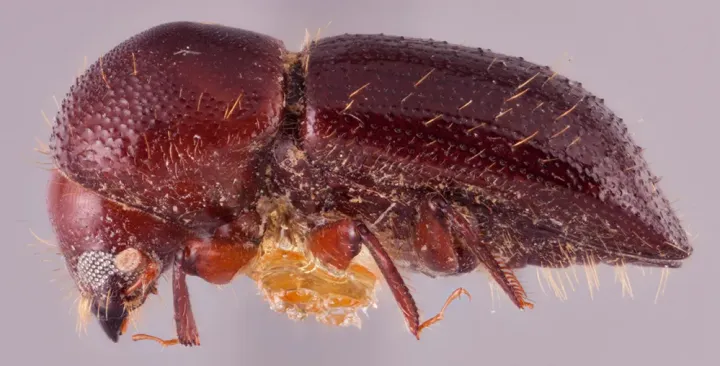
The teak shothole borer (Euwallacea destruens) is a small beetle belonging to the Curculionidae family, specifically the Scolytinae subfamily, known for its destructive impact on teak wood.
Adult beetles are tiny, typically measuring about 2–3 mm in length, with a cylindrical, dark-colored body adapted for tunneling deep into tree trunks.
This species maintains a symbiotic relationship with specific fungi (ambrosia fungi), which they cultivate inside the galleries they bore in the wood.
The life cycle encompasses several stages: eggs, larvae, pupae, and adults, all of which generally occur within the protective environment of the host wood.
Female beetles are responsible for dispersal; they emerge from infested trees, navigate to find new hosts, and introduce their fungal symbionts to establish new colonies.
What it damages
The primary host for this pest is Tectona grandis (teak), a highly valuable timber species widely used for high-end furniture and shipbuilding.
By boring galleries, the beetles cause significant structural damage to the heartwood, which renders the timber largely unsuitable for commercial use.
The associated fungi introduced by the beetles can cause localized decay and discoloration of the wood, further reducing its market quality and value.
While mature trees can often withstand minor infestations, heavy attacks lead to canopy thinning, crown dieback, and eventually the death of the tree.
Economic losses in teak plantations can be immense, as the infestation affects both the quantity and quality of the wood production cycle.
Signs of infestation
The most prominent sign of an infestation is the appearance of small, circular entry holes on the bark, accompanied by fine frass (wood dust) falling from these openings.
As the infestation progresses, bark around the entry holes may become darkened or sunken due to the physiological stress of the tree and fungal growth.
Leaves may show premature chlorosis or wilting, indicating that the vascular system is being compromised by the network of galleries inside the trunk.
In severe cases, wood sections exhibit dark stains or fungal mats within the borer holes, which are visible upon peeling away the bark.
Professional foresters detect active populations by monitoring the frequency of new entry holes during the peak flight periods of the adult beetles.
Control measures
The most fundamental management strategy is the immediate removal and proper disposal of infested trees to prevent the beetle population from spreading.
Implementing pheromone-based traps is highly recommended to monitor adult flight activity and density, allowing for better timing of intervention efforts.
Maintaining high stand vigor is crucial; healthy, well-nourished trees are generally more resilient and less attractive to invading borers than stressed individuals.
Chemical control is rarely effective as the beetles spend most of their life cycle protected deep within the xylem of the tree, shielded from external sprays.
Integrated Pest Management (IPM) strategies, including the encouragement of natural predators and parasitic wasps, remain the most sustainable long-term solution.
Taxonomy
- Latin name
- Euwallacea destruens
- Order
- Coleoptera (beetles)
- Family
- Curculionidae
- EPPO code
- EUWADE
Discussion
No discussions yet — be the first.