
Euwallacea
Euwallacea
Description
How to identify
Euwallacea is a genus of bark beetles from the family Curculionidae. These are tiny insects, typically measuring 2–3 mm in length, which makes them very difficult to detect during the early stages of infestation.
Females are dark brown to black and are capable of flying, which enables them to spread rapidly. Males, however, are significantly smaller, flightless, and spend their entire lives inside the galleries constructed by the females.
A distinctive trait of these beetles is their symbiotic relationship with fungi, specifically Fusarium and Graphium species. The beetles carry fungal spores in specialized organs called mycangia and inoculate the host tree as they bore through the wood.
The lifecycle is centered around these fungal gardens. Upon boring into the wood, the female creates complex tunnels where she cultivates the fungi, which serve as the primary food source for both the larvae and the adults.
Several species within this genus, such as Euwallacea fornicatus, have become major invasive threats globally. They are known to attack hundreds of host plant species, showing a high level of polyphagy.
What it damages
Euwallacea impacts an extremely wide range of hosts, including fruit trees like avocado and citrus, as well as many ornamental and wild species such as maple, willow, sycamore, and oak.
The damage is twofold: the mechanical destruction of the wood caused by the extensive tunneling, and the fungal infections introduced by the beetle. The fungi disrupt the tree's vascular system, causing xylem blockage.
This disruption prevents water and nutrients from reaching the canopy, eventually leading to branch dieback and, in cases of severe infestation, the death of the entire tree.
Even healthy, well-maintained trees are vulnerable. The beetle does not require a stressed host to initiate an attack, which makes it particularly dangerous for both agricultural crops and urban forests.
Economic losses are significant due to the need for total tree removal, loss of agricultural productivity, and the high cost of implementing large-scale monitoring and containment programs.
Signs of infestation
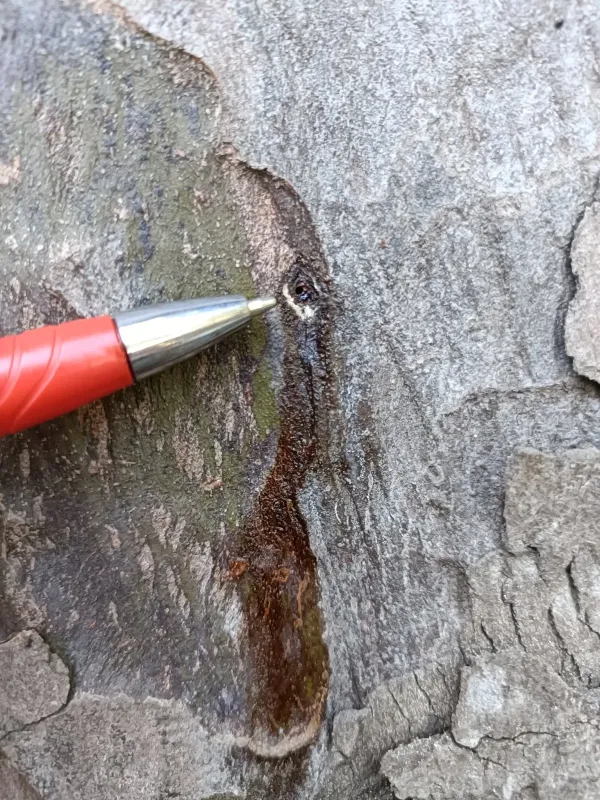
The most common sign of infestation is the presence of very small entrance holes on the bark, often looking like they were made by a needle. Frass, resembling compacted sawdust, may be pushed out of these holes.
In hosts like avocado, visible signs often include white, crystalline exudate or sap weeping from the entrance tunnels. Other species may show dark staining on the bark around the entry points.
A thinning canopy and yellowing leaves are typical symptoms as the fungus restricts water transport. The tree essentially starts to suffer from internal dehydration even when the soil moisture is adequate.
When the bark is removed, the wood surrounding the tunnels shows characteristic dark necrosis. These blackened areas signify the rapid spread of the symbiotic fungi inside the living tissue of the tree.
As the infestation progresses, entire branches may die, leading to structural instability. Such trees are prone to snapping in high winds, creating potential safety hazards in residential areas.
Control measures
Controlling Euwallacea is exceptionally difficult because the beetles spend most of their life cycle protected deep within the woody tissue, where conventional contact pesticides cannot reach them.
- Regular visual monitoring of host trees for the presence of entry holes and frass.
- Use of specialized attractant lures to monitor population density in the area.
- Sanitation, which includes the immediate removal and proper disposal (chipping or burning) of infested material.
- Sanitizing tools between trees to prevent the spread of fungal spores.
Systemic insecticides or fungicides applied via trunk injection may offer some level of suppression but are expensive and labor-intensive, making them suitable mainly for high-value trees or in specific urban landscapes.
Stringent quarantine regulations are essential to prevent the human-aided movement of infested firewood, logs, or nursery stock. Limiting movement is currently the most effective tool in slowing the beetle's geographical expansion.
Taxonomy
- Latin name
- Euwallacea
- Order
- Coleoptera (beetles)
- Family
- Curculionidae
- EPPO code
- EUWASP
Discussion
No discussions yet — be the first.