
Eutrombidium
Eutrombidium
Description
How to identify
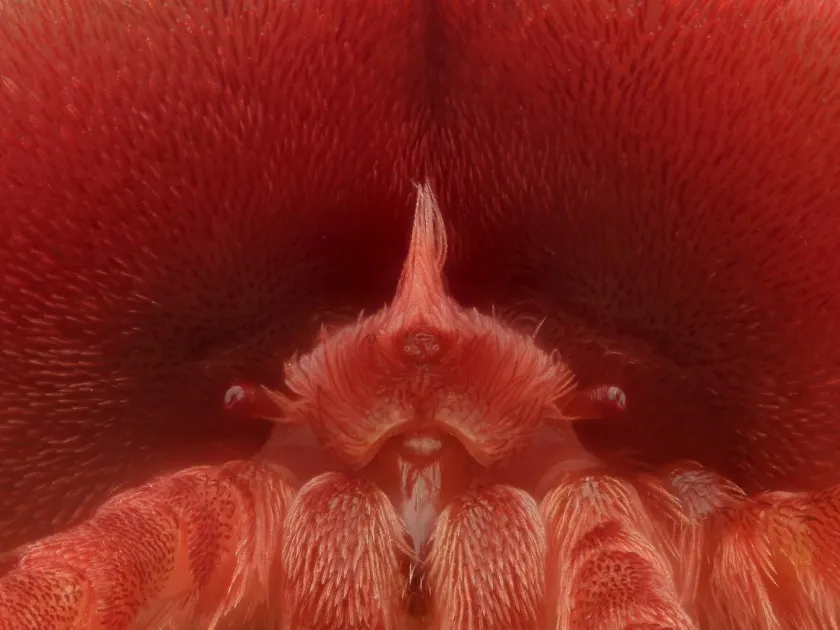
Eutrombidium is a genus of mites belonging to the family Microtrombidiidae (order Trombidiformes). These mites are characterized by their striking bright red or orange coloration, making them easily identifiable in the soil and on vegetation.
Adult mites are predatory and mobile, feeding on various small insects and their eggs. However, their larval stages are parasitic, which is the primary factor linking them to agricultural pest issues.
Adults typically measure between 2 and 4 millimeters in length. Their bodies are covered in fine, dense setae (hairs), giving them a velvety appearance, a trait common among velvet mites.
The larvae are microscopic and often parasitize orthopteran insects, such as grasshoppers, meaning that an abundance of Eutrombidium is often associated with high populations of other pests.
Agronomic understanding of their lifecycle is essential, as the majority of their development occurs within the soil profile, making them highly dependent on soil conditions and moisture levels.
What it damages
Direct damage to crops occurs primarily during the mass emergence of larvae, which can aggregate on young shoots and leaves. While primarily parasites of insects, high densities of larvae can cause physical damage to plant tissues.
Crops most at risk include cereals, maize, and certain industrial plants. Infestations often originate from migration from adjacent fallow lands or field margins.
Damage manifests as plant stress caused by sap-feeding, which disrupts the photosynthetic process and physiological development of the seedling, leading to stunted growth.
Lesions formed on the plant surface serve as entry points for secondary fungal and bacterial pathogens, which can lead to further decay and lower overall crop health.
Significant yield loss is rarely caused by direct feeding alone, but rather by the cumulative stress and secondary infections that weaken the plant's ability to produce grain or fiber.
When it appears
The occurrence of Eutrombidium is highly seasonal and strongly correlated with temperature and the activity cycles of their insect hosts. Peak activity is typically observed during the spring and summer months.
The lifecycle consists of eggs, larvae, nymphs, and adults. The larvae are most active when the soil warms up sufficiently, leading to a synchronization between pest emergence and crop seedling stages.
A dry spring can delay their peak, but once favorable temperature and moisture conditions are met, the population can increase rapidly in a short window of time.
In autumn, adults migrate into deeper soil layers for diapause, where they remain dormant during the winter, ensuring the survival of the population through the cold season.
Field monitoring should commence as soon as daily temperatures consistently exceed 15 degrees Celsius, with inspections focusing on the soil surface and the lower parts of the crop canopy.
Signs of infestation
The primary visual sign is the presence of clusters of small, bright red specks on the leaves or stems, which can be easily spotted during field scouting.
A secondary sign is the development of chlorotic or necrotic spots on the foliage, indicating damage to the epidermis and subsequent disruption of the plant's nutrient transport.
- Ragged leaf edges due to larval feeding activity.
- Stunted or yellowing seedlings concentrated in specific patches of the field.
- Observation of mobile red mites on the soil surface during the early morning hours.
Scouts should also look for infested orthopteran insects in the area, as these serve as key hosts for the larvae and indicate a higher risk of mite outbreaks.
The use of a hand lens confirms the presence of the mite itself, distinguishing it from other tiny red organisms that may be present in the agro-ecosystem.
Control measures
The most effective long-term control method is good agrotechnical management, particularly deep tillage, which disrupts the mite's soil-based development cycle and destroys their overwintering sites.
Chemical control using insecticides or acaricides should be reserved for periods of high population density when the economic injury level is clearly exceeded to avoid resistance.
Weed management is vital, as wild host plants along field margins provide a sanctuary for these mites to persist and breed outside of the main cropping season.
Crop rotation is an essential preventive practice that breaks the lifecycle by changing the availability of hosts and habitat for the mite populations.
Preserving natural predators and using selective biological control agents helps maintain mite numbers below the threshold, promoting a healthier and more resilient agricultural environment.
Taxonomy
- Latin name
- Eutrombidium
- Order
- Mites
- Family
- Eutrombidiidae
- EPPO code
- EUTRSP
Discussion
No discussions yet — be the first.