
European black scorpion
Euscorpius flavicaudis
Description
How to identify
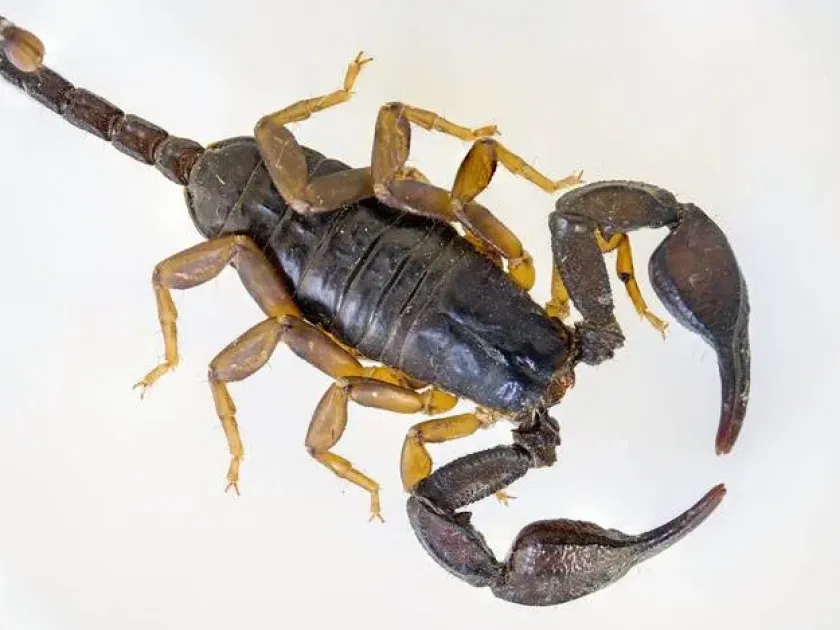
The European black scorpion belongs to the Euscorpiidae family. Adults typically measure between 35 and 45 mm in length, characterized by a dark brown or black exoskeleton.
They are easily recognized by their yellowish-brown legs and telson (the tip of the tail). The body is flattened, an adaptation that allows them to live in very narrow crevices.
These scorpions are nocturnal hunters that prefer dark, humid environments. In agricultural settings, they are often found under stones, logs, or in the foundation cracks of storage buildings.
The life cycle is relatively slow. Females provide parental care by carrying their offspring on their backs during the early stages of development, which ensures high survival rates.
Unlike many other scorpions, their venom is mild, causing reactions similar to a bee or wasp sting, which makes them less dangerous to humans in an agricultural work setting.
What it damages
It is crucial to understand that the European black scorpion is not a plant pest. They do not feed on plant tissues, sap, or roots and cause no direct damage to agricultural produce.
Instead, they act as predators, feeding on various small insects and arthropods. In many cases, they serve as beneficial controllers of other pest populations within an agricultural ecosystem.
There is no economic damage associated with this species. Therefore, they are not classified as a target for pest management programs in commercial or private farming.
The only concern is the potential for accidental stings during manual labor, such as harvesting fruit or cleaning debris, where a scorpion might be hiding.
In essence, the presence of the European black scorpion is generally considered neutral or beneficial for the balance of the garden's local micro-fauna.
When it appears
The activity of the European black scorpion is strongly linked to seasonal temperature variations. They are most active during the warmer months, from late spring through early autumn.
During the peak of summer, they are primarily nocturnal, coming out of their burrows to hunt when humidity levels are higher and temperatures are more moderate.
As temperatures drop in autumn, these scorpions begin to retreat into deeper shelters or hibernating spots, such as soil crevices or structures, to survive the winter months.
The population growth is not tied to crop cycles, meaning that agricultural planting or harvesting schedules do not influence their developmental progression.
In greenhouses where temperatures remain consistent year-round, these scorpions may remain active throughout the winter, provided there is enough prey and humidity.
Control measures
No specific chemical control measures are required or recommended for this species, as they do not threaten crop health or yield.
To reduce their presence in high-traffic agricultural areas or storage rooms, it is best to focus on habitat modification rather than chemical extermination.
Recommended prevention steps include:
- Keeping the area around buildings free of leaf litter and woody debris.
- Sealing cracks and crevices in foundations and storage facilities.
- Removing piles of stones or bricks that provide excellent nesting sites.
Broad-spectrum insecticides should be avoided as they often kill beneficial insects and disrupt the natural balance of the local ecosystem.
Maintaining a clean and organized work environment is the most sustainable and efficient way to manage their population without impacting the surrounding flora.
Taxonomy
- Latin name
- Euscorpius flavicaudis
- Family
- Chactidae
- EPPO code
- ESCPFL
Discussion
No discussions yet — be the first.