
Plum seed wasp
Eurytoma schreineri
Description
How to identify
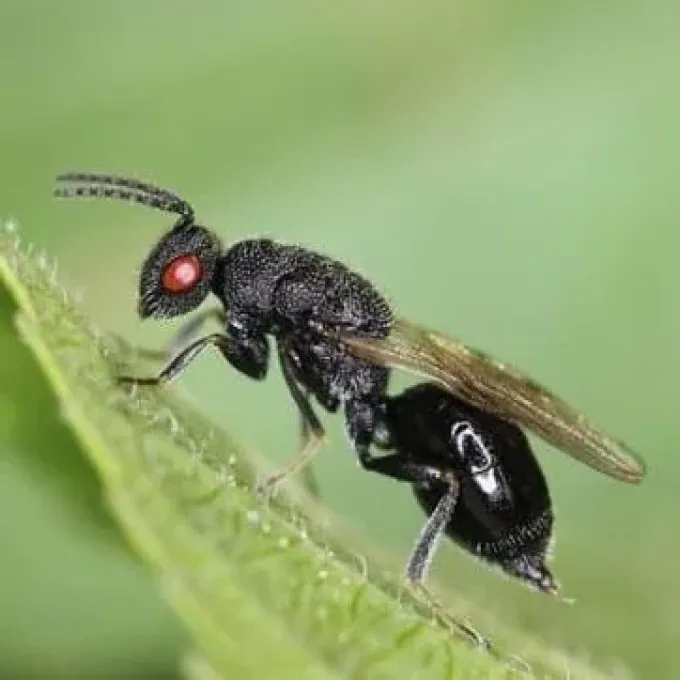
The plum seed wasp (Eurytoma schreineri) is a hymenopteran insect belonging to the family Eurytomidae. The adult wasp is small, typically about 4–6 mm long, with a black body and transparent wings.
The larvae are white, legless, and curved into a characteristic C-shape. They develop exclusively inside the plum stone, feeding on the kernel, which makes the infestation hidden until harvest time.
The life cycle involves egg, larva, pupa, and adult stages. The insect overwinters as a full-grown larva inside the stone of the infested fruit, either on the ground or still hanging on the tree.
Adult emergence occurs in the spring, synchronized with the development of young plum fruits. The female uses her ovipositor to pierce the young fruit and deposit eggs inside the seed.
The population development of this pest is highly dependent on climate conditions, and in favorable years, it can lead to massive outbreaks across commercial and home orchards.
What it damages
The primary host for this pest is the plum tree, although it frequently attacks other stone fruits such as apricots, myrobalan (cherry plum), and occasionally cherries.
The damage is caused by the larva, which consumes the entire kernel of the plum stone. This destroys the seed and often triggers the tree to shed the fruit prematurely.
Infested fruits lose their nutritional value and commercial appearance. They often turn color early and fall, leading to substantial crop losses, sometimes reaching 90% in severe infestations.
Even if the fruit remains on the tree, the damaged stone often leads to internal rot, making the entire fruit unfit for consumption or industrial processing.
This pest is considered one of the most dangerous because the damage is internal and often goes unnoticed by growers until the harvest is already ruined.
When it appears
Adult activity typically begins in late spring, coinciding with the end of the plum blossom period. This is the most critical time for monitoring and control efforts.
The flight period of the adults usually lasts for 3 to 4 weeks. During this window, females seek out new fruit set to lay their eggs, making the timing of insecticide application vital.
Throughout the summer, the larvae feed inside the stone. By the time the fruit begins to ripen, the larvae have finished their feeding and transitioned into the pupal stage.
The insect completes only one generation per year. However, in some cases, larvae can remain in a state of diapause for up to two years before emerging as adults.
Orchard managers must track local phenological data to predict the arrival of the adult wasps and apply protective measures before the egg-laying process occurs.
Signs of infestation
Visible signs of infestation are scarce in the early stages. The young fruit continues to develop normally, masking the internal destruction happening inside the pit.
The most reliable sign of a plum seed wasp presence is the massive, premature fruit drop that occurs before the fruit reaches full maturity.
Upon breaking open the fallen fruit, the stone will appear damaged or hollow, containing the white larva. Often, the stone is slightly thinner or brittle compared to healthy ones.
Sometimes, careful inspection of the fruit surface may reveal tiny, almost invisible entry holes where the female ovipositor pierced the skin.
Post-harvest, finding numerous shriveled, mummified fruits on the tree or scattered on the ground is a definitive indicator of an established plum seed wasp population.
Control measures
Effective management of the plum seed wasp requires a multi-stage approach, focusing on sanitation and precise timing of chemical or biological control agents.
- Strict collection and destruction of all fallen fruits (mummies) to prevent larvae from surviving.
- Deep autumn plowing or tilling of the soil under the trees to bury overwintering pupae.
- Application of systematic insecticides right after the blossom ends and petals have fallen.
- Removal of all dried, unharvested fruits from the tree branches before winter.
- Promotion of natural predatory insects that can help reduce the pest population naturally.
Chemical intervention is most successful when applied shortly after petal fall, targeting the adults before they can successfully lay their eggs in the developing fruit.
Follow-up applications may be necessary depending on the duration of the flowering season, ensuring that all new fruit sets are protected during the peak flight of the wasps.
Taxonomy
- Latin name
- Eurytoma schreineri
- Order
- Hymenoptera
- Family
- Eurytomidae
- EPPO code
- EURTSC
Discussion
No discussions yet — be the first.