
Eurytoma noxialis
Eurytoma noxialis
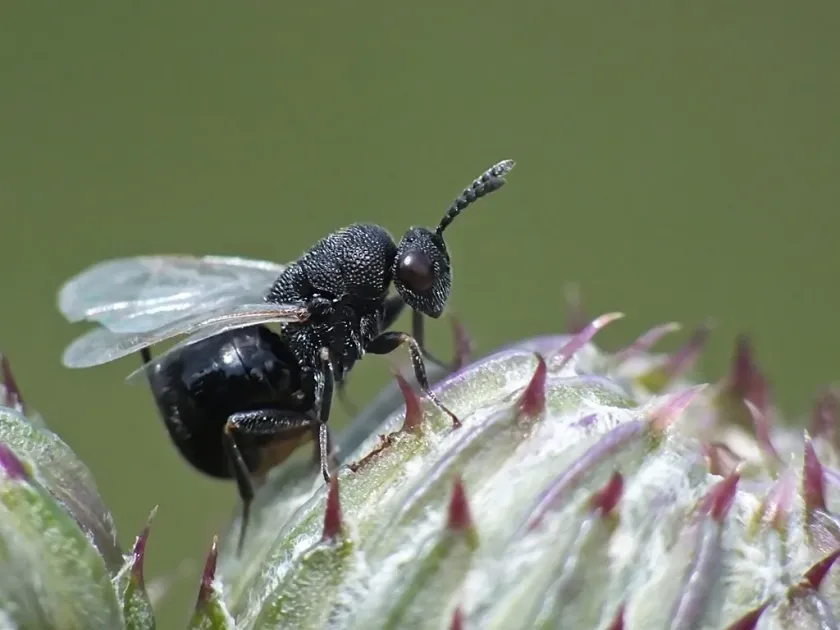
Description
How to identify
Eurytoma noxialis is a species of hymenopteran insect belonging to the Eurytomidae family. The adult wasp is small, typically measuring 2–3 mm in length, with a black, shiny body.
The larvae are white, legless, and lead a cryptic lifestyle within the stems of host plants. Their morphology is adapted to life inside narrow plant tissues, where they form feeding chambers.
This species is highly specialized, primarily targeting cereal crops. Its reproductive cycle is synchronized with the phenological development of host grasses.
Identification in the field is difficult due to the insect's small size and internal development, making it often overlooked until damage becomes visible.
The survival of the species relies on its ability to overwinter as a larva within the stalks of cereal stubble, ensuring it remains close to the next season's food source.
What it damages
The primary host for Eurytoma noxialis is wheat, including both winter and spring varieties. Infestations can cause significant economic damage to cereal production.
The larvae feed on the internal tissues of the stem. This feeding process triggers the plant to develop characteristic galls, which interfere with nutrient transport.
As the galls develop, they obstruct the vascular system, preventing the grain from filling properly and causing the spike to become thin or sterile.
Structural integrity of the stem is compromised, leading to increased susceptibility to lodging. This makes harvesting difficult and results in yield losses.
Beyond quantity, the quality of the grain is severely impacted, often resulting in shriveled kernels that do not meet the standards required for milling and flour production.
When it appears
Adult emergence occurs during the spring, aligning with the stem elongation and heading stages of wheat development. This timing is crucial for the female to lay eggs.
Females insert eggs into the soft stem tissue using an ovipositor. Embryonic development follows, leading to the hatching of larvae that feed throughout the growing season.
The larval stage is spent entirely inside the stem. As autumn approaches, the larvae prepare for diapause within their chambers.
Pupation typically occurs inside the dry stalks, and the insect remains in the stubble throughout the winter months, awaiting the following spring.
Annual population dynamics are heavily influenced by environmental factors such as temperature and humidity, which dictate the success of the new generation.
Signs of infestation
The most visible sign of infestation is the presence of swelling or galls on the wheat stem. These irregularities are often found in the middle or upper sections of the stalk.
Affected plants often display stunted growth, premature yellowing, and visible distortion. In areas of high infestation, entire sections of the crop may appear wilted.
Upon physical inspection, splitting the stem at the site of the gall will reveal the white larva or the empty chamber where the insect has developed.
Lodging or bent stalks are common in infested fields, especially when subjected to wind or heavy rain during the grain-filling phase.
Historical data from previous harvests can serve as a predictor; if high levels of stubble infestation occurred, the risk to the subsequent crop is significant.
Control measures
Effective management begins with strict crop rotation. Avoiding consecutive wheat plantings breaks the life cycle of the pest, preventing larvae from reaching the next generation.
Deep plowing of stubble immediately after harvest is a vital cultural practice. It buries the larvae, preventing adult wasps from emerging in the spring.
Field hygiene is essential. Removing weeds and volunteer wheat plants eliminates alternative breeding sites for the insect during the off-season.
Insecticide application is only effective during the short window of adult activity before eggs are laid. Once larvae are inside the stem, chemical control is largely ineffective.
- Utilizing resistant wheat varieties with thicker or harder stalks.
- Ensuring optimal planting dates to avoid synchrony with adult emergence.
- Removing and destroying infested straw remnants.
- Regular scouting of fields during the critical spring period.
Taxonomy
- Latin name
- Eurytoma noxialis
- Order
- Hymenoptera
- Family
- Eurytomidae
- EPPO code
- HARONO
Discussion
No discussions yet — be the first.