
Sunbittern
Eurypyga helias
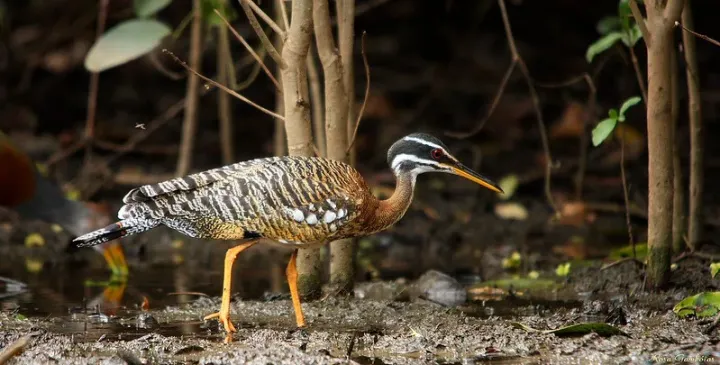
Description
How to identify
The Sunbittern (Eurypyga helias) is a fascinating bird species, classified within the order Gruiformes and the family Eurypygidae.
It is native to the tropical regions of Central and South America. The species is well-known for the striking, sun-like patterns on its wings, which are displayed during courtship rituals or when threatened.
Physically, the Sunbittern is medium-sized with a long neck and slender, sharp bill. It typically inhabits the banks of forest streams and rivers, where it blends in with the dappled light of the forest floor.
The bird is solitary and secretive by nature, often moving slowly to hunt for prey. Its camouflage is highly effective, allowing it to remain unnoticed by predators.
Taxonomically, it is the only member of its family, making it a unique evolutionary lineage that has adapted to the specific conditions of neotropical riparian environments.
What it damages
The Sunbittern is not a plant pest. It is an insectivorous and carnivorous bird that feeds on small animals, posing no threat to agricultural crops or harvests.
Its diet consists primarily of small fish, insects, crustaceans, and amphibians. It lacks the biological mechanisms to feed on plant matter, such as seeds or foliage.
In agricultural settings near tropical wetlands, the presence of a Sunbittern indicates a healthy ecosystem rather than a risk to production. It does not cause physical damage to plants.
Farmers have no reason to implement control measures against this species, as it does not consume crops nor does it act as a vector for plant diseases.
Protecting the Sunbittern is beneficial for environmental health, as it serves as a natural predator of organisms that could potentially become problematic in local water bodies.
Taxonomy
- Latin name
- Eurypyga helias
- Family
- Eurypygidae
- EPPO code
- EYPAHE
Discussion
No discussions yet — be the first.