
Ambrosia beetle
Euplatypus
Description
How to identify
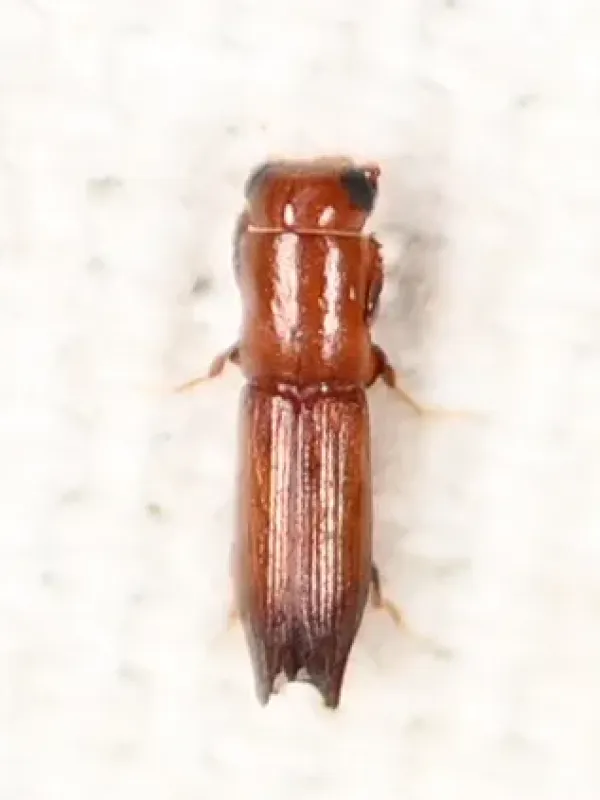
Ambrosia beetles of the genus Euplatypus belong to the Curculionidae family, subfamily Scolytinae. These are small, cylindrical beetles with a dark brown or black coloration, specialized for boring into dense wood.
The body is elongated and narrow, which is an evolutionary adaptation for movement within the tunnels they construct. The head is typically retracted under the pronotum, and the antennae are distinctively club-shaped.
Sexual dimorphism is often present, with males and females having different structures on the elytra tips. This detail is essential for entomologists when identifying specific species within the Euplatypus genus.
Larvae are legless, white, and possess a well-developed head capsule. They develop within individual galleries prepared by their parents and rely on symbiotic fungi for nutrition rather than wood itself.
The size of the adult beetle generally ranges from 3 to 8 millimeters. Their life cycle is deeply integrated with the fungi they carry in specialized structures called mycangia.
What it damages
These beetles affect a wide range of hardwood species, including oak, beech, chestnut, and various fruit trees. Their activity can cause severe economic losses in both forestry and commercial orchards.
Beetles bore deep tunnels into the sapwood and heartwood, which compromises the structural integrity of the tree and disrupts the vascular system responsible for nutrient and water transport.
The primary damage is caused by the symbiotic fungi (e.g., Ambrosiella spp.) that the beetles introduce. The fungal growth clogs the vascular tissues of the tree, leading to severe necrosis and wilting of branches.
Infested wood often exhibits staining due to the fungi, which lowers its timber quality. Multiple exit and entrance holes also make the wood unsuitable for industrial woodworking applications.
Early intervention is crucial as the beetles can colonize a tree in large numbers within a short period, potentially killing healthy trees that are already suffering from environmental stress.
When it appears
Adult beetles are most active during the warmer months when temperatures remain consistently above 15–18 degrees Celsius. Their flight period typically aligns with the beginning of the tree's vegetative cycle.
Females search for suitable host trees and initiate boring, releasing pheromones to attract males. This colonization phase is the most critical time for monitoring and implementing protective measures.
The risk of infestation is significantly higher following periods of drought or frost. These stress factors lower the tree's natural resistance, making them more attractive to the beetles.
Depending on the climatic zone, multiple generations may occur within a single season. The lifespan of an adult individual varies from a few weeks to several months.
During the winter, the beetles typically overwinter as adults within their galleries or under the bark, waiting for the spring season to resume their life cycle and emerge.
Signs of infestation
The most common sign of infestation is the presence of "frass" (wood dust) appearing as fine piles at the base of the trunk. This is produced by the beetles as they clear their tunnels.
Small, perfectly round entrance holes (1–2 mm in diameter) on the bark are clear indicators of presence. In some cases, sap flow or "bleeding" may be visible around these holes.
Foliage on the infested tree may turn yellow, wilt, or drop prematurely due to the disruption of water conduction. Severe or chronic infestations often lead to crown dieback.
When the bark is removed, characteristic dark staining can be seen inside the wood, marking the growth of the symbiotic fungi. This area is often accompanied by an unpleasant odor of decay.
- Presence of 1–2 mm round entrance holes.
- Accumulation of wood dust (frass) at the base.
- Yellowing or premature wilting of the leaves.
- Sap flow originating from boreholes.
- Crown dieback and limb mortality.
Control measures
Effective management begins with strict sanitary measures. Removing and destroying heavily infested trees is essential to prevent the spread of the beetle to healthy surrounding trees.
Using pheromone traps is a key strategy for monitoring beetle populations and timing insecticide applications. These traps help reduce the number of beetles actively seeking hosts.
Systemic insecticides applied during the peak flight season can effectively kill adult beetles before they successfully penetrate deep into the tree trunk.
Maintaining tree vigor through proper irrigation, fertilization, and protection from stress is the best long-term strategy. Healthy trees can often produce enough resin to drown out invading beetles.
Preventive trunk whitewashing with insecticide-amended solutions can create a chemical barrier, making it more difficult for the beetles to initiate their boring process into the bark.
Taxonomy
- Latin name
- Euplatypus
- Order
- Coleoptera (beetles)
- Family
- Curculionidae
- EPPO code
- EPLTSP
Discussion
No discussions yet — be the first.