
Euophryum confine
Euophryum confine
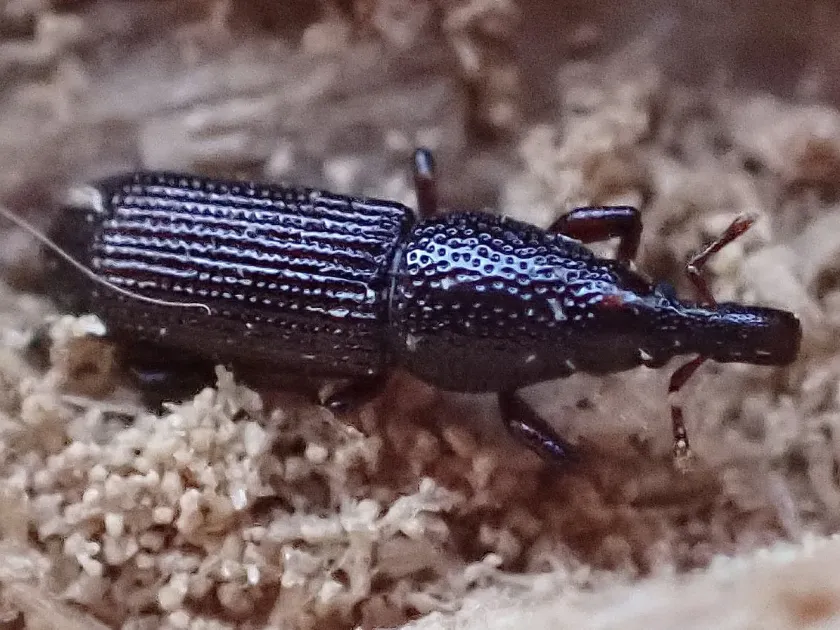
Description
How to identify
Euophryum confine is a species of snout beetle within the family Curculionidae, specifically known as a wood-boring insect that affects timber.
The adult beetle possesses an elongated, cylindrical body, which is an adaptation for living and navigating within the tunnels bored into wood.
The coloration of the adult is typically reddish-brown to dark brown, which allows it to camouflage effectively against decaying wooden surfaces.
Measuring between 2.5 and 4.5 millimeters in length, these beetles are small and often go unnoticed until significant damage has already occurred.
The larvae are legless, white-colored, and maintain a C-shaped body, living exclusively within the tunnels where they consume decaying wood fibers.
What it damages
Euophryum confine primarily targets softwood that has already been weakened by fungal decay or high moisture content.
In structural environments, it is commonly found attacking subfloor timbers, wooden joists in damp basements, and other moist building components.
Warehoused goods, particularly wooden pallets and packing cases stored in humid environments, are also frequent targets for infestation.
In natural outdoor settings, the beetle acts as a decomposer, infesting fallen branches, rotting stumps, and dead logs, thereby accelerating the decay process.
Continued infestation weakens the structural integrity of timber, potentially leading to the failure of load-bearing components if left untreated over many years.
When it appears
Indoor infestations are often active throughout the year, provided that the environment maintains a stable temperature and sufficient moisture levels.
In outdoor environments, the life cycle is seasonal, with peak adult activity occurring during the warmer months of spring and summer.
High humidity conditions significantly increase the likelihood of new infestations, as the beetle is strictly dependent on moisture-rich timber.
Adult beetles can be seen actively dispersing during warmer periods, allowing them to relocate from natural habitats into buildings or storage facilities.
The duration of the developmental cycle is highly dependent on ambient temperature and the degree of wood decay, which serves as the primary food source.
Signs of infestation
The most visible sign of an infestation is the presence of small, perfectly circular exit holes on the surface of the timber.
Fine, flour-like frass (a mixture of wood dust and insect excrement) is often found accumulating near the exit holes or within cracks in the wood.
Upon closer inspection, the interior of the timber will reveal a network of winding, irregular tunnels that are typically clogged with frass.
Surface dampness and the presence of fungal growth are strong indicators that the wood may be susceptible or currently under attack by Euophryum confine.
The timber often feels soft or spongy to the touch, and in cases of severe infestation, the surface may easily crumble under minor pressure.
Control measures
The primary control measure is the reduction of moisture content in the timber, as this insect cannot survive in dry wood environments.
Improving building ventilation and ensuring proper damp-proofing are crucial steps to prevent re-infestation after the initial treatment.
Chemical treatments using specialized insecticides and wood preservatives can be applied to eliminate active colonies and protect sound wood.
Severely infested structural elements should be removed and replaced with new, treated timber to ensure the safety and longevity of the building.
- Regular moisture monitoring of structural timbers.
- Elimination of leaking pipes or water sources near wooden structures.
- Application of professional-grade wood preservatives.
Taxonomy
- Latin name
- Euophryum confine
- Order
- Coleoptera (beetles)
- Family
- Curculionidae
- EPPO code
- ENOPCO
Discussion
No discussions yet — be the first.