
Euglandina
Euglandina
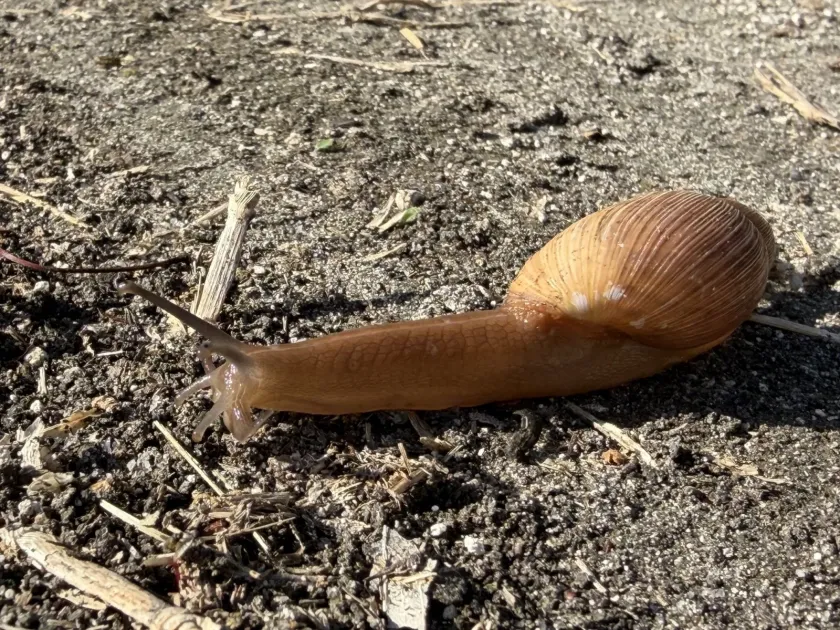
Description
How to identify
Euglandina (Euglandina rosea) is a large predatory land snail belonging to the Spiraxidae family. Its shell is spindle-shaped, reaching lengths of up to 10 cm, and typically features a distinct pinkish or brownish hue.
The snail's body is covered in a textured skin, and its head possesses two pairs of tentacles used for hunting. Unlike common herbivorous garden snails, Euglandina is an active carnivore that tracks its prey.
A key physical feature includes long lower labial tentacles, which act as sensory organs to detect the chemical trails of other snails. This adaptation allows the predator to locate prey efficiently in dense vegetation.
Systematically, this species belongs to the order Stylommatophora. Its evolutionary path is entirely dedicated to a predatory lifestyle, making it one of the most effective hunters in its habitat.
Known commonly as the rosy wolfsnail, this species has gained global attention for its rapid reproduction and its ability to outcompete and eliminate endemic mollusk species.
What it damages
While Euglandina does not feed on crops directly, it causes significant ecological damage. It survives by preying on other land mollusks, including species beneficial to soil health and decomposition.
In regions where it has been introduced, such as Pacific islands, Euglandina has caused the extinction of numerous unique tree snail species. This disrupts the natural trophic chain within local ecosystems.
Because the snail consumes mollusks that aid in the breakdown of organic matter, the soil mineralization process may be hindered in areas where the predator has decimated native snail populations.
Euglandina is indiscriminate, attacking any terrestrial gastropods of suitable size. This lack of diet specificity poses a direct threat to the biodiversity of any region it colonizes.
The danger is compounded in humid tropical environments, where the lack of natural predators allows Euglandina populations to explode, causing permanent damage to local ecosystems.
Control measures
The primary method of control is preventing the accidental introduction of the species into new regions. Strict quarantine regulations on soil and plant imports are essential to stop its spread.
Chemical molluscicides are ineffective, as they kill beneficial mollusks and disrupt the soil environment. The only ecologically sound method is the manual collection and removal of individuals.
If the snail is detected in greenhouses or nurseries, all soil and plant material must be isolated immediately, as the substrate may contain eggs or juveniles of the pest.
Biological control options are very limited because Euglandina sits at the top of the food chain among small terrestrial mollusks and has few natural predators in artificial habitats.
It is strongly advised to inspect all tropical plant imports and decorative soil thoroughly, checking for the presence of eggs or adult snails before integrating them into a new environment.
Taxonomy
- Latin name
- Euglandina
- Order
- Molluscs
- Family
- Spiraxidae
- EPPO code
- EUGDSP
Discussion
No discussions yet — be the first.