
Spruce cone moth
Eucosma tocullionana
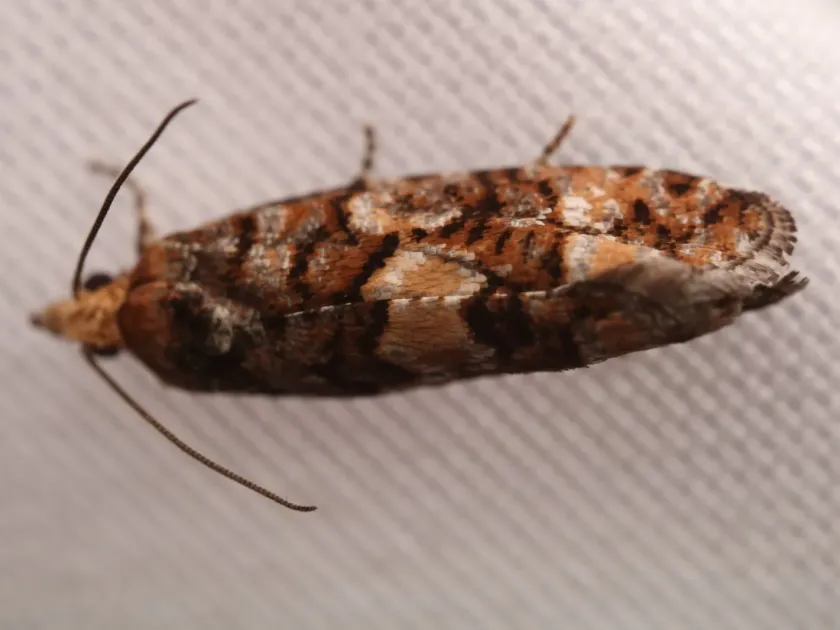
Description
How to identify
The spruce cone moth (Eucosma tocullionana) is a moth belonging to the family Tortricidae. Adults are small, with a wingspan of approximately 15–20 mm, exhibiting brownish-grey wing patterns that provide excellent camouflage against coniferous bark.
Larvae develop through several instars, with their coloration shifting from creamy-white to a reddish-pink hue. The dark head capsule is a distinctive feature often used for identification during field inspections of damaged cones.
This species is a specialist pest, whose life cycle is highly synchronized with the reproductive phenology of spruce trees. They are a significant concern in seed orchards and forest nurseries.
Systematically, it belongs to the order Lepidoptera, family Tortricidae, and is widely recognized as a major pest of spruce seeds in various regions of North America.
Biological monitoring is essential because the moth's presence is often overlooked until significant damage to the seed crop has already occurred.
What it damages
The primary damage is caused by larvae boring into developing spruce cones, where they consume seed scales and developing seeds. This leads to the total loss of the cone's reproductive potential.
High infestation levels can result in the destruction of up to 90% of the annual seed crop, making it extremely difficult to collect viable seeds for forest regeneration programs.
The feeding activity not only destroys seeds but also compromises the structural integrity of the cone, causing premature drying, twisting, and physical deformation.
Damage creates entry points for moisture and secondary pathogens, such as fungi, which further degrade the quality of any remaining seeds within the cone.
For forestry management, this pest represents a significant economic burden, reducing the genetic quality and quantity of seedlings produced in commercial operations.
When it appears
Adult moths typically emerge in the spring, coinciding with the timing of spruce cone development. Mating and egg-laying occur on the exterior of the young, tender cones.
Upon hatching, larvae bore into the cone tissue. The duration of their development is spent entirely inside the cone, which provides a protected micro-environment until they reach maturity.
By late summer, larvae reach the pupal stage. They typically exit the cone to overwinter in the soil or forest litter, remaining dormant until the cycle restarts the following spring.
The species is univoltine, meaning it completes only one generation per year. This predictability allows for targeted timing of control measures during the critical egg-laying period.
Understanding the phenological window between egg-laying and larval entry into the cone is the most vital factor for successful chemical application.
Signs of infestation
The most reliable sign of an infestation is the appearance of resin exudates on the surface of the cones, which occurs as a defensive reaction to larval boring.
- Darkening and premature wilting of specific cone scales.
- Presence of larval frass (excrement) around the entry holes.
- Visible deformation or twisting of the cone shape compared to healthy specimens.
- Exit holes on the cone surface formed after the moth completes its life cycle.
Assessments are best conducted by randomly sampling cones from different parts of the canopy and dissecting them to check for larvae or internal tissue damage.
Visual surveys with binoculars can reveal the presence of damaged or stunted cones, indicating a need for more intensive site inspections.
Control measures
Chemical control involving systemic or contact insecticides is most effective when applied during the period of egg-laying or before the larvae burrow deep into the cone scales.
Cultural control practices, such as the systematic collection and disposal of infested cones during the autumn, significantly reduce the overwintering population in the soil.
Biological control, including the use of B. thuringiensis (Bt) based sprays, provides an environmentally friendly alternative to chemical pesticides for managing larval populations.
Maintaining healthy, diverse forest stands supports populations of natural parasitoids, which act as biological agents to naturally suppress the moth's numbers.
In seed orchards, the use of pheromone traps for monitoring is recommended to determine the exact timing for intervention and to minimize the impact on beneficial insect species.
Taxonomy
- Latin name
- Eucosma tocullionana
- Order
- Lepidoptera (butterflies)
- Family
- Tortricidae
- EPPO code
- EUCOTO
Discussion
No discussions yet — be the first.