
Western pine shoot borer
Eucosma sonomana
Description
How to identify
The Western pine shoot borer (Eucosma sonomana) is a moth belonging to the family Tortricidae. It is a significant forest pest that specifically targets growing conifer shoots.
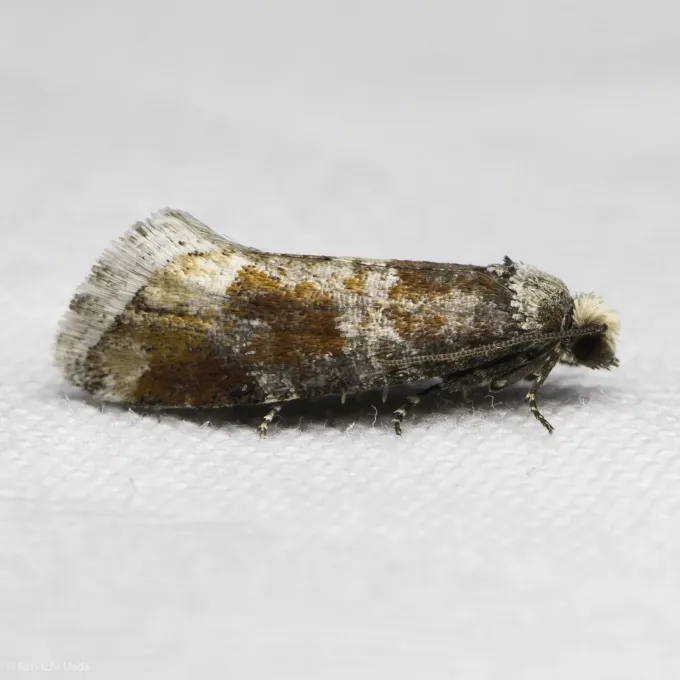
Adult moths have a wingspan of approximately 15–20 mm. Their forewings feature a distinctive, mottled pattern of grey and brown, providing excellent camouflage against pine bark.
The larval stage is the primary cause of damage. The larvae are cream or light pink with a brown head capsule, typically growing up to 15 mm in length.
The lifecycle is univoltine, meaning there is one generation per year. Adults emerge in spring, marking the start of the life cycle that poses a threat to young trees.
Identifying this pest requires careful observation during the early spring flight period, as adult moths are primarily nocturnal and well-camouflaged.
What it damages
The species primarily attacks various pine species, including Ponderosa pine, Lodgepole pine, and Scots pine, particularly in plantation settings.
Larvae feed within the terminal and lateral shoots of young trees, creating tunnels that destroy the pith of the host plant.
This damage significantly stunts the growth of the shoots, causing them to become twisted, stunted, or completely severed, which negatively impacts tree form.
Repeated infestation in young stands can cause long-term growth loss and affect the commercial value of the timber by creating forks and defects in the main stem.
In addition to growth loss, infested trees are often subjected to secondary attacks by wood-boring beetles, further weakening the tree's overall vigor.
When it appears
Adult moths emerge in early spring, typically from April to May, coinciding with the period when pine buds begin to expand and new shoots start to emerge.
Females lay eggs individually on the scales of the developing buds. Once the eggs hatch, the larvae quickly bore into the center of the succulent new growth.
The larval feeding period lasts for several weeks throughout the spring and early summer, during which the larvae grow and complete their development inside the shoot.
By late summer, the larvae finish feeding and emerge from the shoots to pupate in the soil or duff layer beneath the host tree.
The insect remains in the pupal stage throughout the winter, protected in the soil, until the environmental cues of spring trigger the emergence of the next generation.
Signs of infestation
A primary indicator of infestation is the stunted or deformed appearance of new shoots, which may twist or form a "shepherd's crook" shape.
Yellowing or browning of the needles on the terminal shoots is a common symptom, indicating that the vascular system of the shoot has been compromised.
Upon closer inspection, small entrance holes on the surface of the shoot, sometimes associated with resin exudation, confirm the presence of larvae.
If a suspected shoot is cut open, a central tunnel filled with larval frass and tissue debris will be visible, confirming the activity of the shoot borer.
In severely infested stands, the reduction in height growth becomes evident as the trees fail to reach their expected annual height increments compared to healthy trees.
Control measures
Chemical control involving systemic insecticides can be effective if applied during the brief window when eggs are hatching and larvae are attempting to bore into the shoots.
Silvicultural management, such as maintaining proper stand density and promoting species diversity, can make a forest less susceptible to major outbreaks.
Pheromone traps are widely used for monitoring population levels, helping foresters determine the timing and necessity of localized control applications.
Encouraging natural predators, such as parasitic wasps and entomopathogenic fungi, serves as a sustainable way to keep populations below damaging thresholds.
- Regular field inspections during the spring growth phase.
- Removing and destroying infested shoots in nursery environments.
- Selecting resistant or less preferred pine genotypes for reforestation.
Taxonomy
- Latin name
- Eucosma sonomana
- Order
- Lepidoptera (butterflies)
- Family
- Tortricidae
- EPPO code
- EUCOSO
Discussion
No discussions yet — be the first.