
Eucosma conciliata
Eucosma conciliata
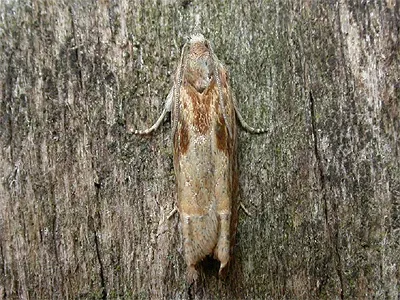
Description
How to identify
Eucosma conciliata is a moth species belonging to the family Tortricidae, commonly referred to as leafrollers. These insects are primarily nocturnal and are well-adapted to life in wooded environments and orchards.
Adult moths possess a wingspan typically ranging between 15 and 20 millimeters. Their forewings feature complex, mottled patterns in shades of brown and grey, providing excellent camouflage against tree bark.
The larvae, or caterpillars, go through several developmental stages (instars). They are highly specialized feeders with robust mouthparts designed to bore into plant tissue, such as buds and young stems.
Accurate identification of the species often requires careful examination of wing patterns or, in research contexts, the dissection of genitalia to distinguish it from closely related Eucosma species.
Understanding the biology and taxonomy of this pest is crucial for integrated pest management (IPM), as it allows for targeted actions during the most vulnerable stages of the insect's life cycle.
What it damages
The primary damage caused by Eucosma conciliata larvae involves the destruction of plant reproductive and vegetative parts. They specifically target developing buds, which can lead to significant crop loss.
Larvae bore into terminal buds early in the season, feeding on the internal tissues. This causes the buds to fail to open, essentially stopping the development of fruit or flowers before they ever emerge.
Leafrolling is another common symptom of infestation. The caterpillars use silk to bind leaves together, creating a protective shelter that also serves as their feeding site, causing localized tissue damage.
In addition to buds and leaves, larvae can burrow into young, tender shoots. This stunts plant growth, causes branches to deform, and increases the plant's susceptibility to secondary infections.
Economic damage is often significant in high-density orchards where even minor infestations can lead to a drastic reduction in fruit quality and overall orchard yield.
When it appears
The life cycle of this pest is strongly synchronized with the phenology of its host plants. Adult moths emerge in spring as temperatures warm, typically coinciding with the bud-break of fruit trees.
Egg-laying occurs on the surface of developing buds and young foliage. After hatching, the larvae quickly access the host plant, beginning their feeding cycle during the period of most active plant growth.
The development from egg to adult is relatively fast, typically spanning several weeks, allowing the population to reach peak activity when the tree is most vulnerable to tissue loss.
Pupation generally occurs in concealed areas within the foliage or in the crevices of bark. This phase is critical as it marks the transition to the adult stage, which repeats the cycle.
Overwintering occurs at the larval stage, protected in dense silken cocoons hidden under loose bark or within plant debris in the soil, allowing the species to survive low winter temperatures.
Signs of infestation
The most reliable early sign of an infestation is the presence of 'blind' or dead buds that remain closed or shrivel during the spring months. These buds often show tiny holes where larvae have entered.
Rolled or tied leaves are clear indicators of leafroller activity. When opened, one can often find larvae, discarded skins from molting, or dark-colored frass (droppings) left behind by the feeding insect.
Deformed, stunted, or dying shoot tips are common signs of larval burrowing. If a shoot is cut open, the tunneling activity of the caterpillar is usually visible as a hollowed-out section.
Presence of fine silk webbing on flowers or fruit clusters is a strong signal that the pests are active and currently feeding in the upper canopy of the tree.
The use of pheromone-baited traps allows growers to detect the exact timing of adult emergence, which is essential for determining when to implement control strategies.
Control measures
Cultural control is a primary management strategy. This includes the systematic pruning and removal of infested twigs and branches, which helps to mechanically lower the local pest population.
Maintaining orchard hygiene, such as removing fallen leaves and cleaning tree trunks, significantly reduces the number of suitable overwintering sites for the larvae.
Biological control, such as the use of Bacillus thuringiensis sprays, is highly effective against young larvae and minimizes the impact on beneficial predators and pollinators.
Chemical control must be applied with precision, focusing on the period when larvae are active but have not yet burrowed into buds, which provides them with physical protection.
- Application of selective insecticides at the 'green tip' stage.
- Deployment of pheromone traps for population monitoring.
- Introduction of natural enemies like Trichogramma wasps during egg-laying.
- Ensuring proper tree spacing to reduce pest migration between plants.
Taxonomy
- Latin name
- Eucosma conciliata
- Order
- Lepidoptera (butterflies)
- Family
- Tortricidae
- EPPO code
- EUCOCC
Discussion
No discussions yet — be the first.