
Etiella behri
Etiella behri
Description
How to identify
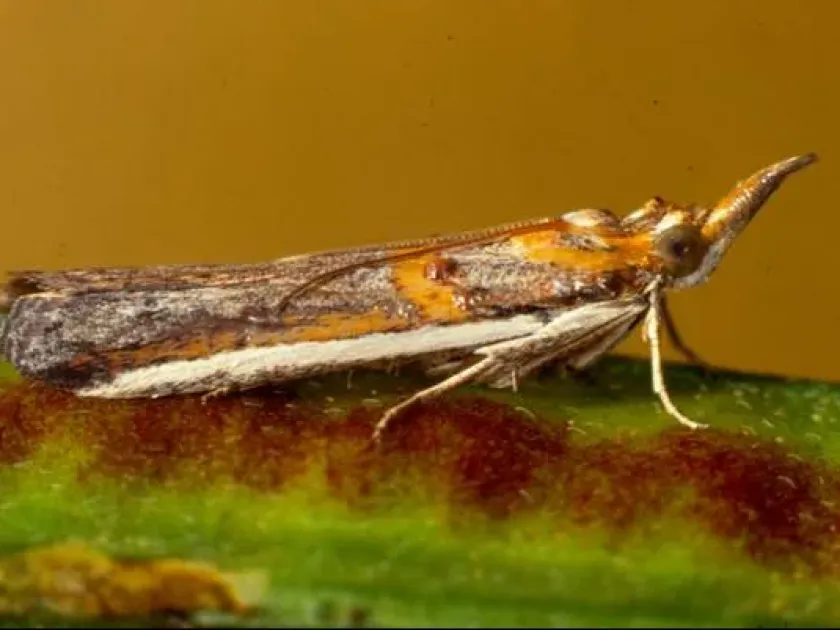
Etiella behri is a species of snout moth belonging to the family Pyralidae, known primarily as a significant agricultural pest.
The adult moth has a wingspan of approximately 20–25 mm, with brownish-grey forewings characterized by a distinct white stripe along the leading edge.
The larvae are spindle-shaped and exhibit color variations from pale green to reddish, often marked with a dark dorsal line.
Pupation occurs within the soil, where the larvae construct tough, silken cocoons to protect themselves during the winter dormancy period.
Adults are nocturnal, making them difficult to observe during the day, which necessitates the use of pheromone traps for accurate monitoring.
What it damages
The primary hosts for Etiella behri include various legume species, such as lupins, soybeans, peas, and vetches.
Larvae cause direct damage by feeding on the seeds within the pods, which significantly reduces both the yield and the quality of the harvested produce.
Feeding larvae often move between seeds within a single pod, destroying multiple grains and leaving behind frass and webbing.
The entry points created by the larvae also serve as infection sites for fungi and bacteria, leading to pod rot and seed decay.
In cases of severe infestation, crop losses can be substantial, often exceeding 30-50% in untreated fields, rendering the yield unsuitable for seed production.
When it appears
The flight of adult moths typically begins in late spring or early summer, coinciding with the flowering phase of leguminous crops.
Female moths lay eggs on young pods or floral parts, ensuring that newly hatched larvae have immediate access to food sources.
The lifecycle from egg to adult takes approximately 30 to 45 days, allowing for multiple generations in regions with warmer climates.
Late-season generations are responsible for producing the diapausing larvae that burrow into the soil to overwinter.
Peak activity generally occurs during the pod-filling stage, which is the period when the crop is most vulnerable to infestation.
Signs of infestation
One of the earliest signs of infestation is the presence of small, circular entry holes on the surface of the pods.
Internal examination of infested pods reveals the presence of larval frass, appearing as small, dark pellets mixed with silk webbing.
The pods may show external signs of stress, such as localized darkening or misshapen areas where the larvae have been actively feeding.
If a pod is opened, the seeds will appear hollowed out or partially consumed, with irregular eating marks characteristic of lepidopteran larvae.
- Entry holes in the pod surface.
- Larval frass inside the pod.
- Silk webbing within the pod cavity.
- Deformed or discolored pods.
- Hollowed-out or damaged seeds.
Control measures
Effective crop rotation is a fundamental practice to prevent the build-up of this pest population on the farm.
Deep plowing following the harvest helps expose and destroy overwintering pupae in the soil, significantly reducing the local population.
Chemical control must be timed precisely to target young larvae before they penetrate the pods and become protected from contact insecticides.
Using pheromone traps is essential for tracking adult flight patterns and determining the optimal timing for intervention.
Biological control methods, such as the release of egg parasitoids like Trichogramma, can be integrated into management programs to reduce infestation levels.
Taxonomy
- Latin name
- Etiella behri
- Order
- Lepidoptera (butterflies)
- Family
- Pyralidae
- EPPO code
- ETIEBE
Discussion
No discussions yet — be the first.