
Beech bark beetle
Ernoporus fagi
Description
How to identify
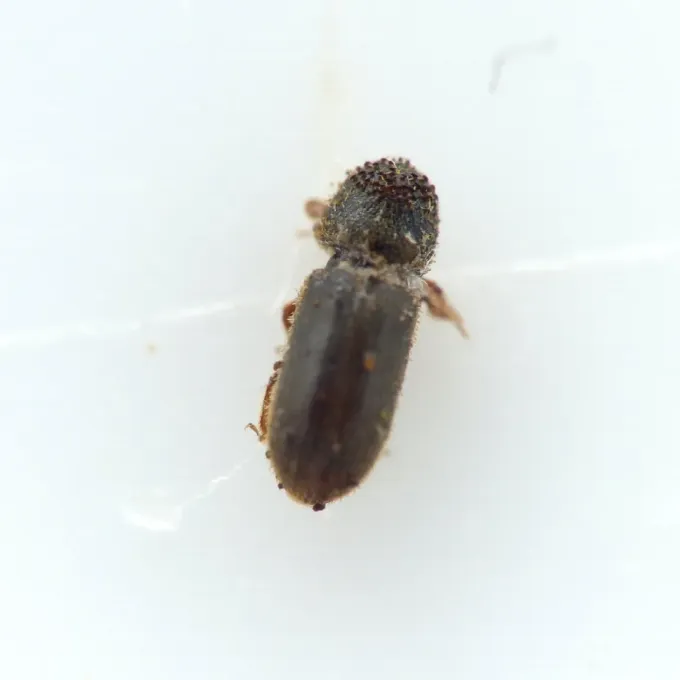
The beech bark beetle (Ernoporus fagi) is a small coleopteran insect belonging to the Curculionidae family and the Scolytinae subfamily. Measuring only about 1.5–2.0 mm in length, these beetles are often overlooked in dense forests.
The adult beetle has a cylindrical body with a dark brown to black coloration. The body is covered with fine, pale hairs, which helps in identifying the species under magnification.
The larvae are typically legless, white-colored grubs with a distinct yellowish-brown head capsule. They are perfectly adapted to live and feed within the inner bark tissues of host trees.
These insects are highly specialized and primarily infest the beech tree (Fagus sylvatica), making them a specific threat to these forest species.
Field identification is often based on the specific patterns of the maternal galleries etched into the inner bark, which are distinct for this particular species compared to other bark beetles.
What it damages
Ernoporus fagi targets the bark of beech trees. While it prefers weakened or stressed trees, it can occasionally attack healthy ones if the population density is high enough.
The damage begins when adults bore into the bark to create galleries. The larvae then feed on the phloem and cambium layers, which are essential for nutrient transport in the tree.
This feeding activity disrupts the tree's vascular system, leading to a decline in tree vigor. In severe cases, it causes branch dieback and, eventually, the death of the entire tree.
Economic damage includes the degradation of timber quality and the loss of forest productivity. These trees often become hubs for other secondary wood-boring insects and fungal pathogens.
In forest management, the beetle acts as an indicator of tree health; significant outbreaks often suggest that the stand is under environmental stress or poor management conditions.
When it appears
The life cycle of the beech bark beetle is highly dependent on environmental temperatures. Adults usually overwinter in the bark of host trees or in the leaf litter near the base of the trunk.
Spring activity typically begins as temperatures rise. Beetles emerge to find new suitable host trees for mating and egg-laying, usually during late spring to early summer.
The female bores a gallery into the bark and deposits eggs. Larval development occurs throughout the summer months inside the protective layers of the tree bark.
By late summer or autumn, the new generation of adults reaches maturity. They may either remain within the bark for winter or emerge to search for new hosts depending on the climate.
Depending on the latitude and local weather patterns, the beetle may have one or two generations per year, significantly impacting the severity of the infestation in a given season.
Signs of infestation
The most reliable sign of an infestation is the presence of fine "boring dust" (frass) on the bark surface or near the base of the tree, which indicates beetle boring activity.
Visual symptoms often include premature yellowing of leaves or stunted growth in parts of the tree crown, which points to vascular system damage.
Patches of dead or peeling bark may be visible. If the bark is carefully removed, characteristic star-shaped or branching gallery patterns are revealed beneath.
Sap flow or resin-like exudates may appear on the bark surface at the site of entry holes as a defensive reaction of the tree against the pest.
Crown dieback, specifically in the lower sections of the canopy, is a common indicator that the beetle population has successfully established itself on the trunk.
Control measures
The primary control strategy involves sanitary silviculture. This means identifying and removing infested trees before the next generation of beetles emerges and spreads to healthy neighbors.
Maintaining high forest stand vigor is the best preventive measure. Proper thinning and selective logging help ensure that trees remain healthy and capable of resisting low-level pest attacks.
Monitoring using pheromone-baited traps provides essential data on beetle population trends, allowing forest managers to make informed decisions about intervention timings.
Biological control, such as preserving habitats for insectivorous birds and predatory insects, helps regulate bark beetle populations naturally without chemical intervention.
- Regular forest health surveys to detect early signs of bark beetle activity.
- Prompt sanitation logging and removal of infested timber from the forest site.
- Proper disposal of slash and wood residues to minimize breeding grounds.
- Promoting a diverse forest ecosystem to encourage natural pest predators.
Taxonomy
- Latin name
- Ernoporus fagi
- Order
- Coleoptera (beetles)
- Family
- Curculionidae
- EPPO code
- ERNPFA
Discussion
No discussions yet — be the first.