
Chinese mitten crab
Eriocheir sinensis
Description
How to identify
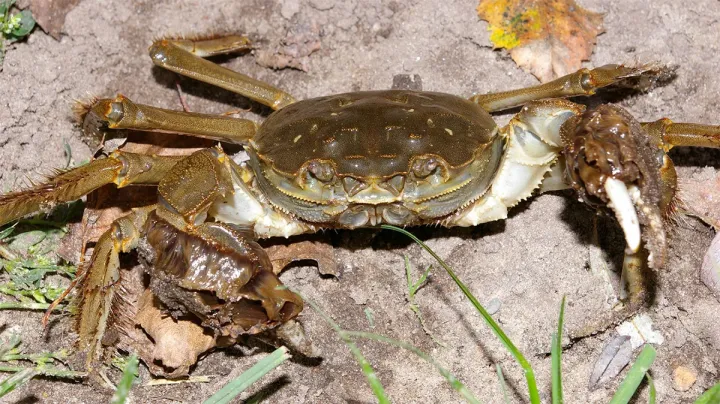
The Chinese mitten crab (Eriocheir sinensis) is an invasive crustacean species belonging to the Varunidae family. It is easily identified by the dense patches of hair on its claws, resembling fur.
Adult specimens possess an olive-brown carapace up to 8 cm wide. A key distinguishing feature is the presence of four distinct teeth on the lateral edges of the carapace.
This species is catadromous, meaning it migrates from freshwater rivers to saline estuaries to spawn. Its lifespan ranges from 3 to 5 years, during which it adapts to a variety of aquatic environments.
The species exhibits remarkable ecological plasticity, surviving in diverse temperature and salinity conditions. This ability allows it to rapidly colonize new water systems and agricultural infrastructure.
Reproduction occurs in estuaries, where females release thousands of eggs. After the larval stage, young crabs migrate upstream, penetrating deep into irrigation channels and agricultural fields.
What it damages
The primary agricultural damage caused by the Chinese mitten crab involves the destruction of irrigation systems. Their burrowing activity weakens levees, canal banks, and dams, leading to structural failures and water loss.
In rice cultivation, the crabs cause significant crop loss by cutting the roots of young rice plants. This damage often requires replanting and leads to reduced overall yields in infested regions.
Aquaculture operations suffer as the crabs destroy fish and shellfish stocks. They also damage fishing gear, particularly nets, which they shred with their powerful claws, causing direct financial losses to farmers.
The crabs contribute to the siltation and degradation of drainage and irrigation networks. Their extensive tunnel networks destabilize the soil, increasing maintenance costs for water management authorities.
As a vector for parasites, such as the oriental lung fluke, the species poses health risks to humans and livestock that rely on the affected water sources for consumption or irrigation.
When it appears
Crab migration activity is most pronounced during the spring and autumn months. In spring, juvenile crabs move from brackish waters into freshwater, occupying new irrigation and drainage zones.
During the summer, the crabs are highly active in feeding, which coincides with the primary growth phases of agricultural crops. This is when their impact on rice paddies is most severe.
In the autumn, adult crabs migrate back towards the sea for spawning. During this period, mass aggregations can block sluices, gates, and water intake structures, disrupting farm operations.
Activity levels drop significantly during winter, with the crabs spending most of their time in burrows at the bottom of water bodies, though they remain active during warmer spells.
Optimal temperatures for their activity range from 10 to 25 degrees Celsius. Mild winters combined with global warming are contributing to the expansion of their habitable range.
Signs of infestation
The most visible sign of infestation is the presence of numerous circular burrows along the banks of canals and ponds. These burrow entrances range from 3 to 10 cm in diameter.
Discarded crab shells and claw fragments found on the shore are strong indicators of a resident population. These remnants are often left behind by predators like birds or mammals.
Nighttime observation near water bodies often reveals the presence of crabs. They are primarily nocturnal and are frequently seen moving along the banks or on dikes after dark.
Damaged fishing nets with large, irregular tears are a classic indicator of the crabs' destructive foraging habits. These tears differ significantly from wear-and-tear caused by currents.
Unexpected drops in water levels in irrigation ditches, when sluices are closed, often point to leakage caused by the crabs' tunnel systems compromising the structural integrity of the banks.
Control measures
Mechanical barriers, such as fine-mesh metal screens, are the most effective method for blocking the entry of crabs into irrigation systems and farm reservoirs.
Trapping programs using specialized crab pots are essential for population suppression. Frequent monitoring and removal of trapped individuals can significantly reduce the local density.
Long-term control involves hardening canal banks with concrete or heavy geotextiles to prevent the crabs from creating burrows in the soil structures.
Management of ballast water in shipping is critical to preventing the spread of larvae to new regions. Strict adherence to international biosecurity standards is required.
Chemical control methods are rarely recommended due to their high toxicity to non-target aquatic organisms and the potential for water contamination in agricultural production.
Taxonomy
- Latin name
- Eriocheir sinensis
- Family
- Grapsidae
- EPPO code
- ERCHSI
Discussion
No discussions yet — be the first.